
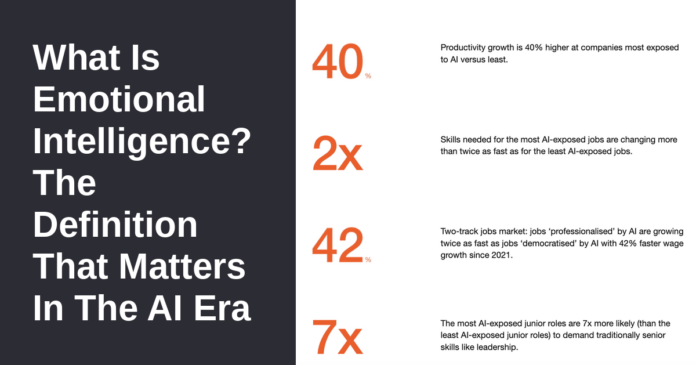
Here’s the most underreported and underrated statistic in this year’s labor data: According to PwC’s 2026 Global AI Jobs Barometer, which analyzed more than a billion job ads across six continents, entry-level roles most exposed to AI are now seven times more likely to require traditionally senior-level skills, like judgment and leadership.
Seven times as likely to require senior-level skills for entry-level work.
Something deep has changed, and on a structural level. For decades, the unwritten rule of career progression was that “technical expertise gets you through the door and emotional intelligence gets you promoted.” That rule has been flipped on its head because of the way AI is shifting the modern landscape of work. When the technical, knowledge-based component of a job can be augmented or automated, the human skills then become an entry requirement.
So, while the question of “what is emotional intelligence” has been answered numerous times, the definition has shifted in some important ways, evolving to fit the demands of 2026, which are quite different from those of 2006. So let’s dig in.
The Modern Definition of Emotional Intelligence
Emotional intelligence (EI) is your ability to recognize and understand emotions in yourself and others, and to use that awareness to manage your behavior and your relationships toward effective and desired outcomes.
To understand EI better, let’s talk about three things that EI is not. First, despite how it’s often framed, EI isn’t about being nice. EI is about being effective. In fact, many of the most emotionally intelligent leaders find themselves delivering the news nobody else wants to deliver.
Second, EI isn’t your personality. Personality is stable and largely fixed from a young age, while EI is a set of skills you can measurably improve with practice.
Lastly, EI isn’t a proxy for IQ. The two are essentially unrelated, which is why so many brilliant people say and do the stupidest things and why the smartest person in the room is so often not the one running it.
The Four-Box Model Of Emotional Intelligence
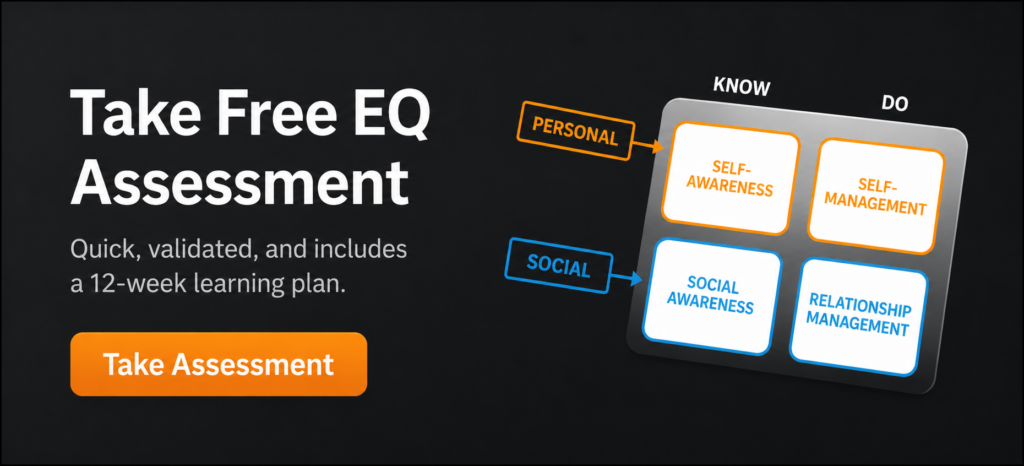
When you set out to grow your emotional intelligence, it helps immensely to break it down into four core skills. To measure your ability across each skill, psychologists typically recommend that you start by taking a validated emotional intelligence assessment.
Self-awareness is your ability to accurately recognize your own emotions as they happen and understand what drives them. It’s knowing what makes you tick. Your triggers, your tendencies under pressure, the gap between how you think you come across and how you actually do.
Self-management is what you do with your self-awareness. It’s the ability to stay flexible and direct your behavior productively, especially when you’d rather not. This isn’t a matter of suppressing your emotions, which research has proven doesn’t work. It’s a matter of working with your emotions toward a better outcome.
Social awareness is the outward-facing counterpart to self-awareness. It’s your ability to accurately read other people’s emotions and what’s genuinely going on with them. Social awareness includes empathy, but it also includes your ability to pick up on the emotions and tendencies of other people.
Relationship management is the skill that relies heavily on the other three skills, as you draw on all three to effectively build, maintain, and manage your interactions and relationships. Skills like conflict resolution, critical conversations, feedback, influence, and trust all hinge on your relationship management capabilities.
AI + EI = ROI
The business case for emotional intelligence was strong before AI arrived. Drawing on data from more than 500,000 assessments, EI expert Travis Bradberry found that emotional intelligence accounts for 58% of performance across all job types, and that 90% of top performers score high in it. He found that EI is roughly twice as predictive of success as IQ, and that your compensation follows your EI. High-EI professionals earn an average of $29,000 more per year than low-EI counterparts.
Now add AI, and the equation gets more interesting. AI is producing real productivity gains. PwC finds productivity growth running 40% higher at the companies most exposed to AI than at the least exposed. But productivity is not the same as return. The gap between what AI produces and what an organization actually realizes in return is bridged almost entirely by human skills. That bridge—EI—is where ROI is won and lost.
The market has noticed. The new types of skills being added to AI-exposed roles are 2.5 times more likely to depend on skills like empathy, judgment, and creativity. Any specific technical capability has a shortening shelf life, and what holds value is the layer underneath. These are the roles PwC calls “professionalized,” where AI absorbs your routine work and human interaction, and human judgment becomes increasingly important.
Employers say the same thing when you ask them directly. The World Economic Forum’s Future of Jobs Report 2025 ranks EI skills like resilience, flexibility, agility, leadership, social influence, motivation, and self-awareness as among the top ten most desirable skills.
AI supplies the leverage, and EI helps you exercise the judgment you need to turn your increased productivity and efficiency into realized profit.
How You Can Win In The AI Era
Here’s what makes emotional intelligence different from nearly every other leadership variable. Unlike IQ or personality, which are essentially fixed by early adulthood, all four EI skills are learnable at any age.
Emotions travel through the limbic system before reaching the rational brain, and the pathway between the two is plastic, meaning you can practice and change your brain’s response. Practice a new response often enough, and it becomes the default path that your brain takes. This change, assuming it’s a positive way, represents an increase in your emotional intelligence.
So while it’s true that the old rule still holds, that “technical expertise gets you through the door, emotional intelligence gets you promoted,” the timing of this is changing. AI is steadily making the part that got you through the door the table stakes, and pushing the part that got you promoted into the job description of an entry-level employee.
So whether you’re a company leader, preparing to enter the workforce for the first time, or somewhere in between, one thing is certain. Social-emotional skills matter now more than ever.