
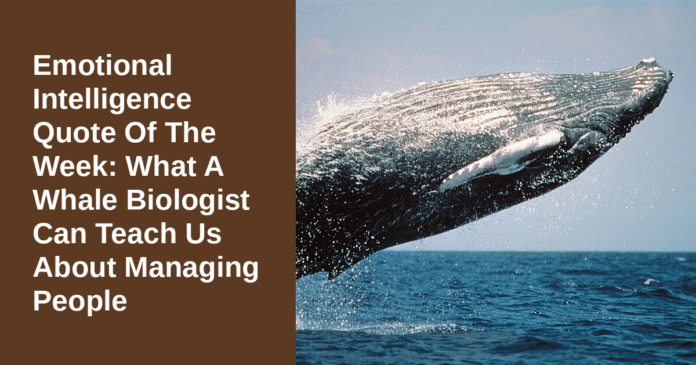
“Any observant local knows more than any visiting scientist. Always. No exceptions.”
—Roger Payne, Whale Biologist
When Roger Payne arrived in the San Jose Gulf in Argentina to begin researching whales, he had every credential a visiting expert could want: a Cornell PhD, a MacArthur Fellowship, and his famous 1967 discovery that humpback whales sing.
But, he approached his research with the utmost humility, because as he wrote in his book Among Whales, “Any observant local knows more than any visiting scientist. Always. No exceptions.”
His point was that everything happens at the center, not the periphery. No matter how much research you might do from the periphery, you’ll always be missing essential context that only those who are on the ground can have. In what’s now the longest-running study of individual whales anywhere, Payne would go on to find that right whales can be told apart by the callosities on their heads. His work offers a lesson in managing people.
How Whale Biology Applies To Emotional Intelligence
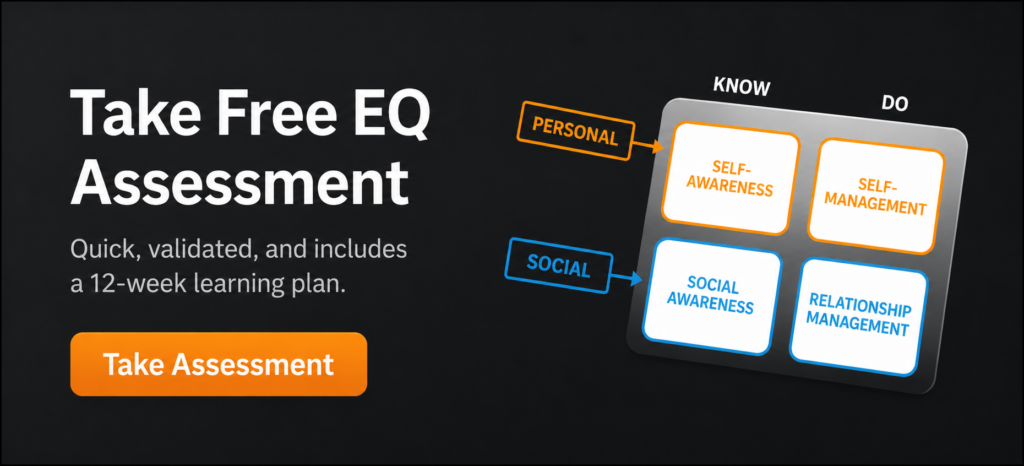
Emotional intelligence (EI) is your ability to recognize, understand, and manage your own emotions and the emotions of others in order to be more effective in your relationships, goals, and work. It comprises four core skills:
- Self-Awareness, your ability to recognize your emotions as they happen and understand your tendencies.
- Self-Management, your ability to use that awareness to choose your behavior instead of reacting.
- Social Awareness, your ability to pick up on the emotions, needs, and concerns of others.
- Relationship Management, your ability to use your awareness of your emotions and others’ to handle interactions well.
Payne’s work applies not just to whales and science, but also to interacting with people. Just as you can only learn so much about whales from the periphery, you can only pick up on the emotions, needs, and concerns of others (social awareness) by walking the floor, by getting your hands dirty. You can’t read a room you’re never in.
To improve across each of these four emotional intelligence areas, including social awareness, psychologists recommend that you take an emotional intelligence self-assessment.
Perspective-Taking Doesn’t Work. Perspective-Getting Does.
In 2018, Tal Eyal and colleagues ran 25 experiments on whether taking another’s perspective made people more accurate about their thoughts and feelings. They found that it didn’t. Accuracy slipped while confidence sometimes rose. What worked was perspective-getting, where people went out and obtained the information they needed to understand the other person.
For example, researcher Anita Tucker randomly assigned 19 hospitals to an 18-month management-by-walking-around program. What they found was that in the work areas that improved, leaders succeeded by prioritizing easy-to-solve problems. In other words, by walking the floor, leaders could pick up on daily obvious problems and fix them. It sounds obvious, how many managers are actually doing this?
An EI Strategy You Can Apply Now: Walk The Floor
Doug Conant walked the Campbell Soup campus in sneakers, asking whoever he met how he could help. Sam Walton flew to his stores weekly, walked in unannounced, rode delivery rigs with his drivers, and ate 4 a.m. breakfasts with distribution center night shifts. Leaders who spend time on the frontlines develop better relationships, understand the context of the work they’re involved in, and find and solve problems that other leaders can’t.
Here’s a simple six-step framework you can use to walk the floor as a leader.
- Pick one place the work happens where you have no standing reason to be. For example, a support queue, a sales call, or a warehouse.
- Put it on your calendar to go visit at least one time.
- Arrive with no agenda item and nothing to announce.
- Watch before you ask any questions.
- Ask one or two questions, get to know the experts in this area of the business, and try to let their answers run long.
- If relevant, fix one small problem you heard.
Putting This Quote To Action
The people you work with are already the observant locals of their own areas of expertise. They know things about your customers, your process, and each other that won’t get passed on in your average meeting. So go walk the floor and see what you learn.