
Marketing professor Shaphali Gupta and her colleagues set out to test whether a chatbot’s emotional intelligence changes its effect on users. Her findings, published in Psychology & Marketing, describe a sinister trade-off that seems to slide under the radar. The warmer and more attuned the bot was to the participant’s feelings, the better that person felt. This sounds like it would be a good thing, but Gupta found that these participants then had less desire to go see real people.
The problem here is a big one, one that social media exposed over the last decade as we entered what many people are calling “the loneliness epidemic.” Scrolling through social media builds parasocial relationships, where we feel connected to people who don’t even know we exist. Parasocial relationships are dangerous because they ease our desire for social interaction without providing many of the important benefits that human-to-human interaction offers.
AI companions are the next iteration of this same problem, and potentially a much more potent iteration, because they can win far more of your attention and sustain it for longer.
The Research: Why The Warmest Chatbots Push People The Furthest Away
Gupta’s team started by reading how real chatbot users talk about themselves and their experience. Gupta analyzed their public posts across Reddit, YouTube, and Trustpilot and found two core themes:
- People described genuine emotional relief after speaking with a high EQ chatbot.
- People admitted they no longer had the time or desire to see their real friends.
Then Gupta and her team tested this observation in an experiment with 167 university students. She had the students read a scenario involving a chatbot with either high or low emotional intelligence. Her findings were quite clear. On the one hand, the high-EI bots raised psychological wellbeing—happiness, self-esteem, a sense of purpose. And on the other hand, they lowered social wellbeing, or how integrated that person feels in their community.
Perceived closeness drove both outcomes. The same warmth toward the bot that produced the feeling of emotional relief also increased the odds that the participant felt less connected to real people and their community.
In a second experiment, Gupta incorporated augmented reality, letting participants imagine the bot sitting beside them in their own room. Immersion amplified both directions at once: more comfort and heightened withdrawal from real people.
In a similar experiment, Stanford researcher Yutong Zhang and a team from Stanford and Carnegie Mellon surveyed 1,131 AI chatbot users and analyzed 464,687 of their messages. Companionship-oriented LLM use tracked with lower wellbeing, and the association deepened the more intensively people used it.
How Emotional Intelligence Can Help You Balance AI Use With Wellbeing
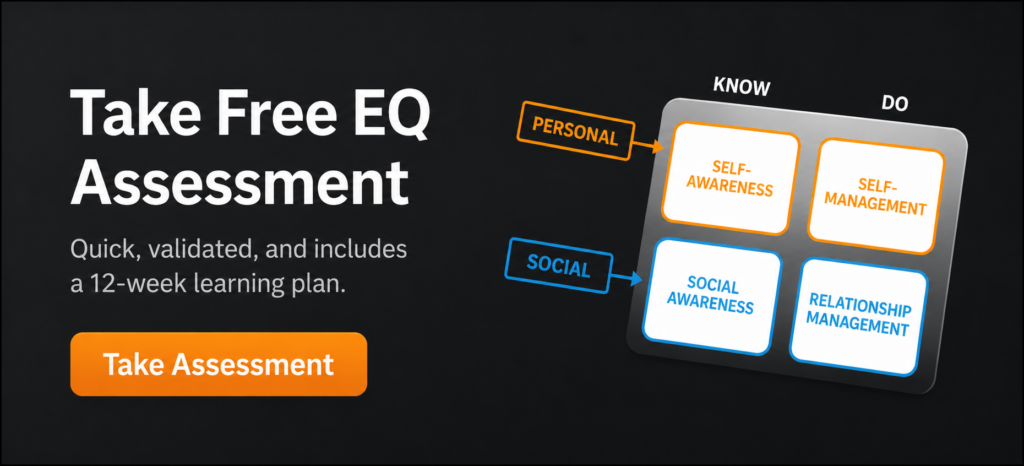
Emotional intelligence (EI) is your ability to recognize and understand emotions in yourself and in others, and to use that awareness to manage your behavior and your relationships. It breaks down into four core skills: self-awareness, self-management, social awareness, and relationship management. To understand your baseline emotional intelligence score, psychologists recommend that you take a validated self-assessment.
Relationship management is the most advanced of the four skills, because it requires that you use the other three in concert. One essential component of relationship management is your ability to manage your energy around social interaction and relationship building. If you use up all of your social energy on social media and chatbots, you could easily end up feeling too exhausted to interact with people in a substantive way.
An EI Strategy You Can Apply Right Now: Learn To Seek Out ‘Nutritious’ Social Interactions
Think of interacting with a chatbot as the social equivalent of a donut. It tastes good. It lights up your reward system. But you can eat donuts all day and end up malnourished, because the thing that felt satisfying carried none of the nutrition that your body needs to survive and thrive.
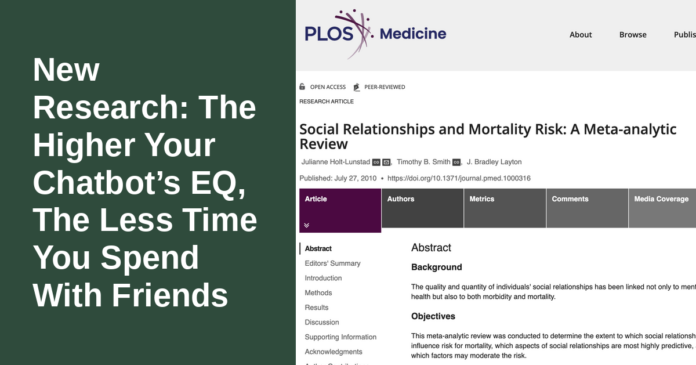
Human-to-human connection is the same way. Stanford neuroscientist Ben Rein spends most of his time debunking wellness myths, but the one wellness intervention he endorses most is social interaction. He points to a meta-analysis led by psychologist Julianne Holt-Lunstad that pooled 148 studies and followed 308,849 people for an average of seven and a half years: those with stronger social relationships had a 50% greater likelihood of survival. Rein notes that positive interaction releases oxytocin, serotonin, and dopamine together, while isolation drives cortisol up.
The strategy here is simple in concept but difficult to execute. Schedule out social interactions the same way you pursue nutritious meals or exercise. Put the coffee on the calendar. Call a friend instead of texting. Say yes to the thing you’d rather decline. You can still talk to LLM’s and use them to better your work, but you can, and you must, refuse to let them replace real interaction.