

Imagine two different construction workers, each has a nail-related accident. The man with almost no injury was writhing in agony, while the man with a four-inch nail lodged near his brain kept working for six days, not even realizing the nail was there.
Dr. Rachel Zoffness, a pain psychologist at UCSF and author of Tell Me Where It Hurts, told both stories on a recent episode of the podcast Hidden Brain. The first worker jumped off a plank onto a nail that pierced his boot, and by sheer chance, passed cleanly between his toes. No puncture, blood, or injury, but he was still sedated for the pain he believed he felt. The second worker was clipped in the jaw by a misfiring nail gun. He assumed he was fine, and went back to work. Days later, a dental scan for a toothache found a four-inch nail embedded near his prefrontal cortex. How could their experiences of pain be so utterly different?
Your Brain Is A Danger Detector, Not A Damage Detector
Zoffness’s explanation is that the brain is a danger detector, not a damage detector. It weighs every scrap of available evidence—sight, memory, context, emotion—before deciding how much pain to manufacture, almost independent of what’s actually happening in the tissue.
In other words, pain isn’t just registered by the brain. It’s constructed by it. That’s the core of what researchers call the biopsychosocial model. The biopsychosocial model shows that pain is never purely physical, because the parts of the brain that generate emotion are the same parts that generate pain. That doesn’t make brain-constructed pain any less real. In fact, Zoffness insists that pain is never purely mental, and that it’s physical and emotional simultaneously, without exception. The biopsychosocial model also explains why phantom limb pain is possible. A limb that no longer exists can still hurt, because the pain was never truly located in the limb to begin with.
This Pain Psychologist’s Trick for Catching a Thought Before It Takes Over
Zoffness has a name for the part of your mind that narrates pain. She calls it your “pain voice.” It’s the thought that insists you’re permanently broken and will never improve.
She’s seen first-hand how powerful that narration can be with patients like Kai, a man whose chronic pain was so severe he couldn’t touch his own feet. His sister once swapped his prescribed gummy for a plain one without telling him, and his pain relief was identical either way. That’s because his brain wasn’t responding to the medication, it was responding to what he expected the medication to do.
How Emotional Intelligence Can Help Ease Your Pain Voice
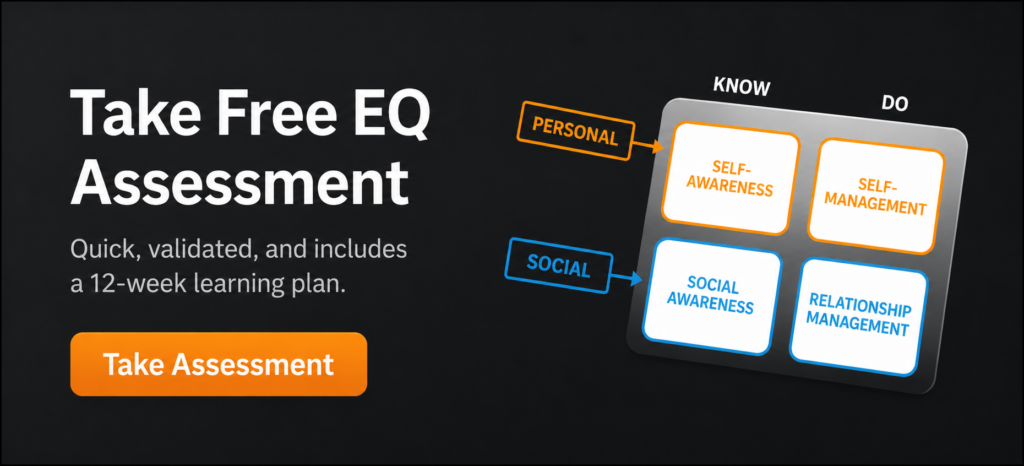
That gap between what’s actually happening and what the mind narrates about what’s happening, is intimately tied to emotional intelligence (EI). EI is generally defined by experts like Dr. Travis Bradberry as your ability to recognize and manage your own emotions, and to recognize and respond well to the emotions of others. EI is typically broken into four core skills: self-awareness, self-management, social awareness, and relationship management. Experts recommend that you self-assess your emotional intelligence to understand your baseline and areas for improvement.
Your “pain voice” is most connected to your self-awareness. “Pain voice” is essentially a form of self-talk, or the narrative and tone of voice that you run through your head at any given moment. Your self-talk is the product of your values, beliefs, and confidence. By learning to shift your self-talk to be more positive and realistic, you can speak to yourself in a way that’s more aligned with your values and beliefs. This of course applies to your pain voice, by helping you see that your pain is likely not going to last forever, but it also applies to how you speak to yourself just before you give a big speech, while you’re out on a first date, or in the moment as you handle your crying baby after a long day of work.
An EI Strategy: Ask This One Question To Interrupt Your Pain Voice
Most people experience catastrophic thoughts as though they’re facts. Zoffness’s antidote is a technique she calls “detective questions,” where you pause to really interrogate your thought instead of accepting it at face value.
Her go-to question is quite simple. She asks, “Is this thought a fact?” Not whether it’s possible, or whether it feels true in the moment, but is it, beyond question, verifiably true? For most pain-voice predictions, the honest answer is no.
What You Actually Get to Control: Your Self-Talk
While it’s of course an extreme example, the real difference between the two construction workers came down not to the injury, but the story each of them told themselves to believe. For one, this resulted in a strong feeling of pain that was entirely unnecessary, and for the other, a dangerous amount of pain denial.
You won’t always get to choose what happens to your body, your workload, or your week, but you do get a say in whether you accept the first frightening sentence your mind offers, or pause long enough to question whether it’s true. That pause and change in self-talk may be small, but according to pain scientists like Zoffness, it’s often enough to completely shift your experience.