
Emotional Intelligence Train The Trainer Program: What To Look For
“90% of top performers are high in emotional intelligence.”
That’s not a motivational poster quote — it’s research from Dr. Travis Bradberry, author of The New Emotional Intelligence. EQ is one of the clearest predictors of leadership success, team performance, and even employee retention. In a business climate where hybrid teams, AI disruption, and talent shortages are the norm, EQ skills aren’t “nice to have” anymore — they’re mission-critical.
If your organization is going to invest in emotional intelligence training, how you deliver it matters just as much as what you teach. That’s where an emotional intelligence train the trainer program comes in. Done well, certification equips your facilitators to run engaging, memorable workshops that make learning stick — and gives participants tools they can use for years to come. Done poorly, it results in forgettable sessions, wasted budgets, and zero measurable change.
In this article, you’ll learn:
- What to look for (and what to avoid) in a train the trainer program
- The benefits of getting certified vs. building your own curriculum from scratch
- Real-world examples of EQ training that drive results
- What a strong EQ train the trainer curriculum includes
- Frequently asked questions about cost, transferability, and program design
Let’s start by breaking down what separates a high-impact certification from a costly misstep.
1. What To Look For in an Emotional Intelligence Train The Trainer Program (And What to Beware Of)
Not all EQ train the trainer programs are created equal. The right program will set you up for consistent, high-impact delivery across your organization. The wrong one will leave you with a binder, a bill, and little else.
Here’s what to look for — and the red flags to watch out for:
✅ Includes Both Assessment and Curriculum
An EQ workshop without a robust curriculum is like a map without directions. Participants need more than an assessment debrief — they need a clear framework for understanding EQ and practical tools for improving it. Look for programs that combine:
- A validated EQ assessment
- A complete workshop curriculum that teaches the model, skills, and strategies for growth
✅ Built-In Reinforcement Tools
Learning doesn’t stick without follow-through. Beware programs that:
- Charge you for every re-test without offering development tools
- Offer “e-learning” that’s just static web pages no one will revisit
- Expect you to invent your own activities, coaching plans, and reinforcement tactics
Instead, seek out programs that provide:
- Access to high-quality digital or app-based reinforcement
- Coaching guides and activities you can run over time
- Re-test options built into the license
At LEADx, we include one full year of reinforcement for every single participant kit purchased. This includes one year of access to a human, ICF-certified EQ coach, behavioral nudges, and microlearning exercises.
Overcomplicated Models
While there are many ways to slice emotional intelligence, most leaders don’t need 16 dimensions and academic jargon. We’ve found that a four-dimension model is plenty, letting you introduce more advanced concepts later as behaviors and strategies tied to the core framework.
Example: Under Self-Awareness, you might teach leaders to notice their emotional triggers, reflect on their impact, and solicit feedback. Simple, actionable, effective.
Ongoing Fees, Non-Transferable Licenses
Many providers lock you into:
- Yearly “update” fees
- Non-transferable certifications (if you change jobs, you lose the credential)
- Single company-only permissions
Look for certifications that are yours for life with no annual renewal fees, and that you can use regardless of where you work or coach.
Outdated Content
Legacy vendors often rely on assessments and slide decks developed 15–20 years ago. In today’s workplace, people skills and influence are essential to competing in an AI-driven economy. Even leading EQ experts like Dr. Travis Bradberry have moved on from older models to build modern, research-backed programs that fit the way people work today.
Uneditable Slide Decks
Some big-name companies deliver training materials where the slides are locked as JPEGs, meaning you can’t edit, tailor, or customize for your audience. This rigidity:
- Makes you look like you’re reading someone else’s script
- Stops you from adding relevant stories, industry examples, or company-specific language
Choose a provider that trusts you as a facilitator, giving you both a perfected script and the flexibility to adapt.
2. The Benefits of Emotional Intelligence Train The Trainer Certification
Getting certified to deliver EQ training is more than just a line on your résumé — it’s an investment in your skills, your organization’s capability, and your career.
Here’s what you gain:
You Don’t Have to Build from Scratch
Skip the months (or years) it would take to research, design, and test your own EQ program. A quality certification hands you a ready-to-go, research-backed curriculum that’s been proven to engage participants and deliver results.
Learn Directly from EQ Experts
You’ll be trained by people who have devoted their careers to making emotional intelligence practical and actionable, not just theoretical. You’ll gain insights, stories, and techniques you’d never get from self-teaching.
Access to Premium Tools
Certification typically includes:
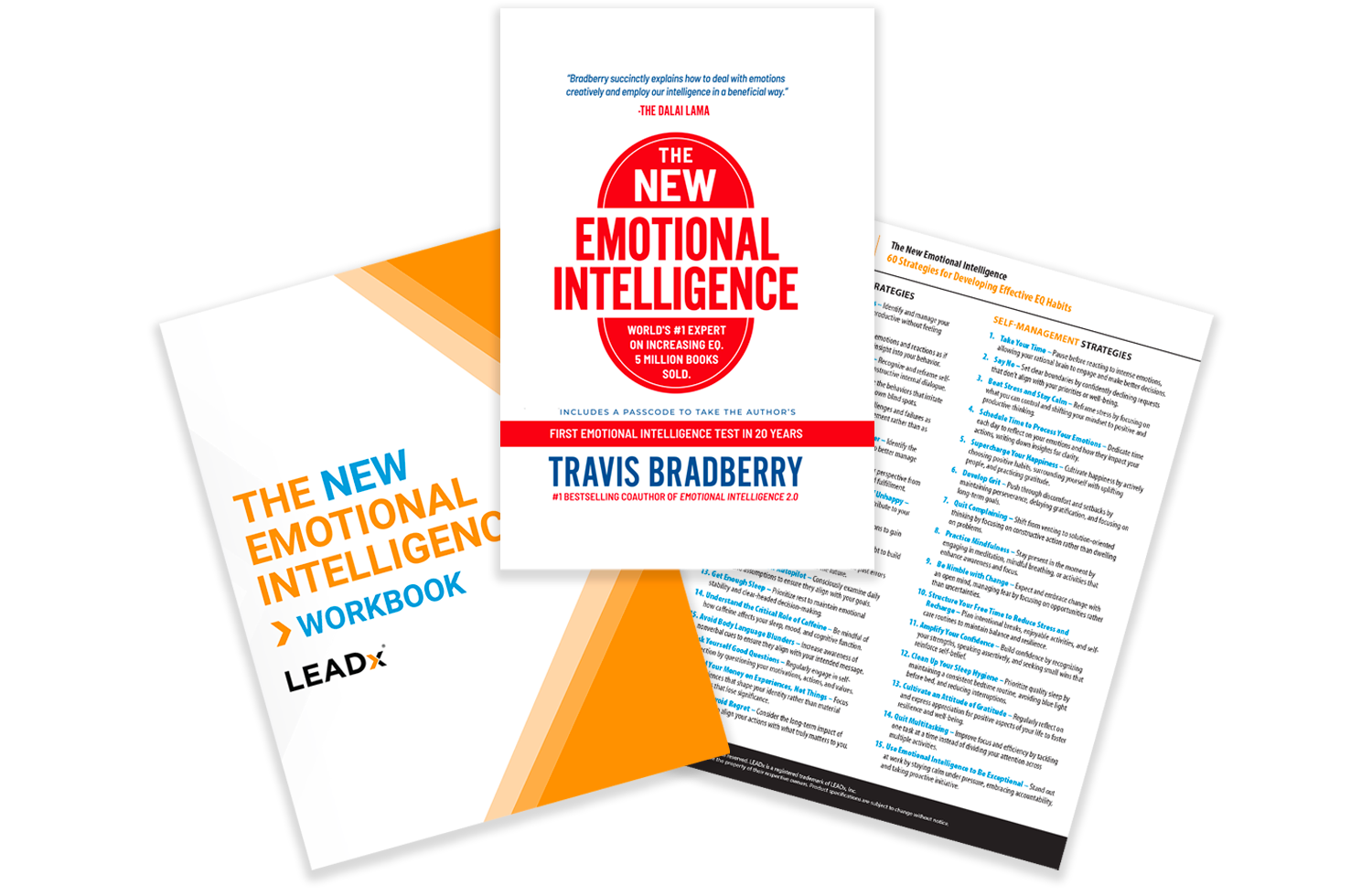
- A validated emotional intelligence assessment
- Workshop slide decks and facilitation guides
- Participant workbooks and digital resources
- Reinforcement tools that keep learning alive long after the session
Grow Your Own Skills
You won’t just learn how to teach EQ — you’ll become a subject matter expert yourself. That means more confidence in the classroom, sharper EQ skills in your own life, and a credential you can carry into any role in the future.
Ongoing Expert Support
When you hit a tricky question in a workshop or need help tailoring content for a specific audience, you’ll have a team of experts you can tap into for guidance.
Boost Organizational ROI
For decision-makers, certification means:
- Consistency: Every session is delivered to the same high standard, no matter who facilitates
- Cost savings: One-time certification lets you train as many internal teams as needed without paying outside vendor fees every time
If you’re going to invest in EQ training, getting certified to deliver it internally can pay for itself many times over — in better results, stronger teams, and reduced long-term costs.
3. Real-World Examples of EQ Train The Trainer Success
Nothing builds confidence in a program like seeing the results others have achieved. Here are five examples that show how emotional intelligence training — especially when reinforced over time — delivers measurable impact.
Example 1 – U.S. Air Force: Cutting Turnover by 85%
Key takeaway: Measuring and developing EQ in high-stakes roles reduced costly turnover from 35% to less than 5%, saving millions annually.
Years ago, the U.S. Air Force faced a costly challenge: civilian recruiter turnover was at 35%, with each departure costing more than $3 million annually in hiring and training. They began assessing emotional intelligence in all recruiter candidates, hiring only those who scored high alongside traditional qualifications. The result? Turnover dropped below 5%, saving $2.7 million per year.
They’ve since expanded EQ assessment into other critical roles — pilots, air traffic controllers, and pararescue jumpers — with projected savings of $190 million. The lesson: EQ can be measured, developed, and directly tied to performance outcomes.
Example 2 – Fortune Brands: Making Learning Stick
Key takeaway: EQ training paired with optional reinforcement led to 100% bottom-line gains for fully engaged leaders.
During a period of rapid change, a Fortune 500 division trained its leaders in EQ using a 360-degree feedback assessment and workshop. Leaders could then choose from three follow-up options: executive coaching, video-based e-learning, or online goal tracking.
Results were clear:
- Leaders who used all three reinforcement tools → 100% saw significant gains
- Leaders who used some tools → 71% saw gains
- Leaders who skipped reinforcement → 82% saw no improvement
The program was eventually rolled out company-wide, proving that ongoing practice is the difference between temporary knowledge and lasting behavior change.
Example 3 – L’Oréal: Driving Sales and Reducing Turnover
Key takeaway: Selecting for EQ boosted annual sales by $91K per salesperson and cut turnover by 63%.
At L’Oréal, sales agents chosen for certain emotional competencies significantly outsold peers selected through the old hiring process. This EQ-focused approach added $2.5M in net annual revenue and reduced first-year turnover by nearly two-thirds.
Example 4 – Manufacturing: Improving Safety, Productivity, and Morale
Key takeaway: EQ-trained supervisors cut lost-time accidents by 50% and exceeded productivity goals by $250K.
When supervisors were trained in emotional competencies like listening and problem-solving, results included:
- Lost-time accidents cut in half
- Formal grievances reduced from 15 to 3 per year
- Productivity exceeding goals by $250,000
A similar program at another plant saw a 17% production increase, while a control group without training saw no improvement.
Example 5 – Retail: Handling Stress = Better Store Performance
Key takeaway: Store managers with strong stress-management skills outperformed peers on multiple profitability metrics.
In one retail chain, the most profitable stores were led by managers best able to handle stress — as measured by net profit, sales per square foot, sales per employee, and return on inventory investment.
Bottom line: Across industries, EQ training works best when it’s more than a one-and-done workshop — it’s assessed, taught, and reinforced in a structured way. A strong train the trainer program gives you the tools to make that happen.
4. Curriculum Outline for a Strong EQ Train The Trainer Program
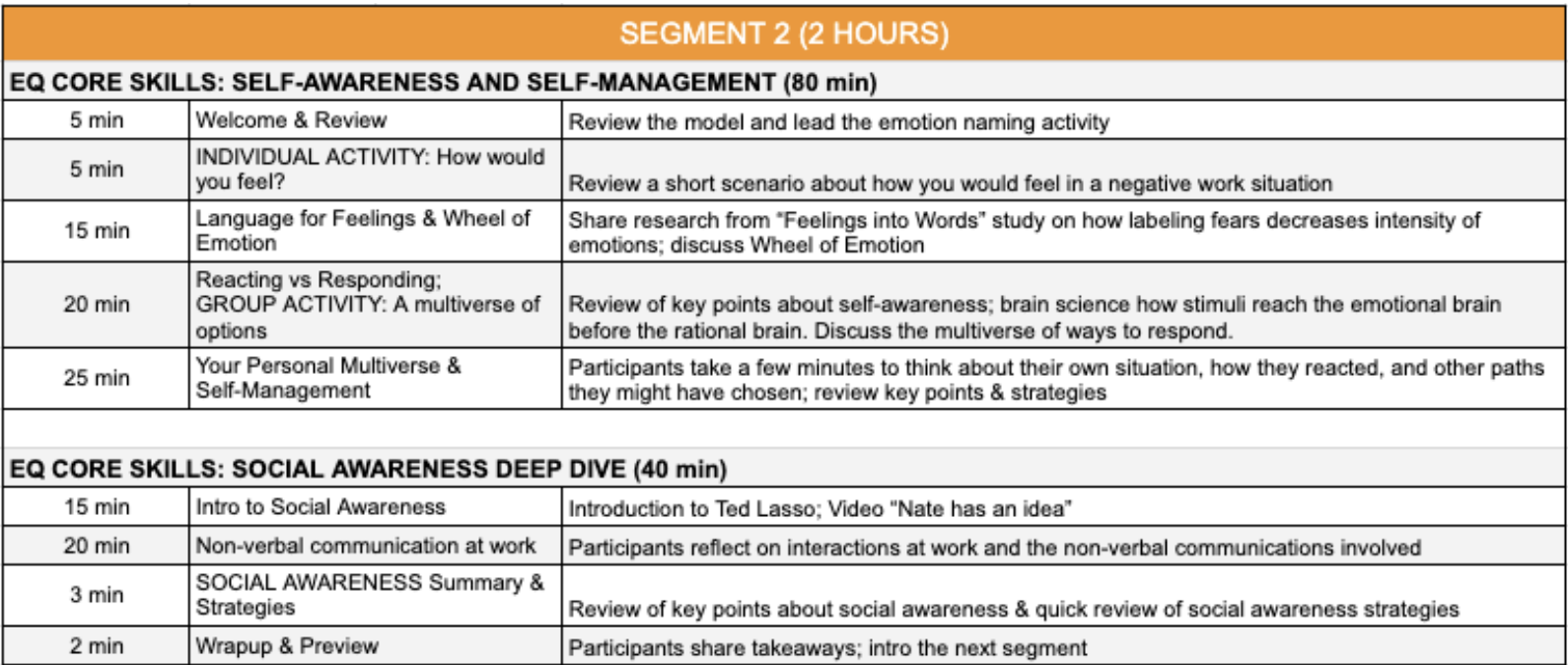
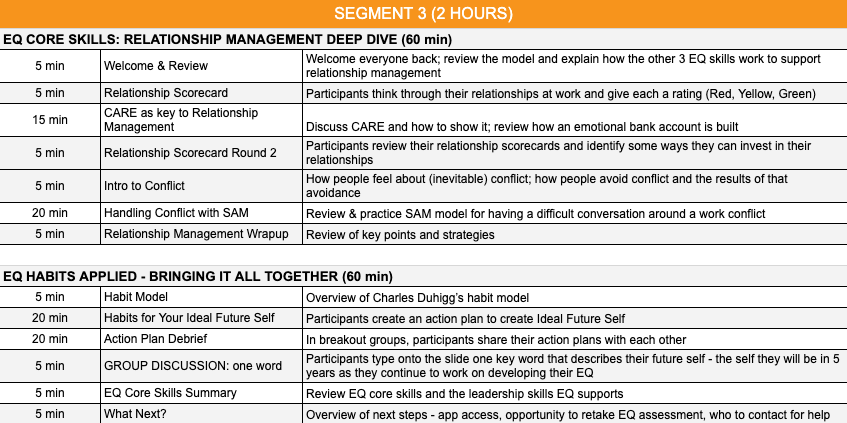
A great emotional intelligence train the trainer program doesn’t just tell you what to teach, it shows you how to teach it in a way that sticks. Here’s an example of what a high-impact, two-day certification can look like.
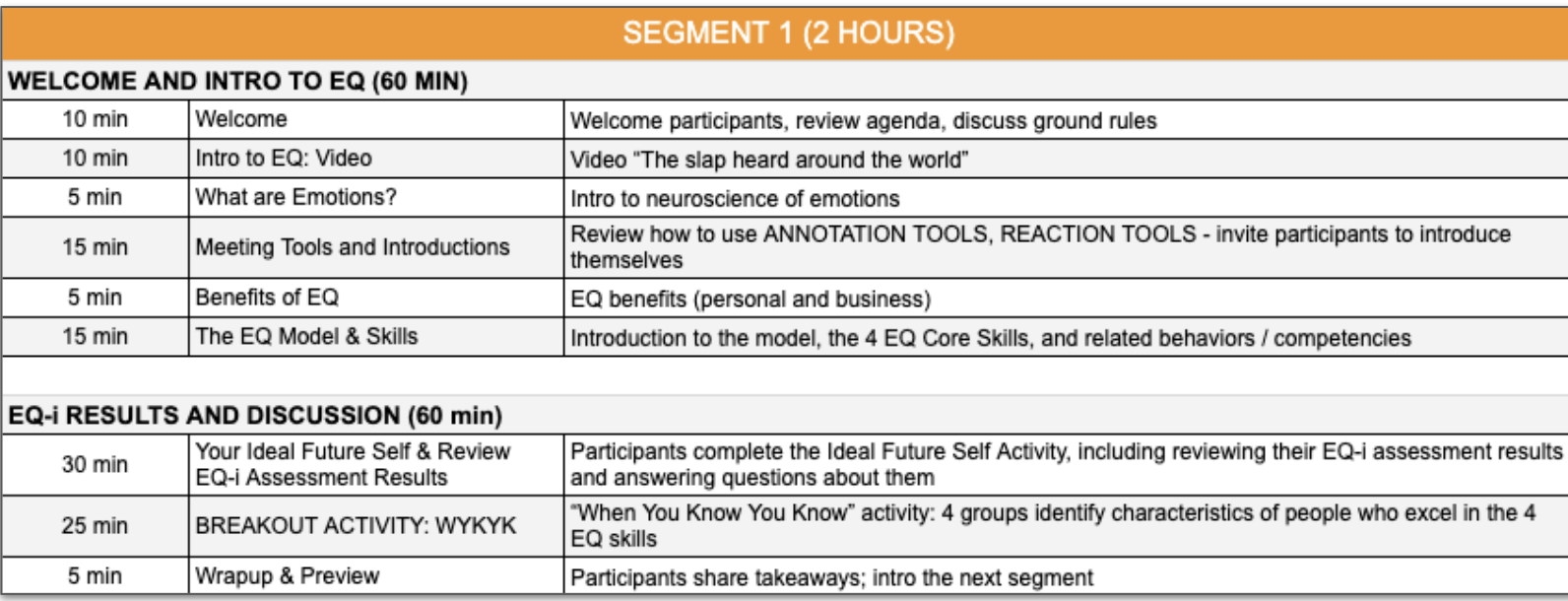
Day 1 – Experience the Workshop as a Participant
You’ll go through the full EQ program exactly as your learners will, so you understand the flow, tone, and impact from the inside out.
- Welcome & EQ Overview – Sets the stage for why EQ matters and how it drives business results.
- Personal EQ Assessment Debrief – Learn to interpret results and connect them to real behaviors.
- The Four Dimensions of EQ – A simple, research-backed model that’s easy to remember and apply.
- Core Skill #1: Self-Awareness – Understand emotional triggers, impact, and feedback loops.
- Core Skill #2: Self-Management – Techniques for staying composed and effective under pressure.
- Core Skill #3: Social Awareness – Recognizing and understanding others’ emotions in real time.
- Core Skill #4: Relationship Management – Building trust, resolving conflict, and influencing others.
- Application & Action Planning – Participants create personal EQ growth plans they can actually stick to.
Why it matters: Experiencing the program first builds empathy for your learners and gives you confidence to replicate the same impact.
Day 2 – Learn to Facilitate the Program Like a Pro
Now that you’ve experienced the workshop, it’s time to get behind the curtain.
- Facilitation Best Practices – From managing group dynamics to handling tough questions with ease.
- Slide Deck Walkthrough – Learn the “why” behind each slide so you can deliver it with confidence.
- Debriefing the Assessment – Step-by-step guidance on leading impactful, personalized discussions.
- Breakout Practice Sessions – Facilitate sections of the workshop in small groups and get feedback.
- Customization Tips – How to adapt content for your audience while staying true to the core curriculum.
- Q&A with Master Trainers – Bring your toughest scenarios and get expert solutions on the spot.
Why it matters: You leave not just with materials, but with the skill and confidence to engage any audience and adapt to any room.
The result? You walk away fully certified, armed with editable materials, a proven reinforcement system, and the ability to deliver emotional intelligence training that’s memorable, actionable, and scalable.
5. Frequently Asked Questions About EQ Train The Trainer Programs
We get these questions all the time from L&D leaders, HR teams, coaches, and consultants who are considering certification.
Q: What is the cost of your emotional intelligence train the trainer program?
A: $3,495. This includes your certification, all facilitation materials, and lifetime rights to deliver the program without annual renewal fees.
Q: Once certified, what does it cost to purchase your assessment and participant materials?
A: $135 per participant. We offer a 15% discount for government and nonprofit organizations, plus bulk discounts starting at 5% off for more than 100 participants.
Q: Who is your train the trainer program designed for?
A: It’s open to anyone — internal L&D teams, HR leaders, independent coaches, and consultants. If you’re passionate about building emotional intelligence skills in others, this program is for you.
Q: Do I need prior facilitation experience?
A: No. Our Day 2 “learn to facilitate” session gives you the skills, structure, and confidence to lead the program effectively — whether you’re a seasoned trainer or brand new to facilitation.
Q: Is the certification transferable if I change jobs or start my own coaching business?
A: Yes. Your certification is for life. There are no “update fees” or restrictions on where or for whom you can deliver the program.
Q: Can I deliver the program virtually as well as in person?
A: Absolutely. You’ll receive materials and guidance for both in-person workshops and virtual sessions, so you can adapt delivery to your audience.
Q: How long does certification take?
A: Two days. Day 1 is experiencing the full workshop as a participant; Day 2 is learning to facilitate, customize, and practice delivery.
Q: What kind of support will I get after certification?
A: You’ll have ongoing access to our team of master trainers for questions, guidance, and best practices — plus updated materials as we evolve the program.
Q: What makes your certification different from others?
A: In addition to lifetime certification with no renewal fees, you get:
- A research-backed assessment and curriculum
- Built-in reinforcement tools for sustained learning
- Editable materials so you can customize for your audience
- A program designed by Dr. Travis Bradberry, co-author of The New Emotional Intelligence
Have a question not listed here? Send us an email at info@leadx.org or call us at (267)702-6760.