
If you had to bet on one skill for the next decade, what would it be? Vibe coding? Data literacy? Prompt engineering?
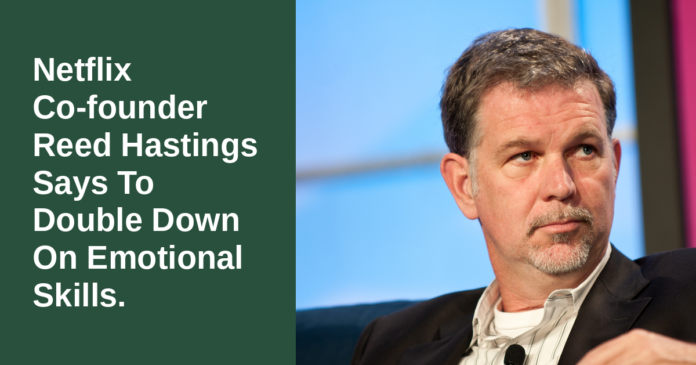
Netflix co-founder Reed Hastings would bet on something else entirely.
Speaking on the Possible podcast, Hastings said that if he had a three-year-old today, he would double down on emotional skills.
“Anything that lives in the emotional realm will not be impacted as much by AI, because we humans react to these things emotionally,” Hastings told Possible co-host and LinkedIn co-founder Reid Hoffman.
This is a striking thing to hear from an Anthropic board member. But Hastings’s reasoning is economic, not sentimental. He made the point that salaries are determined not by how valuable a job is to society, but by the balance of skill supply and demand.
AI is rapidly expanding the supply of skills like analysis, drafting, summarizing, and code. But emotional skills are about to get scarce relative to demand, and most organizations are not ready for that.
Santiago “Santi” Jaramillo has a front-row seat to the gap. He is co-founder and co-CEO of Pragmatico, which focuses on the human and cultural aspect of AI transformation and change management for mid-market companies.
Jaramillo is watching in real-time as AI commoditizes what companies have long overrewarded.
“For 20 years we’ve promoted people for visible output and quarterly numbers, then acted surprised when our managers didn’t know how to develop people,” said Jaramillo. “When everyone has a research analyst, a writer, and a coder in their pocket, individual output stops being a differentiator. What’s left is the work AI can’t do for you.”
The “work that AI can’t do for you” will be familiar to anyone who has led a team: reading a room, coaching a junior teammate through a tough call, and noticing when a top performer has checked out.
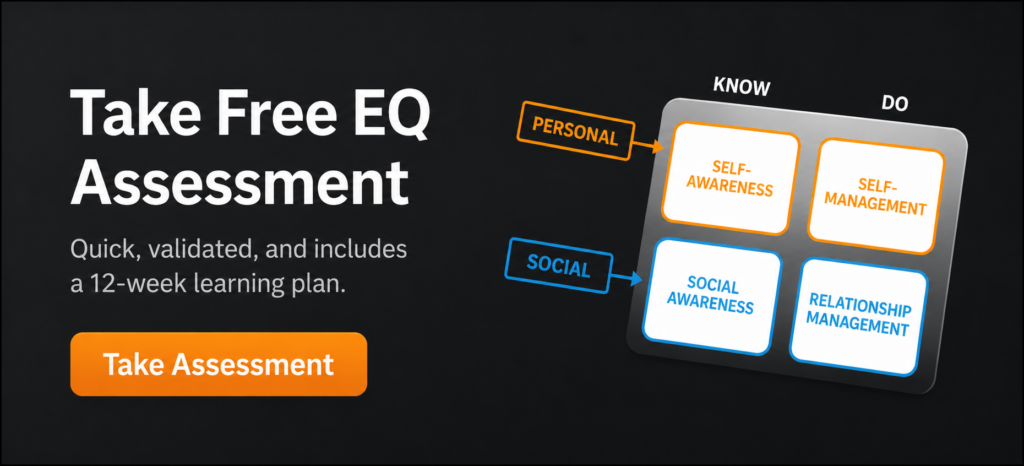
These are all examples of emotional intelligence. Every validated model of emotional intelligence calls upon four skills: self-awareness, self-management, social awareness, and relationship management. Most leaders treat these as traits people either have or don’t, rather than competencies that can be developed.
Which raises the question: How, practically, can leaders help their teams build EQ day-to-day?
The Personal Operating Manual
At a recent Pragmatico all-hands offsite, Jaramillo ran his own team through an exercise known as the Personal Operating Manual, devised by executive coach Adam Weber. Everyone answers five prompts, first privately in writing, then out loud with the group:
- I’m at my best when…
- I get derailed when…
- A pattern I know about myself, for better or worse…
- You’ll know I’m under pressure when…
- The most useful way to support or challenge me is…
“You learn things about people from the Personal Operating Manual that months of Slack messages and Zoom conversations never surface,” said Jaramillo. “You also hear yourself say things out loud about your own patterns that you’ve never quite put into words before.”
You have to know your “tells” in order to share them, which fundamentally makes the Personal Operating Manual an exercise in self-awareness. That’s why it’s so important for the leader to share their answers with the group first. Admitting that you get short with people when a deadline slips, or that you disappear into your inbox when you’re overwhelmed, makes it safe for the person three levels down to make the same kind of vulnerable admission. Teams learn emotional intelligence matters when they watch their leaders modeling emotionally intelligent behaviors.
What To Do With What You Hear
Social awareness is usually a guessing game. You watch for signals, read the pause, infer the mood, and hope you got it right. The Personal Operating Manual replaces most of that guesswork with direct testimony. The exercise hands the leader access to their teams’ inner workings, in their own words.
At Pragmatico’s offsite, the most useful thing it surfaced wasn’t any one person’s quirks, but insight into how the two people running the company behave under pressure.
When stressed, Jaramillo defaults to excellence. He slows down and raises the standard. His co-CEO, Randy Stocklin, defaults to speed. He compresses timelines and moves projects forward, full-steam ahead.
Neither instinct is wrong, but they often pulled in opposite directions. Until the Personal Operating Manual exercise, that tension didn’t have a name. Saying it out loud it changed the conversation, and gave the team a shared understanding to work from. When the leaders at the top can say “this is my default, and I know it’s different than yours,” it gives everyone else permission to do the same.
Most leaders support everyone in similar ways, usually defaulting to how they’d prefer to be supported themselves. Once a team member has stated “I get derailed when…,” you can catch the tell and respond in the moment based on what that person has indicated they need. One team member does their best thinking under friction and wants to be pushed, while another needs you to slow down before jumping to solutions. Same moment, opposite responses.
Over time, the team learns that pressure is something you name and move through together, rather than something everyone white-knuckles alone.
You Can’t Reward What You Can’t See
Once a team has shared how they operate out loud, emotional labor stops being invisible. You’ll start noticing when a team member supports a colleague in a moment of overwhelm. Celebrate it when it happens: in the team meeting, the all-company Slack channel, or in the note to the group. Be specific about the emotional work rather than only the outcome it produced. “She noticed that a teammate was underwater and stepped in to lighten the load” tells everyone watching exactly what the company counts as performance.
Recognition is a free and immediate way to communicate what’s important. It’s also not enough on its own. The harder task is writing emotional intelligence into the criteria that dictates who gets ahead. What does it look like in your promotion rubric? Your interview questions? Your scorecards? If the honest answer is that it doesn’t appear anywhere, then every message you send about its importance is undercut by the system that ignores it.
Hastings’s scarcity logic says the market will eventually force a repricing of emotional skills. Here’s a test any leader can run this quarter: audit your last ten promotions and ask what they actually rewarded. If the pattern is loudest voice and biggest number, you’ve found the gap between what you say you value and what you reward.