
Many healthcare leaders are promoted because they’re excellent practitioners, not because they were formally trained to manage departments or lead people. This creates a difficult paradox. Hospitals and health systems depend on leaders to create alignment, accountability, and calm under pressure. Yet many of those same leaders are busy clinicians navigating patient care, staffing challenges, cross-functional complexity, all while bearing the emotional weight of the work itself.
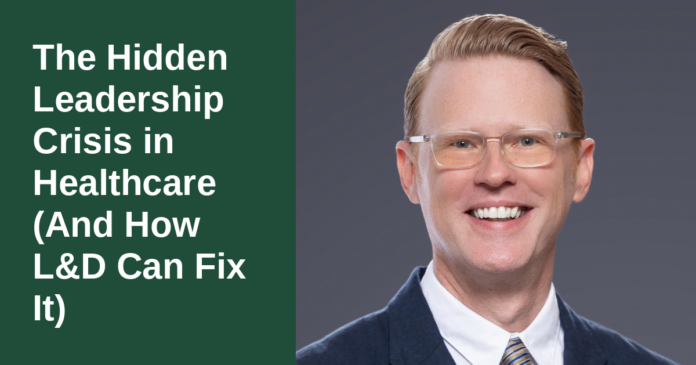
Matt Painter, an organizational development leader at Cape Fear Valley Health Center with a Ph.D. in business, industrial-organizational psychology, sees this tension clearly. “The leadership development audience in healthcare is a challenge from the time investment required,” he told me. “Our people are rightly focused on the exceptional provision of care.”
Painter’s solution is to map out what great leadership looks like and then align people with that map through a blend of systems, training, and assessment. A growing body of quantitative research and qualitative interviews with talent development leaders in healthcare shows that well-executed talent development programs can increase team effectiveness, improve patient care, and reduce burnout, making leadership development and culture formation a vital investment.
Transformation Begins with a Shared Cultural Goal
For Painter, the starting point is defining the ideal culture. Only then can you create a clear roadmap founded on mission, vision, and values leading to alignment. It helps the organization become “anchored in who we are and how we operate.”
“If you don’t have a clearly defined and embedded mission, vision, and values, then managers throughout the system operate from their own paradigms,” Painter explained. The result is what he calls “cultural competition” and “culture drift.” Different leaders vie for their own cultural vision which may or may not be shared. Decisions slow down, silos develop, and conflict increases because people aren’t operating from the same definition of what the organization values.
Values Must Be Defined Behaviorally
Most organizations have values, but many fail to define what those values look like in action. Painter is blunt about the gap. “Many organizations will define values, but they don’t do it behaviorally,” he said. To create alignment, you need behavioral specificity.
For example, an organization may say it values “innovation,” but innovation can mean different things in different contexts. Does it mean creative license? Evidence-based improvement? Research? Best practices? A tolerance for experimentation? The right question to be asking instead is “How does our organization define and engage in innovation?”
One of Painter’s preferred tools to help answer this question is what he calls “cultural vignettes.” These vignettes are mini cases that serve to highlight positive behaviors or cultural infractions that leaders can share to help reach a mutual understanding of what their values look like in action.
Operationalizing Culture Requires an Owner, Steward, Architect, and Ambassadors.
Another point of failure when it comes to cultural work is unclear role assignment. Painter sees four key roles when it comes to defining and enacting your culture.
The first is the owner. “As far as I’m concerned, the CEO owns it,” he said. “There’s no amount of culture programming or culture work that can survive or succeed without CEO ownership.”
The second is the steward, usually the chief people officer or CHRO. This leader, in concert with the Owner and Architect, creates the structures that embed values into the organization and holds people accountable to them.
The third is the architect: the OD executive or culture partner. This person (Painter’s role) designs the roadmap for culture transformation. Painter describes the OD role as “somebody who can architect the roadmap for culture development and once designed becomes the foreman of the culture transformation.”
The fourth is the ambassador. That is everyone. Culture becomes real when people at every level of the organization enact the agreed-upon values.
Leadership Development Reinforces Your Culture
Painter sees a common mistake in organizations: they hire someone in leadership development with the expectation that they will “improve the culture,” but then don’t empower that person to influence the system. “They want leadership development to do training,” he said, “but the training itself can only do so much.”
This is a critical point for HR and L&D leaders. Training can build skills, create a shared language, and help leaders practice new behaviors, but if the executive team doesn’t buy into the values and help enact them, your training will always be limited. “You can’t throw training at people and expect a positive outcome when it’s not part of the larger performance system,” he said. Painter believes the solution is to empower someone in leadership development with the authority to architect and implement in partnership with the CEO and CPO.
Talent Systems Must Support the Culture
Finally, culture has to be supported by the broader talent ecosystem.
Painter points to organizational structure as a key example. “Span of control matters,” he explained. “If a manager has too many direct reports, it becomes difficult to build real relationships, coach effectively, or hold people accountable in a meaningful way.” Even if you execute on everything else in this article, it could fall apart when the span of control is too broad.
“All of your talent systems have to align to the desired culture,” Painter said. Recruitment, selection, onboarding, organizational structure, employee relations, total rewards, leadership development, organizational learning, and most importantly accountability, all have to align with your desired culture. As in the span of control example Painter shared, as soon as one of these elements falters, the whole system is threatened.
Culture Work Is An Ongoing System
Building a strong healthcare culture is not a one-time initiative but an ongoing commitment that requires clear ownership, behavioral specificity, and systems aligned to shared values. When leaders treat culture as a living roadmap rather than a wall poster, they create the conditions for better leadership, healthier teams, and ultimately, better patient care.