
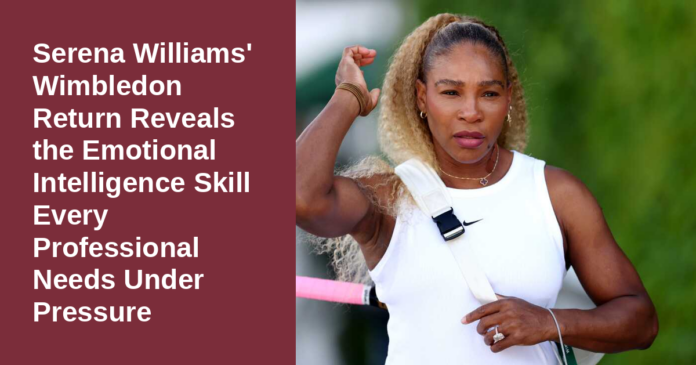
On June 30, 44-year-old Serena Williams walked onto Centre Court for her first singles match in nearly four years. Across the net from Williams stood her opponent, Maya Joint, a 20-year-old Australian less than half her age. Fifteen thousand people packed the stands, millions more tuned in, and the match set ratings records on ESPN.
Rennae Stubbs, one of Williams’ coaches, told the Associated Press that her single pre-match request was that Williams try to “control her emotions and her nerves.” No one, Stubbs added, could even remotely quantify the amount of pressure Williams carried onto that court.
As her coach, Stubbs knew that Williams needed above all else to calm down and find her center. If she could do that, her abilities, talent, and experience would all fall into place and project her forward. About an hour into the match, Stubbs saw it. In the middle of the second set, Williams took one big, deep breath. Stubbs turned to Serena’s sister Venus and said, “Oh I think she just relaxed.”
Williams lost the match, 6-3, 6-7 (6), 6-3, but after that breath, she pushed the second set to a tiebreak — and won it — against an opponent half her age, playing on an injured knee.
The moment is a great example of emotional intelligence, as an all-time great struggled to manage her emotions, then centered herself in real time in the midst of a long-awaited return. What follows is a breakdown of what happened and how we can all learn from it.
What Williams Was Feeling, and How Her Emotional Intelligence Helped Her
Consider how much emotional baggage Williams carried with her onto that court. She walked out as Serena Williams, the 23-time Grand Slam champion and seven-time Wimbledon winner (this is what the fans saw). Yet, at the same time, she was 44 years old, nursing a serious knee injury, and had spent the last four years away from singles competitions. The pressure to be the player the world expected to see surely generated high-stakes stress. And this is exactly the kind of stress that the emotional brain treats as danger or a threat.
As emotional intelligence expert Dr. Travis Bradberry writes, “The brain is wired to react emotionally first. Incoming signals reach the limbic system, where emotions are generated, before they ever reach the rational brain. Under enough pressure, the emotional response hijacks behavior before reason even gets a vote.” When the pressure is tied to your very identity, as it likely was for Williams, the stakes are even higher. That’s why Williams’ coach, Stubbs, was so pleased to see Williams do something as simple as take a breath.
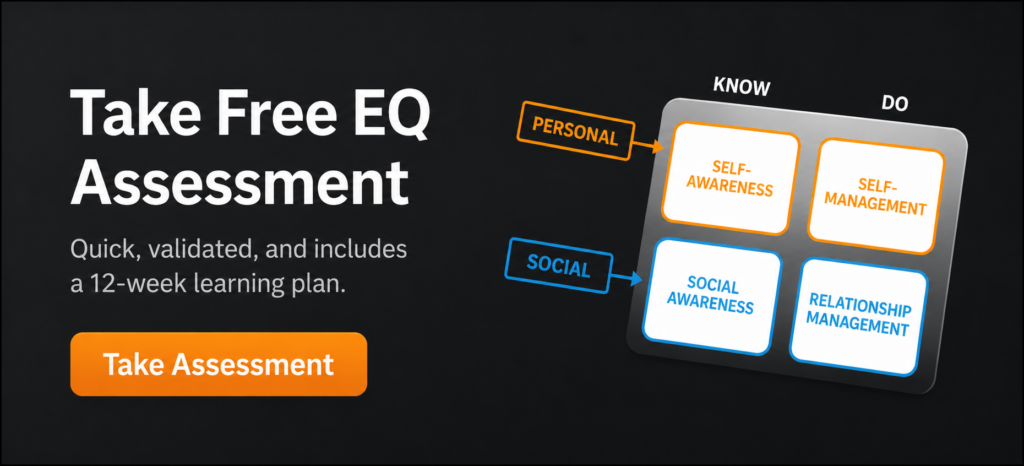
Emotional intelligence (EI) is your ability to recognize emotions in yourself and others, and to use that awareness to manage your behavior and relationships. It comprises four core skills: self-awareness, self-management, social awareness, and relationship management. To improve your EI across each of the four core dimensions, experts recommend that you measure your scores using a psychologically validated assessment like the free EI Self-Assessment.
Williams taking a moment to breathe and re-set herself was a demonstration of the second skill, self-management. Self-management is your ability to use awareness of your emotions to direct your behavior toward a positive outcome. Self-management is especially valuable when your emotions are pulling you somewhere unhelpful (think self-doubt, imposter syndrome, or perfectionism), and you can use self-management behaviors to calm down and move toward a more productive behavior. By just taking five seconds to breathe, Williams completely shifted her brain’s stress response. This of course gave her a chance to play at her best.
The EI Takeaway: Practice Structured Breathing to Center Yourself
Bradberry recommends one EI strategy that maps directly to William’sell-timed breath: Practice Mindfulness by staying present through meditation, mindful breathing, or other activities that heighten awareness and focus.
The research backs up Bradberry’s study. A 2023 randomized controlled study led by Stanford researchers and published in Cell Reports Medicine found that five minutes of daily structured breathwork improved mood and reduced physiological arousal. On top of that, the study found that breathwork had this effect almost immediately, calming the body’s stress response in a matter of minutes, not months or years.
If you’re interested in implementing breathwork in your own life, one of the most practical forms is called box breathing, and it’s used by navy seals, athletes, and performers. The concept is incredibly simple. You inhale through your nose for four seconds, hold your breath for four seconds, exhale for four, and then finally you hold for four more seconds while deplete of breath.
Next time you find yourself at your own “Centre Court,” repeat this pattern of boxed breathing at least four times. As the research suggests, you’ll calm yourself down, free yourself from your stress response, and be able to think more clearly about your next move. Your brain, your body, and your future self will all thank you.