
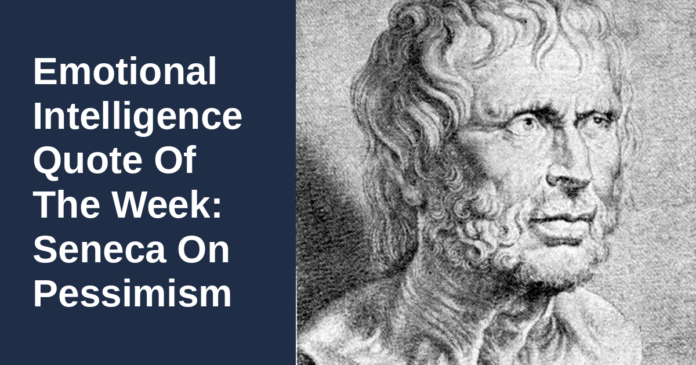
Lucius Annaeus Seneca’s friend Lucilius was spiraling over a danger that hadn’t arrived, and might never arrive. So, Seneca did what any good friend does, and he wrote him a sprawling letter riddled with philosophical musings. In Letter 13 from Letters from a Stoic, titled “On Groundless Fear,” he wrote:
What I advise you to do is, not to be unhappy before the crisis comes; since it may be that the dangers before which you paled as if they were threatening you, will never come upon you; they certainly have not yet come. Accordingly, some things torment us more than they ought; some torment us before they ought; and some torment us when they ought not to torment us at all. We are in the habit of exaggerating, or imagining, or anticipating, sorrow.
What Seneca is pointing out is what psychologists now call “pessimism bias.” Meaning, we have a tendency to assume the worst, even though the research shows that these worst-case scenarios rarely come to fruition.
What Seneca Knew About Pessimism Bias Long Before Psychologists Proved It
Research from Penn State backs up the main idea behind Seneca’s letter, the idea that we bias towards pessimism and over-imagine negative futures. Lucas LaFreniere and Michelle Newman tracked people with generalized anxiety and found that 91.4% of their worries never actually came to be. An earlier study that they reference found a similar thing, that the rare worries that did materialize turned out easier to handle than people expected.
What makes pessimism bias so convincing is that it doesn’t feel like a “bias.” It feels like foresight. The research shows that your mind is wired to treat a negative future as though it has already happened. That means your brain pushes you to move straight to grieving a bad outcome before it has even happened. That instinct likely evolved to help our ancestors identify and prepare for major threats like predators and cold winters, but it’s far less useful when we apply that same catastrophic thinking to tinier life details like an email from a boss.
How Emotional Intelligence Can Help You Overcome Pessimism Bias
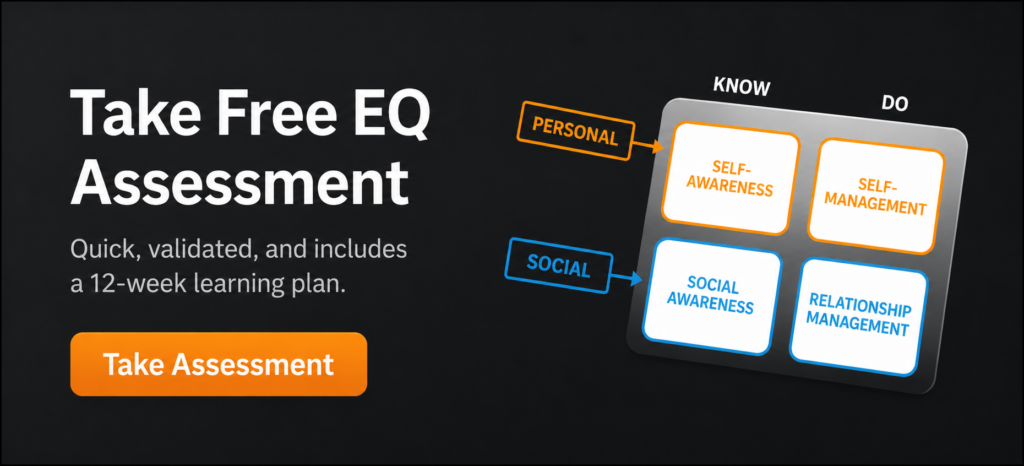
Emotional intelligence (EI) is your ability to recognize, understand, and manage your own emotions, as well as the emotions of other people, in order to be more effective in your relationships and life. EI is made up of four core skills:
- Self-Awareness, or your ability to recognize and understand your emotions
- Self-Management, or your ability to deal with and regulate your emotions
- Social Awareness, or your ability to recognize and understand the emotions of others, and your ability to empathize with others.
- Relationship Management, or your ability to use each of the aforementioned skills to build, maintain, and foster relationships with other people.
In emotional intelligence terms, Seneca was describing a breakdown in self-awareness as his friend Lucilius struggled to separate his imagined worst-case scenario from the more realistic and probable one. Through a honed sense of self-awareness, Lucilius could more effectively pick up on his negative emotions (i.e., anxiety, fear, panic), and then see that there’s a logical divide between how he feels and what is likely to really happen.
Because our emotions drive so much of our thinking and day-to-day experience, self-awareness is a foundational skill of emotional intelligence, and every other skill in the model depends on your ability to spot your own patterns. To get a sense for your self-awareness, psychologists recommend that you take a validated emotional intelligence self-assessment.
What Pessimism Bias Looks Like Now
Imagine you’re sitting at home, unable to sleep at 11 p.m. because you’re replaying that hard conversation with your teenager that you know you need to have tomorrow morning. You imagine her furious with you and your relationship becoming strained for months, or years. You imagine the details of the fight, the blowback, the inability to connect with her later that week. Then, you have the actual conversation, and it’s much calmer, shorter, and kinder than the one your mind built up. She gets angry, but she sees the ways you were wrong, and by the next week, things are back to normal. But by the time you even had the conversation, you had lost two whole nights of sleep worrying about and replaying the event in your head. You spent massive amounts of emotional energy, and it takes you days to catch up on your sleep and feel good again.
Putting This Quote Into Action: A Simple EI Strategy You Can Apply To Overcome Pessimism Bias
Seneca’s own remedy, to apply logic to your emotional situation, works in theory, but it’s pretty tough to execute. One strategy that can work wonders is to just write out your fears. Once you get them down on the page, it becomes a bit easier to move forward. And, in the future, as more than 91% of your fears never become realized, you’ll see that pattern in your notebook. So many of your fears won’t amount to anything. With time, when you go to write down your fears, you’ll learn that pattern and feel less dread.
Seneca’s insight holds up because the underlying pattern hasn’t changed in two thousand years. Most of what we dread never arrives, and the dread itself is often the only real cost. Naming this bias and noticing that you’re anticipating an unarrived sorrow can help you loosen its grip. That’s the real takeaway here from Seneca. Learn to catch the story your mind is inventing, and you’ll win the present moment back for your own enjoyment.