
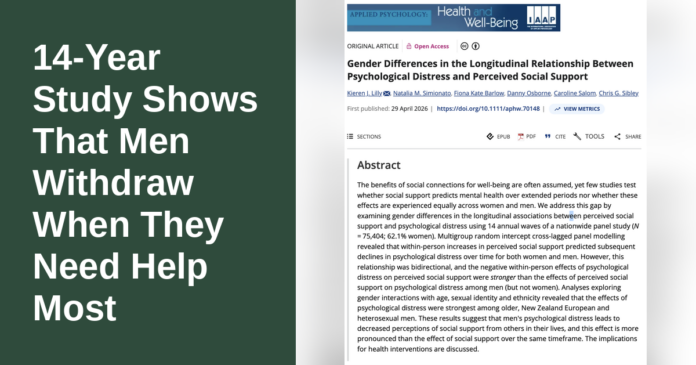
For fourteen years, researchers tracked mental health and social life for 76,409 people in New Zealand. It was called the New Zealand Attitudes and Values Study, a national panel based at the University of Auckland. Across 15 waves, they studied 76,409 people, beginning in 2009.
Kieren J. Lilly, PhD, now at the University of Queensland’s Institute for Social Science Research, led the analysis with five colleagues, including University of Auckland psychologist Chris G. Sibley. What they found is fascinating, though uncomfortable.
Distress and social support feed each other in both men and women, but in men specifically, experiencing distress actually predicted losing support.
Support Helps Everyone. Distress Costs Men More.
The study, published in Applied Psychology: Health and Well-Being, measured distress and perceived support. Wave after wave, the obvious pattern held: People who found support showed lower distress later. Meanwhile, rising distress over time tended to track with a lower degree of support.
In men, that second path, where distress erodes future support, was especially strong. In women, it wasn’t. Lilly and colleagues concluded that men’s distress “leads to decreased perceptions of social support from others in their lives.”
The likely cause of this is unspoken social norms, not biological wiring. Men are widely expected to be self-reliant and stoic, betraying little to no emotion and needing no help. Under this expectation, men can feel a certain degree of pressure to not be struggling and to hide it from their friends and significant others when they are struggling.
Why This Is A Matter of Emotional Intelligence
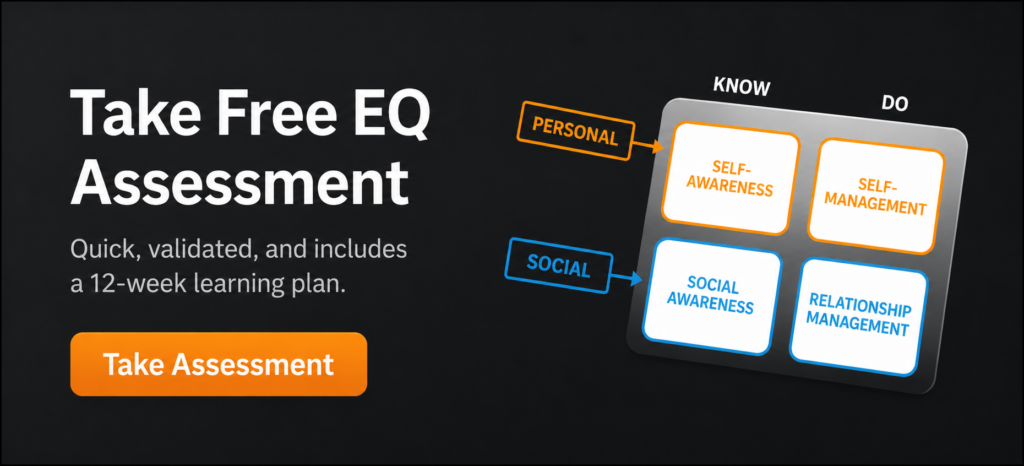
Emotional intelligence (EI) is your ability to recognize, understand, and manage your own emotions, and to recognize and influence the emotions of people around you. EI is made up of four core skills:
- Self-Awareness, or your ability to recognize and understand your emotions
- Self-Management, or your ability to deal with and regulate your emotions
- Social Awareness, or your ability to recognize and understand the emotions of others, and your ability to empathize with others.
- Relationship Management, or your ability to use each of the aforementioned skills to build, maintain, and foster relationships with other people.
To get a sense for your emotional intelligence and where you stand to improve, experts recommend you take a validated emotional intelligence test. This struggle that men face to reach out for connection and get the support they need is largely a matter of relationship management. Relationship management is about building and keeping connection, and leaning into that discomfort of asking for help is an important part of building authentic and meaningful relationships.
The EI Strategy You Can Apply: The Early Flare
A ship in trouble always tries to fire their flare while they can still be seen by another ship. If they wait too long, they’ll have slipped below the horizon with nobody left to signal.
If you think of distress as the first sign of trouble on a ship, then men struggle to shoot their flares. They shoot them too little and too late. The skill is learning to lean into the discomfort of asking for help, and doing so early on.
Here’s a 4-step process you can follow to ask for help.
- Get to know your “go-dark” tells. Classic examples include declining invitations, one-word replies, or saying “I’m just slammed.” These little one-off responses may seem trivial, but they’re often the early mechanisms we use to avoid getting help.
- Pick your go-to people in advance. Know who you want to go to for help before you need it.
- Ask for help at a 3, not a 9. It’s easy to feel like the little things don’t warrant asking for support, but over time, the little things start to add up.
- Give out help to those close to you. Ask your friends how they’re really doing and offer support however you can. This will help normalize asking for help and giving help between you and your close friends.
Putting This Research Into Action
Fourteen years and 76,000 people show that the withdrawal effect in men is real and self-reinforcing. To break that loop for yourself, you need to develop that muscle of asking for help. And remember, every time you ask for help, you also show your friends that it’s okay for them to ask you for help when they need it.