
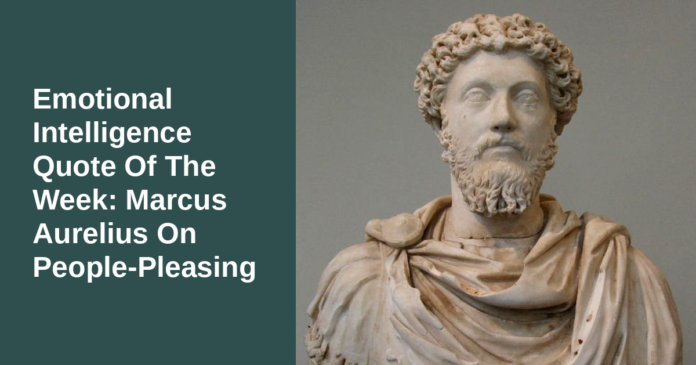
Marcus Aurelius ruled Rome from 161 to 180 AD. His private notebooks, which we now call Meditations, were never written for readers. They were meant to be reminders to himself. In Book 12, the last of his meditations, he wrote:
“It never ceases to amaze me: we all love ourselves more than other people, but care more about their opinion than our own.”
It’s fitting that Marcus Aurelius, who had essentially unlimited public approval, could see this so clearly.
He goes on to write, “If a wise person forbade you from concealing a thought or from imagining anything without immediately shouting it aloud, you would not last a single day.” His point being, we constantly monitor our thoughts and filter them through how other people will react before we speak. We should remind ourselves of this constantly, because this filtering of our thoughts affects how we make decisions (both for better and for worse).
Why This Is A Matter Of Emotional Intelligence
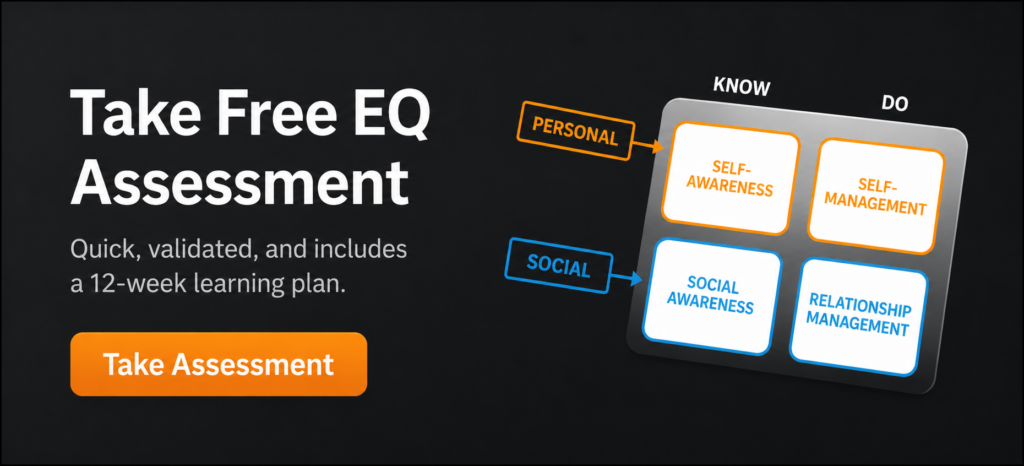
Emotional intelligence is your ability to recognize, understand, and manage your own emotions and the emotions of others in order to be more effective in your relationships, goals, and work. It is made up of four core skills:
- Self-Awareness, or your ability to recognize and understand your emotions
- Self-Management, or your ability to deal with and regulate your emotions
- Social Awareness, or your ability to recognize and understand the emotions of others, and your ability to empathize with others
- Relationship Management, or your ability to use each of the aforementioned skills to build, maintain, and foster relationships with other people
To assess your emotional intelligence, experts recommend that you take a psychologically validated emotional intelligence assessment.
In this quote, Aurelius is describing a dilemma of self-awareness. A big part of self-awareness is knowing your values and beliefs, because your ability to align your actions with your values and beliefs directly impacts your emotions. For example, when you make a decision that doesn’t align with your values (i.e., you do something ethically ambiguous to make a sale), you’ll stir up negative emotions in yourself. On the flip side, when you uphold your values (i.e., you turn down the sale because you refuse to cross over into the ethical gray area), you will ultimately feel positive emotions, even if it’s difficult to recognize that in the moment.
Too often, our misaligned decisions are the result of pressure we feel to please people around us (i.e., your boss, a prospect, or someone you look up to).
The Research Behind This Idea: People-Pleasing Isn’t Worth Your Time Or Energy
Psychologists Thomas Gilovich, Victoria Husted Medvec, and Kenneth Savitsky coined the term, “the spotlight effect,” which says that we tend to badly overestimate how much other people care about us and what we do. We imagine the spotlight on us, when in reality, other people are much more concerned with themselves.
In one study, people in a group discussion overestimated how prominent their own best and worst remarks had been to everyone at the table. In reality, most people don’t register your actions nearly as deeply as you might think.
Worse, Erica Boothby and her colleagues found that after conversations, we consistently underestimate how much our conversational partners liked us. Boothby speculated that this is partially driven by how harshly we judge our own performance.
Even though Aurelius pointed this out some two thousand years ago, the contemporary research supports his thesis. Despite the fact that we agonize over how we come across to others, those people tend to pay less attention to us and judge us less harshly than we expect them to. The harshest critic of you is almost always you.
Putting This Quote Into Action
Next time you find yourself tempted to make a decision to please the people around you, pause and ask yourself how that decision aligns with your own values. If your decision misaligns, slow down and try to come up with a new way forward. If it aligns, move forward knowing that you’re doing the right thing.
As you get better and better at this, you’ll find something interesting begins to happen. The more you act in pursuit of your own values, the more genuine and interesting you come across to other people. And, in turn, people will actually like you more, not less, than they did when you were constantly trying to please them.