
How to Improve Emotional Intelligence at Work With Dr. Travis Bradberry
Sixteen years after a blockbuster bestseller, Dr. Travis Bradberry returns with a harder-to-fake assessment and deeper, habit-forming strategies.
The first thing you notice about Dr. Travis Bradberry isn’t his résumé—5 million books sold, translated into 25 languages, 2.6 million LinkedIn followers, Chief People Scientist at LEADx. It’s his presence. He was deeply calm, present in the moment, and responding thoughtfully to each question. And this was despite the fact that as I later learned, he had a jackhammer rattling right outside his window. It was an on-brand entrance for the world’s most widely read voice on emotional intelligence (EQ): life gets noisy; composure is a choice.
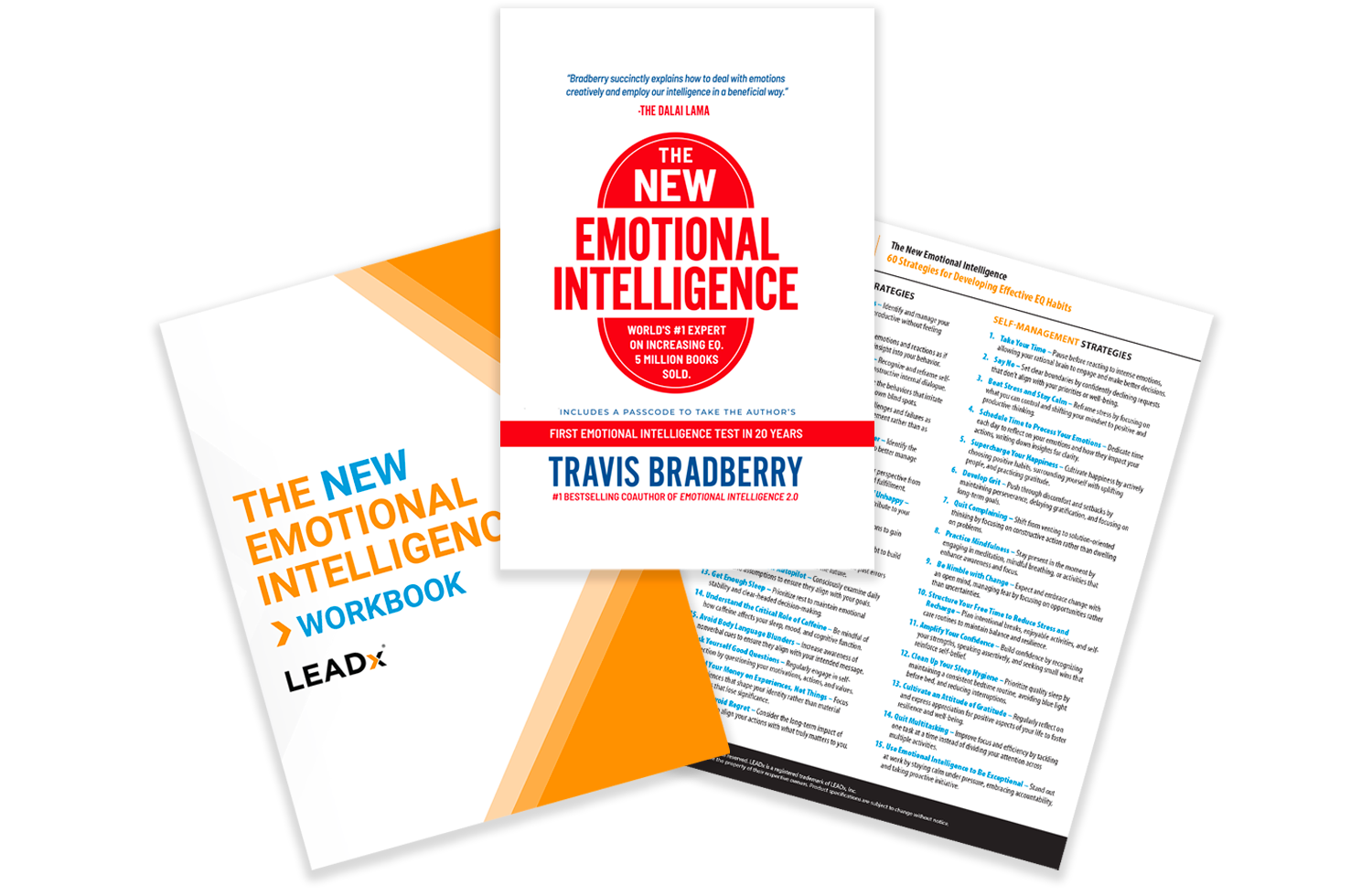
Most leaders know Travis from Emotional Intelligence 2.0, the book you’ve seen in airport bookstores for years. It became the go-to primer on EQ skills and quick, practical tactics. But as Travis told me, “Those are my thoughts from sixteen years ago.” In the time since, psychology and neuroscience have leapt forward, his own research and writing have expanded, and—critically—he had the freedom to redesign his EQ assessment from scratch. The result is a wholly updated playbook: a new book, a new test, and a sharper method for actually changing behavior. He called it The New Emotional Intelligence.
What’s different now? In short: more rigor, more depth, and a path that moves beyond insight to habit. The new assessment is designed to be far harder to “fake good,” and the book’s 60 tactics—organized across self-awareness, self-management, social awareness, and relationship management—go twice as deep as his earlier strategies. It’s still approachable; it’s just grown up with the science.
Why a “New” Emotional Intelligence, Why Now?
Evergreen doesn’t mean finished. “I can’t imagine anyone here hasn’t evolved professionally in the last sixteen years,” Travis told me. He certainly has. In the intervening years he’s analyzed data from more than 2 million test-takers, watched what sticks (and what doesn’t) inside real companies, and tracked research that better explains why emotions drive so much of what we do. “On average,” he pointed out, “we experience around 400 emotional events a day.” If you don’t understand those signals—and your reflexes to them—you’re not really steering your behavior; you’re being steered by it.
That premise leads to two upgrades:
1) A re-engineered assessment you can’t game. Self-report tools are notorious for wishful thinking. In his earlier test, the “right” answer could be a little too obvious to people intent on looking good. The new instrument attacks that weakness with a more nuanced frequency scale. Counterintuitively, “always” isn’t always intelligent; for many behaviors, almost always is healthier than always, and rigid extremes can reflect overuse. If you mindlessly max out the scale to impress, you’ll actually lower your score—yielding a more objective profile and a truer roadmap for what to practice next.
2) A deeper, practice-first method for real behavior change. Insight without repetition rarely rewires anything. The updated book offers 60 strategies—twice the average length of the earlier tactics—precisely because depth matters when you’re trying to turn a new behavior into an automatic one. The aim is not a one-day aha; it’s to practice small, concrete behaviors until you “catch yourself” doing them without thinking. That’s the sign a new neural pathway has formed—and the moment EQ moves from concept to capability.
Travis’s own favorite strategies hint at the range within his book. For self-awareness: You spot it, you got it—use the traits that irrationally annoy you in others as a mirror for what you might be missing in yourself. For relationship management: Lose the battle to win the war—choose your hills wisely rather than reflexively proving you’re right and eroding trust. The common thread is pragmatic, bite-size practice you can repeat often enough to stick.
A Test You Can’t Fake: Inside the New EQ Assessment
Classic self-assessments invite wishful thinking. Travis knows—his earlier instrument was wildly popular, and with popularity comes pattern recognition: savvy test-takers could sometimes sniff out the “right” answer and inflate their scores. The new assessment closes that loophole.
The key shift is a more nuanced frequency scale. In many items, “always” isn’t the gold medal and “never” isn’t the villain; for a surprising number of EQ behaviors, almost always beats always, and rigid extremes can reflect overuse. If you try to “fake good” by maxing out every response, you’ll often lower your score. That design choice produces a more objective snapshot of how you actually behave—not the polished version you wish you did.
Why does this matter? Because the book functions like a prescription. Your score profile maps to specific strategies segmented across the four core skill areas: self-awareness, self-management, social awareness, and relationship management. If the profile is off, the advice will be off. A harder-to-game instrument means you’re sent to work on the right things, in the right order.
A word on 360s vs. self-reports: both live on frequency scales, and both have a place. The self-assessment gives you an internally consistent baseline and a personal plan; a 360 adds the crucial outside view. In enterprise rollouts, we like to recommend a 360 to them so leaders see where self-perception and social impact align—or collide.
From Insight to Habit: How EQ Actually Improves
Most workshops deliver awareness; too few deliver automaticity. Travis’s methodology is unapologetically behaviorist: pick a small, concrete strategy, repeat it until you catch yourself doing it without thinking, then layer on the next one. That “catch yourself” moment is the signal that a new neural pathway is in play.
That’s why this edition includes 60 strategies—and why each one goes roughly twice as deep as before. It’s not more for more’s sake; it’s the level of detail people kept asking for so they could translate ideas into daily practice.
- Self-Awareness — “You Spot It, You Got It.” Notice the behaviors in others that irrationally get your goat. Those spikes of irritation are data about you. Pause, label the emotion, and interrogate why this, why now until you land on a pattern you can train.
- Relationship Management — “Lose the Battle to Win the War.” Being right is satisfying; being trusted is strategic. EQ leaders choose their hills. When your impulse is to prove a point, ask whether doing so strengthens or strains the relationship you’ll need next quarter.
In Travis’s large-scale implementations, the teams that practiced these micro-behaviors the most were the ones that improved their leadership performance the most. The relationship is linear: more practice, more improvement; no practice, no change.
How to put this to work this week
- Take the assessment and accept the score profile as a starting point, not a verdict.
- Pick 2–3 strategies matched to your lowest sub-scores. Make them visible—calendar nudge, sticky note, or daily checklist.
- Rehearse the cue. Decide when you’ll use the behavior (e.g., “When I feel annoyed in a meeting, I’ll name the emotion silently and ask one clarifying question before responding”).
- Track frequency, not perfection. Aim for almost always over time, not an immediate “always.”
- Retest at 4 and 12 weeks to confirm you’re practicing the right muscles and to refresh your prescription.
Emotion Is Contagious: Leaders Set the Weather
When I asked Travis how EQ scales from the individual to the team, he didn’t hesitate: tone starts at the top. Leaders model how to process pressure, change, and conflict—and everyone else calibrates to that signal. Research shows that emotions spread through groups via mirroring and social cues.
- Name the emotion, then name the next best move. “I’m frustrated by the delay; here’s how we’ll stabilize this week.”
- Normalize check-ins. Start meetings with one clarifying question to surface signal without derailing into therapy.
- Make ‘almost always’ the target. Extremes can backfire. Modeling balance beats modeling bravado.
The Business Case Your CFO Can’t Ignore
We surveyed a thousand heads of leadership development and heard the same refrain: priorities are high; time, headcount, and budget are low. If EQ is going to win resources in 2025, you need receipts.
Travis devotes a section of the new book to those receipts: case studies where EQ programs drove bottom-line results. The pattern he’s seen is straightforward: baseline the current state, introduce assessment + practical strategies, reinforce habit-building, and track changes that matter—leadership effectiveness, team output, customer metrics, quality, safety, and regrettable attrition. In one project for a division of Fortune Brands, the amount of practice leaders completed predicted their performance gains—linearly.
A simple proof path (pilot → prove → scale):
- Pilot with one function or cohort. Use the new self-assessment (and a 360 if feasible) to get clean baselines.
- Prescribe 2–3 strategies per person based on their score profile. Keep the practice small and trackable (daily checklist, manager check-ins).
- Re-test at 4 and 12 weeks. Show movement in targeted skills and connect it to operating KPIs.
- Roll forward only the elements that drove change, then scale.
Burnout, Boundaries, and the Part EQ Really Plays
Is burnout an EQ issue? Partly. Travis separates environmental load (organizational factors) from personal regulation (how you respond). You may not control deadlines, ticket queues, or headcount. You do control self-management: boundaries, time architecture, recovery routines, and how you metabolize stress signals before they become stress reactions.
- Protect deep-work windows (and model it visibly).
- Set response-time norms to prevent “always on” creep.
- Coach to agency: “What’s in your control this week? What’s the smallest change that would relieve the most pressure?”
Bias, Better Judgment, and Why “Self-Aware First” Still Wins
Your read on people is only as good as your read on yourself. Social awareness and relationship management hinge on accurate evaluation—of context, intent, and impact. Start with self-awareness, label your default reactions, and use bias interrupters to slow the impulse and upgrade the next move.
- Name the snap judgment. Consider alternate explanations.
- Buy one beat. Ask a neutral clarifier before acting.
- Check the mirror. If something irrationally annoys you, run You Spot It, You Got It.
Don’t Run a Workshop. Run a System.
Most organizations don’t fail at insight; they fail at maintenance. The fix is a system you can actually run.
- Baseline with the self-assessment (+360 for key roles).
- Teach the fundamentals in a focused session.
- Prescribe 2–3 strategies per person tied to lowest sub-scores.
- Practice daily, publicly. Leaders model; managers reinforce.
- Retest at 4 and 12 weeks. Refresh the prescription.
- Wire it into cadence. Add one EQ behavior to performance check-ins; start meetings with a two-minute “signal scan.”
- Tie to one or two operating metrics. Watch for trend breaks in pilot groups.
And you don’t have to build this out from scratch. At LEADx, we built our certification program to help you execute on each of the above pieces.
The 12-Week EQ Pilot Playbook (Steal This)
Weeks 0–1: Align & Baseline
- Identify one function or cohort (30–80 people).
- Run the new self-assessment (+360 for managers).
- Select two org KPIs (e.g., first-call resolution and regrettable attrition).
Weeks 2–3: Teach & Prescribe
- Deliver a focused EQ workshop (half-day).
- Issue 2–3 personalized strategies per person.
- Managers ask weekly: “Where did you use your strategy?” “What got in the way?”
Weeks 4–8: Practice & Reinforce
- Daily micro-reps; track frequency.
- Leaders model “name the emotion, name the next move.”
- Send two nudges per week tied to each person’s strategies.
Week 4 Retest: Adjust
- Re-run the self-assessment; swap stale strategies.
- Share early wins with Finance.
Weeks 9–12: Sustain & Translate
- Keep the practice cadence.
- Translate EQ wins into KPI shifts (stories + data).
- Prep the scale plan: fund only what moved the needle.
End of Week 12: Report Out
- Show skill gain deltas, practice adherence, KPI trends.
- Greenlight phase two or iterate the pilot.
The Last Word: Make It a Habit or Don’t Bother
Travis ended our conversation with a simple charge to L&D leaders: “insight opens the door; repetition changes the brain.” If you want more emotionally intelligent teams, give people a real pathway—clear prescriptions, tiny daily reps, and retests that confirm progress. A one-day event starts the journey. The system gets you there.
And if you’re the leader everyone watches? Remember: you set the weather. Model calm curiosity under pressure, choose your hills, and design a culture where almost always is the quiet, compounding win.