

Nearly nine in ten employees who work in empathetic workplaces report that they received adequate AI training and that they feel positive about AI adoption. Among all employees, this figure drops to 51%, and in workplaces that employees describe as toxic, this figure collapses to 33%.
The finding comes from Businessolver’s 2026 State of Workplace Empathy AI Special Report, released in August and surveyed more than 1,000 working U.S. adults across six industries. All of these companies—whether they’re considered empathetic, neutral, or toxic—have similar budgets and resources. The real differentiator lay in the company culture. Specifically, in how empathetic that culture felt.
Empathy Drove Improvement Across Every Metric Measured
In empathetic cultures, 83% of employees said AI makes them more optimistic about their future with their organization, compared with just 61% of all employees. Eighty percent also said that AI gives them more agency and control over their work, compared with just 54% overall.
The inverse holds too. In toxic cultures, 51% worry they will fall behind on using AI effectively, and the same share worry about what AI means for their future at the company.
You can think of these numbers as an adoption forecast. If your organization isn’t creating a culture of empathy, then you’re going to struggle to convince your employees to adopt AI into their work even if you train for it aggressively. Meanwhile, companies with empathetic cultures could train AI less aggressively and still see better adoption numbers.
Why This Is A Matter Of Emotional Intelligence
Emotional intelligence (EI) is your ability to recognize and understand emotions in yourself and others, and your ability to use that awareness to manage your behavior and your relationships.
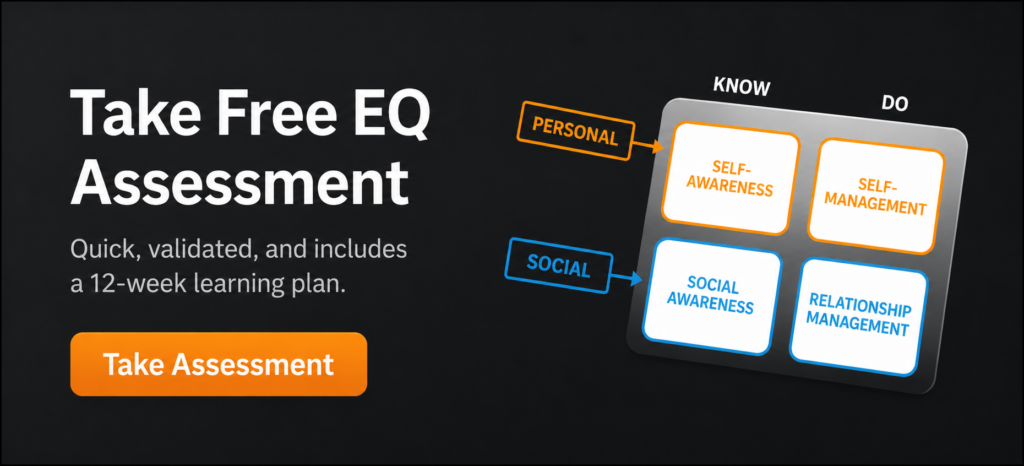
You can break EI down into four core skills: self-awareness, self-management, social awareness, and relationship management. To measure how you score across each of these four core skills, experts recommend that you take a validated emotional intelligence assessment.
As this data shows, fear of AI is not necessarily a technology problem you can solve with a better upskilling program. Instead, it’s a matter of building that high-empathy culture. This means that your managers need to be skilled at creating an environment of empathy within their teams, so that their team members feel heard, understood, and cared for.
The Research: Empathy Needs To Be Interactive
Too many leaders fall into the same trap when they’re trying to be empathetic. They focus all of their energy on imagining how their team feels.
Nicholas Epley, a professor of behavioral science at the University of Chicago Booth School of Business, tested this idea with his colleagues Tal Eyal and Mary Steffel across 25 experiments published in the Journal of Personality and Social Psychology. In their experiments, they would ask people to adopt another person’s perspective. What they found was that people produced no reliable gain in accuracy when they did so. In fact, the exercise often made them less accurate while also making them more confident—a potent combination if there ever was one.
What they found worked much better was what they call “perspective-getting.” In other words, you need to actually ask people about their perspective. Epley’s results show how a manager who tries to guess at their team’s AI fears will end up wrong about what their team actually fears, and at the same time, confident that they’re right.
A Simple EI Strategy You Can Use To Create An Empathetic Environment As A Leader
As you navigate the inevitable fears and anxieties around how AI is changing the working landscape, try to actually go out and get the perspectives of your team members. Follow this little four-step process for guidance:
- Write your guess down first. Before you talk to anyone, privately note what you believe each person on your team fears about AI.
- Ask something concrete. Skip “How do you feel about AI?” Instead, try asking, “What part of your job would you least want AI to touch?”
- Compare your guess to their answer. You’ll start to see the difference between your perceived awareness and your actual awareness.
- Act on the exact thing your team member named, ideally within a week. A fear that gets named and then ignored curdles into cynicism. But acting quickly will build an environment where your team feels heard and cared for.
Putting This Research Into Action
If you’re a manager, try the above strategy on three people on your team this week. If you’re not, try it in your personal life. Ask your partner or your kid for their perspective directly, instead of assuming you know.
Emotional intelligence is fundamentally about building relationships, and doing so hinges on your ability to stay open to people whose emotions and perspectives differ from your own. Rather than direct a ton of effort toward imagining how the people around us might feel (because let’s be honest, that takes a ton of energy), try to go out and get their perspective first-hand.