
The Top 5 Emotional Intelligence Measurement Tools (And How To Choose the Right One)
In the age of artificial intelligence, emotional intelligence may be your company’s last competitive advantage.
According to the World Economic Forum’s Future of Jobs Report, emotional intelligence is one of the top skills employees will need to thrive in the years ahead—right alongside analytical thinking and AI literacy. But unlike AI tools, emotional intelligence isn’t something you can buy and deploy. It’s something you have to build, intentionally, one skill at a time.
And like any skill, EQ must be measured before it can be developed.
What Is Emotional Intelligence?
Emotional intelligence—the ability to understand and manage your emotions and the emotions of others—isn’t a vague personality trait. It’s a trainable, measurable set of skills. In fact, EQ can be broken down into four core competencies:
- Self-awareness
- Self-management
- Social awareness
- Relationship management
At LEADx, we follow this model closely. Our Chief People Scientist, Dr. Travis Bradberry, has spent the past two decades studying emotional intelligence and designing assessments used by millions of people. He’s found that when you measure EQ the right way, you spark self-awareness, guide personal growth, and create a foundation for true behavior change.
But not all EQ assessments are created equal.
Some are built for personal reflection. Others are built for hiring. Some come with coaching and reinforcement tools. Others drop you into a 30-page report and wish you luck.
In this article, I’ll break down the four best emotional intelligence measurement tools available today—what they’re great at, where they fall short, and how to choose the one that fits your goals.
The Top 4 EQ Assessment Tools, Compared
In the next section, we’ll compare the four most widely used and accessible EQ assessments on the market, across seven critical criteria:
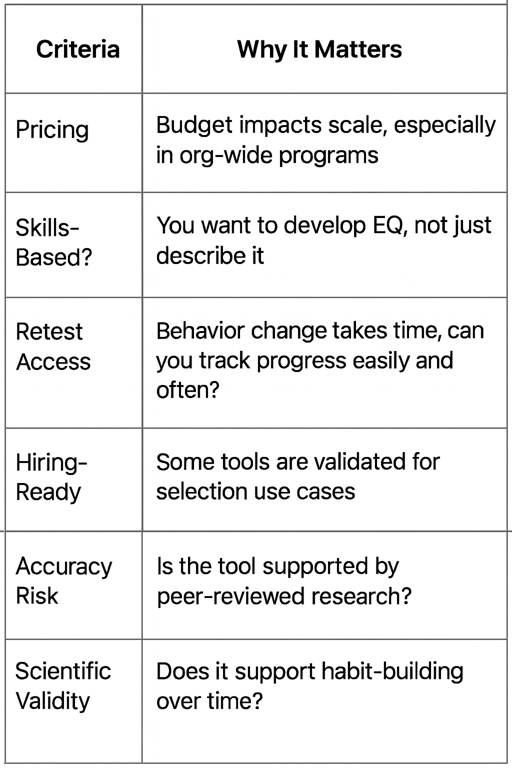 Let’s dive in.
Comparison Table: Top 4 Emotional Intelligence Assessment Tools
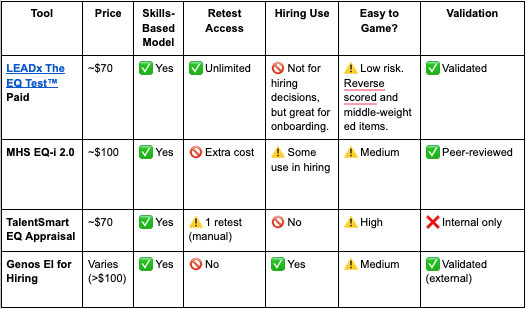
NOTE: This list sticks to self-assessments. To learn more about 360’s, read this article.
Tool #1: LEADx Paid Emotional Intelligence Assessment
Best For: Leadership development, coaching, onboarding, org-wide EQ programs
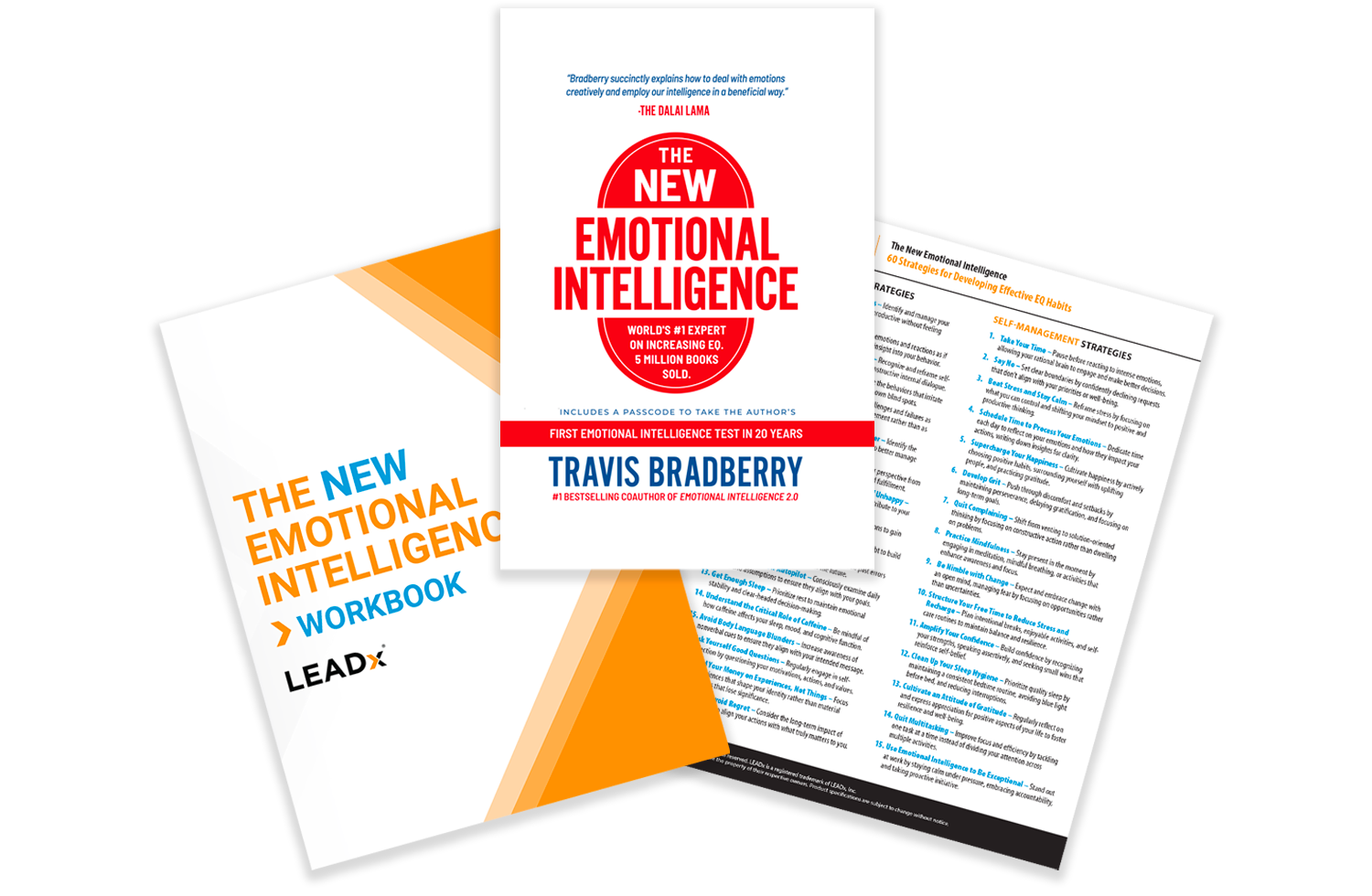
Designed by Dr. Travis Bradberry—author of The New Emotional Intelligence and Emotional Intelligence 2.0 and former architect of the TalentSmart EQ test—this assessment is built from scratch with 20+ years of practitioner feedback in mind. It blends psychometric rigor with practical usability.
- Includes 1-year access to a self-paced EQ reinforcement platform and optional ICF-certified EQ coach.
- Unlimited retests, enabling progress tracking across time.
- Middle-weighted Likert items help reduce gaming and flatten out inflated responses. It’s also validated by an external team of psychologists.
- Not designed for hiring or selection purposes, but ideal for L&D use cases.
“I wrote the original EQ test that over 2 million people used. Then I took everything I learned—and made it better.”
— Dr. Travis Bradberry
Tool #2: MHS EQ-i 2.0 / EQ 360
Best For: Executive coaching, clinical-grade assessments, consultant use
The EQ-i 2.0 is perhaps the most widely validated emotional intelligence tool in the market. It measures 15 distinct sub-skills and has been used in peer-reviewed research for decades.
- High psychometric validity, ideal for pre/post program evaluation.
- Can be used as a part of hiring.
- No built-in reinforcement or coaching.
- Can overwhelm non-expert participants with too much data and jargon. It’s tough to process 15 sub-skills at once and come out knowing where to focus your time and practice.
Pro tip: Use the EQ-i when you need depth and rigor, not quick actionable insights.
Tool #3: TalentSmartEQ Emotional Intelligence Appraisal
Best For: Quick self-assessment, individuals, low-lift programs
Developed by Bradberry over two decades ago, the TalentSmart tool helped bring EQ into the mainstream. But it hasn’t evolved much since.
- Limited validation—only internal, no peer-reviewed studies.
- No middle-weighted items, making it easier to “score high” without accuracy.
- Only one retest allowed, and you have to send out an email to request it.
- Reinforcement materials are static PDFs and videos from the early 2000s.
While still useful for fast scans, it’s not ideal for modern coaching or development. The assessment’s author Travis Bradberry moved on to a new assessment and company for a reason…
Tool #4: Genos EI for Hiring
Best For: Talent acquisition, hiring decisions, pre-employment screening
Genos EI offers a dedicated Selection Report designed for hiring contexts. It evaluates behaviors predictive of workplace performance and cultural fit.
- Widely used across industries including government, education, and finance.
- Requires a certified administrator to use legally and ethically in selection.
- No retest or development program attached—this is for one-time use only.
- Backed by validation studies and used in academic research.
If you’re hiring for people-facing roles like sales, HR, or customer service, this is your best bet.
FINAL THOUGHT: The best assessments include a certification with workshop curriculum. If you want to roll out EQ company-wide, you need more than just the ability to debrief the assessment. Learn more about different certification options here.
Sample Use Cases: How to Apply EQ Assessments at Work
The best emotional intelligence assessment isn’t just the most accurate—it’s the one that fits your goals. Whether you’re building a culture of empathy, launching a new leadership program, or looking to measure ROI, here’s how to apply the top tools in real scenarios:
Use Case #1: Leadership Development Programs
Recommended Tool: LEADx Paid or MHS EQ-i 2.0 / 360
If you’re building a structured leadership journey, start with a validated EQ assessment. Use it to establish a baseline, then follow with a workshop, reinforcement, and a retest 3–6 months later. I’d give the edge to our tool at LEADx because you can deliver a workshop and give your participants access to one year of EQ coaching.
Pro tip: Compare before/after scores to identify behavior change—and correlate with engagement or performance data.
Use Case #2: New Hire Onboarding
Recommended Tool: LEADx Paid or MHS
Emotional intelligence is one of the best predictors of collaboration, coachability, and adaptability—all traits you want in new hires. Introduce EQ during onboarding to help employees understand themselves and reduce friction as they integrate into teams.
Bonus: Unlimited retests let you circle back at 90 or 180 days to track growth.
Use Case #3: Hiring and Selection
Recommended Tool: Genos EI for Hiring
EQ assessments aren’t always legal or effective in hiring—unless they’re built for it. Genos offers one of the only validated tools for selection. Use it for roles that demand empathy, influence, and emotional control (sales, healthcare, leadership, etc.).
Important: Always work with a certified professional when using assessments in hiring.
Use Case #4: Open-Enrollment EQ Classes
Recommended Tool: LEADx Paid or Free
Want to scale EQ across the company? Open a company-wide EQ training track using LEADx’s self-paced platform. Use the free version as a teaser, or the paid version for deeper reinforcement. Then compare results between participants and non-participants.
Real ROI: One LEADx client tracked EQ scores and saw a 19% performance lift in sales reps who went through the program.
Why You Need to Measure Emotional Intelligence
You can’t improve what you don’t measure.
While most organizations say they value emotional intelligence, very few actually track it. And that’s a missed opportunity. Because once EQ is measured correctly, it becomes one of the most actionable, trainable skills in your leadership development toolkit.
Here’s what effective EQ measurement enables:
- Self-awareness and Insight: A well-designed assessment shines a light on blind spots and strengths, helping participants understand how they show up to others—and to themselves.
- Behavior Change and Habit Formation: Assessment isn’t a one-time event. It’s a starting line. The best tools offer reinforcement and retesting, so people can see their progress and stay motivated over time.
- Data-Driven Development Plans: Whether you’re launching a manager onboarding program or a company-wide culture initiative, an EQ baseline helps you tailor the learning journey and target your coaching.
- Proof of Behavior Change and ROI: Organizations that track EQ scores over time can correlate improvements to outcomes like employee engagement, retention, and even performance metrics like sales or leadership bench strength.
“Most companies talk about soft skills. But emotional intelligence is a hard skill—with hard data to support it.”
— Dr. Travis Bradberry, Chief People Scientist, LEADx
The Right Tool Depends on the Outcome You Want
Emotional intelligence is no longer a soft skill—it’s a strategic asset. And like any asset, it’s only as valuable as your ability to measure, track, and improve it.
At LEADx, we believe in measurement that leads to action. That’s why our assessments don’t just diagnose. They set you up to change your behavior. With unlimited retests, platform-based reinforcement, and access to expert EQ coaches, we’ve made it easy to embed emotional intelligence across your organization.