
The Ultimate Guide to Emotional Intelligence 360 Assessments
Research from Harvard Business Review shows that emotional intelligence is the single biggest predictor of effective leadership, more than IQ or technical skills.
For this reason, many leaders now get trained in emotional intelligence. Yet, surprisingly few of them receive detailed behavioral feedback on their EQ. Without it, they rely on self-assessments (less accurate, more biased), and they miss out on seeing a holistic picture of how their EQ ties to their effectiveness as a leader.
A great emotional intelligence 360 assessment will:
- Uncover hidden blind spots that traditional self-assessments miss
- Provide clear, actionable insights to guide leadership development
- Build trust and improve team performance by fostering more self-aware, emotionally intelligent leaders
But when it comes to choosing the right 360 EQ assessment certification, it can be surprisingly tough. How do you know if the price reflects the value you’re getting? Which EQ tool aligns best with your organization’s goals? And what really separates one vendor from another?
This guide has you covered. Below, you’ll find everything you need to make an informed decision—from a breakdown of what EQ 360 assessments are, to vendor comparisons, sample items, reporting features, and tips for using the results to fuel lasting growth.
Why Use a 360 Instead of a Self-Assessment?
Many emotional intelligence assessments rely on self-reporting, asking individuals to rate their own emotional skills, like self-awareness, self-management, social awareness, and relationship management. While these tools can be insightful, they only tell a fraction of the story.
A 360 assessment goes further. It gathers feedback from a circle of colleagues: direct reports, peers, managers, and sometimes clients or partners. Here’s why that matters:
1. Overcomes Self-Bias
We all have blind spots. Some leaders underestimate their strengths. Others overestimate their emotional impact. A 360 cuts through this by comparing how you see yourself with how others experience you. This contrast is where the real learning happens.
2. Provides a Big, Accurate Picture
Instead of one point of view, you get many. This mosaic of feedback (both qualitative and quantitative) creates a clearer, more balanced picture of a leader’s emotional intelligence in real-world situations. The result? More valid and reliable insights.
3. Delivers More Data Points for Better Decisions
With a self-assessment, you’re working with a single data source. A 360 multiplies that, giving you averages across rater groups, qualitative comments, and blind spot indicators. This level of detail helps HR and coaching professionals prioritize development areas more effectively.
4. Shows Exactly How EQ Impacts Leadership
The best 360s link emotional intelligence directly to leadership outcomes. If a manager scores low on impulse control and receives lower ratings from direct reports, it’s a clear signal that managing emotions under pressure is affecting team morale. The 360 makes these connections obvious and actionable.
5. Boosts Self-Awareness, and Quickly!
Feedback from others can be a wake-up call. And that’s a good thing. Leaders who receive 360 feedback often experience immediate jumps in self-awareness—an essential first step to emotional growth. In fact, research published in HBR found that while most people believe they are self-aware, only 10–15% actually are.
6. Sparks Real Behavior Change
Unlike generic training, an EQ 360 gives each leader a personalized development map. The reports typically include specific, practicable strategies based on their lowest-scoring areas. With coaching support, those strategies can translate into visible, lasting behavior change.
Comparison of Top Emotional Intelligence 360 Assessment Certifications
Here’s an overview of seven of the primary providers of 360 EQ assessment tools. I recommend reading this table, then reading the rest of the article, then returning to this table.
| Provider | EQ Model Used | Report Practicality | Creator Expertise | Scientific Validation | Reinforcement Tools | Workshop Option | Certification Pricing | Notes |
| LEADx Emotional Intelligence 360 | Bradberry 4-box, skill-based model: Self-awareness, self-management, social awareness, relationship management. | User-friendly; clear visuals, specific behavioral feedback, rater group breakdowns | Dr. Travis Bradberry | High – based on validated models, client use, and 3rd-party validation by multiple psychologists. Validated for business impact! | EQ book, microlearning, self-paced courses, full workshop, and 1 year access to human EQ coach at LEADx. | Yes – EQ Habits workshops, keynotes, and certification | ~$3495 (includes certification for workshop, platform access, 1 year of coaching for every participant) | This is Dr. Bradberry’s new assessment based on 25 years of research, writing, and feedback on his old 360. |
| MHS EQ 360 | Bar-On EQ-i 2.0 (15 subscales, 5 composites) | In-depth and data-rich; can overwhelm non-experts | Dr. Reuven Bar-On | High – peer-reviewed, normed globally | Leadership workbook, coach guide | No | ~$2,500 USD | Risk of “info overwhelm.” No workshop. |
| TalentSmartEQ 360 | Goleman’s 4 domains | Easy to interpret; high usability. No coaches allowed. | Dr. Travis Bradberry & Dr. Jean Greaves | Medium – No academic review. No published validation report. | Workshop | Yes | $4000 | Expensive, uses Dr. Bradberry’s old assessment. No real pull-through of learning. |
| Genos EI 360 | Genos 6 Skill Model (behavior frequency-based) | Intuitive traffic-light visuals and narrative comments | Dr. Ben Palmer | Moderate to high; validated internationally | Action plans, behavior flags | Yes | –$3,000 USD + $1k annual fee | $1k/year renewal adds up over time for orgs serious about EQ rollout. |
| Six Seconds SEI 360 | 8 competencies under Know/Choose/Give Yourself model | Coaching-friendly and simple to explain | Joshua Freedman, Anabel Jensen | Moderate – practitioner-led research | Journals, toolkits, eLearning | No | $460 | Good price for certification, but you only get the assessment. |
| BlueEQ 360 | BlueEQ’s 5 Dimensions | Highly visual with heat maps and behavioral flags | Business psychologists and consultants | Proprietary validation; benchmarked internally | Coaching guides, 55-page report | Yes. | Pricing on request | Strong appeal to analytical leaders and STEM orgs |
| RocheMartin ECR 360 | Emotional Capital framework (10 leadership traits) | Executive-ready design; well-balanced layout | Dr. Martyn Newman | Peer-reviewed; strong UK & AU usage | Action planning, team analytics | Yes. | ~$2,900–$3,200 USD | Combines trait + behavior insight; strong in coaching firms |
Note: While of course we are biased (we are LEADx), our bias is based on decades of combined EQ training experience. Our goal when we designed our tool was to make it indisputably the best product at the best price. And we hope this table reflects that!
How Emotional Intelligence 360 Assessments Improve Team Performance
It’s no secret that emotionally intelligent leaders build stronger, more resilient teams. But what does that really mean in practice? And how does an emotional intelligence 360 assessment play a role?
Let’s break down the impact of emotional intelligence on leadership, and why a multi-rater assessment is the fastest way to unlock individual and team growth.
1. Emotional Intelligence and Leadership Are Inseparable
Emotional intelligence isn’t just a “nice to have” for leaders—it’s foundational. Leaders set the tone for communication, collaboration, and trust. When they’re self-aware, empathetic, and emotionally regulated, they create safer, more productive environments for everyone around them.
In fact, Harvard Business Review reports that emotional intelligence is the strongest predictor of effective leadership, more important than IQ or technical skills. And leaders who exhibit high emotional intelligence are more likely to retain top talent, lead high-performing teams, and navigate conflict successfully.
An emotional intelligence 360 assessment helps leaders see exactly which emotional competencies—like empathy, stress tolerance, and impulse control—are impacting their teams, both positively and negatively. When those patterns are revealed, targeted coaching and training can lead to fast, measurable improvements in leadership effectiveness.
2. The Science of Emotion Contagion
Emotions are contagious. Research shows that teams unconsciously “catch” the moods of their leaders through subtle cues like facial expressions, tone of voice, and body language. This is known as emotion contagion—and it’s a powerful force.
If a leader frequently shows frustration or anxiety, their team will likely mirror that energy. But if a leader demonstrates calm, optimism, and empathy, it creates a ripple effect of psychological safety and focus.
This concept is supported by a growing body of neuroscience research. This University of Minnesota lecture offers a clear breakdown of how emotion contagion works in teams, and why emotional self-management is critical for leadership.
An emotional intelligence 360 assessment surfaces blind spots in this area. For example, a leader may rate themselves as composed, but peers and direct reports may perceive them as reactive or dismissive under pressure. That kind of discrepancy is a lightbulb moment—one that drives real behavioral change.
3. From Vague Feedback to Actionable Data
Another reason EQ 360 assessments work: they combine quantitative ratings with qualitative feedback. The result is a report that doesn’t just tell leaders what they need to improve, but also why and how.
Quantitative scores provide benchmarks—how a leader sees themselves vs. how others see them across competencies like empathy, assertiveness, and flexibility. But the real gold is often in the comments. These narrative insights give color to the numbers and offer specific examples of behavior in action.
For HR and L&D teams, this structure makes emotional intelligence easier to coach, teach, and measure. And for data-minded professionals, it adds credibility to what’s often seen as a “soft” skill. It’s no longer just a personality trait—it’s a set of observable behaviors backed by data.
4. Winning Over Skeptics: A Real-World Example
To see this in action, consider the story of a senior leader in a global food science company—let’s call her Megan.
Megan was technically brilliant. She held multiple patents, was known for her deep product knowledge, and had consistently hit her KPIs. But her department was experiencing high turnover, and engagement scores were below average.
When the company rolled out emotional intelligence 360 assessments for their leadership team, Megan expressed that it felt like a waste of time. “My team has the lowest rate of turnover,” she said. “I’d rather spend my time on the science.”
But when she received her EQ 360 feedback report, her perspective completely shifted. Nowhere in the qualitative comments did her colleagues mention her technical skills. Instead, they focused on leadership behaviors:
- “She always remembers what’s going on in our lives.”
- “She never panics, even under tight deadlines.”
- “She really listens when someone has a concern.”
It was the first time Megan realized that her impact wasn’t just about her technical expertise and strategy, it was also about how she made people feel. Her quiet empathy and steady presence were her true leadership superpowers.
That feedback changed the course of her career. She began leaning into those behaviors more intentionally, mentoring new managers, and ultimately became department head. Today, Megan is known as a legacy leader in her organization, not just for her innovations but for the team culture she helped build.
What Makes a Good Emotional Intelligence 360 Assessment?
Not all EQ 360s are created equal. Some assessments overwhelm participants with overly complex models or vague results. Others strike the right balance—delivering scientifically valid insights in a way that’s easy to understand, apply, and build a development plan around.
So what should you look for in a high-quality emotional intelligence 360 assessment?
1. A Blend of Quantitative and Qualitative Feedback
The best EQ 360s combine structured scoring with narrative feedback. This dual format gives you both the what and the why. Quantitative scores help identify trends across rater groups (e.g., your peers consistently rate you lower on emotional self-awareness than you rate yourself). But qualitative feedback—anonymous comments from colleagues—offers context that brings the numbers to life.
When these two formats work in harmony, leaders gain insight that is not just diagnostic, but actionable.
2. Validated Science Made Practical
A great EQ 360 is grounded in psychometric research and validated models, but doesn’t require a Ph.D. to interpret. If the results are too academic or convoluted, leaders tune out—or worse, misinterpret the feedback.
Some EQ 360s are extremely robust, measuring 15 subscales across five composite areas. While this depth is useful for trained coaches, the sheer number of dimensions can make it difficult for busy leaders to process and apply the insights. It’s a classic case of information overload.
That’s why many organizations are moving toward simplified frameworks, like the four-domain model (Self-Awareness, Self-Management, Social Awareness, and Relationship Management). These broader categories are easier to digest, especially when paired with clear, observable behaviors underneath. This doesn’t sacrifice scientific rigor—it just delivers it in a way that leaders can actually use.
3. Behavior-Based Ratings
Top-tier EQ 360s don’t just measure internal traits—they assess real behaviors that colleagues can actually observe. For example:
- “Remains calm during high-pressure situations”
- “Listens carefully before responding”
- “Responds constructively to feedback”
This level of specificity helps leaders focus on what to do differently, not just how to feel differently. It also makes the feedback more trustworthy—raters are reflecting on what they’ve seen, not guessing about your inner emotional state.
Behavior-based results are also easier to track over time, making it possible to see growth with future assessments or performance check-ins.
4. Personalized, Actionable Strategies
Feedback is only useful if it leads to action. The most effective EQ 360 assessments don’t stop at pointing out blind spots—they go further by providing practical recommendations tailored to the leader’s scores.
For instance, if a leader scores low in empathy, a good assessment might suggest:
- Practicing active listening by paraphrasing what others say
- Asking open-ended questions to better understand colleagues’ perspectives
- Blocking off time for weekly one-on-ones to build relationships
This kind of personalized guidance transforms insight into impact. The goal isn’t just awareness—it’s sustainable behavior change.
5. Built-In Support for Learning and Growth
Even the best assessment report won’t change behavior on its own. That’s why the strongest EQ 360s include supporting content designed to reinforce learning over time. This might include:
- A coaching guide for debriefing results
- A workshop or group session to build shared language across teams
- Self-paced microlearning or on-demand video lessons to support continuous development
Ideally, the assessment becomes the starting point for a broader emotional intelligence journey—not a one-time event. When combined with coaching or structured training, the impact compounds over time.
EQ 360 Certification: Why Get Certified?
Anyone can hand out a report. But helping someone truly understand and act on their emotional intelligence feedback? That takes skill.
That’s where EQ 360 certification comes in. Whether you’re an executive coach, HR business partner, or learning and development professional, getting certified in an emotional intelligence 360 assessment gives you the tools to facilitate powerful, transformational conversations.
The Power of a Great Debrief
Most leaders aren’t trained to interpret psychological data. A 360 report—especially one filled with blind spots, gaps, or negative feedback—can be confusing, even overwhelming.
Certified EQ 360 facilitators are trained to:
- Create psychological safety during the debrief
- Normalize difficult feedback so leaders don’t shut down or get defensive
- Focus the conversation on actionable insights, not personal flaws
- Guide reflection and meaning-making, so the leader feels empowered rather than exposed
These are more than soft skills—they’re essential to unlocking the full value of the assessment. A well-run debrief doesn’t just explain the report; it sparks motivation, accountability, and growth.
Behavior Change Requires Follow-Through
Emotional intelligence isn’t built in a day. It takes consistent effort—and the right support—to turn feedback into long-term improvement.
That’s why EQ 360 certification programs emphasize not just interpreting results, but facilitating ongoing development. Certified practitioners can help leaders:
- Prioritize the right competencies to focus on
- Create a customized, practical behavior-change plan
- Integrate EQ strategies into their daily leadership routines
- Set goals and track progress over time
- Use the 360 as a baseline and re-measure in 6–12 months to see growth
This kind of structured follow-through is what separates a great coaching engagement from a forgettable feedback session.
Seamless Integration with Training and Coaching Programs
An EQ 360 becomes even more powerful when it’s part of a larger coaching or learning experience.
Certified facilitators can design or deliver programs that align directly with the feedback from the 360. That might include:
- A 3–6 month coaching engagement focused on key EQ competencies
- A team workshop that builds shared understanding and vocabulary
- Integration with self-paced EQ microlearning to reinforce specific skills
When the training is built around the data—not just generic content—leaders are more likely to engage, improve, and retain what they learn.
Certification ensures you know not just what the tool measures, but how to use it to drive real change.
Ready to Launch the Next Generation of Emotionally Intelligent Leaders?
The LEADx Emotional Intelligence 360 is the latest innovation from Dr. Travis Bradberry. It’s built on 25 years of research, writing, and real-world feedback from his original 360 assessment.
This next-gen tool uses Dr. Bradberry’s 4-box, skill-based model—Self-Awareness, Self-Management, Social Awareness, and Relationship Management—to deliver clear, actionable insights through a simple, user-friendly interface. Leaders get specific behavioral feedback, rater group breakdowns, and visual reports that make interpretation intuitive and development personal.
Every 360 assessment is paired with:
- One year of ongoing access to a human, ICF-certified, EQ coach for every participant
- A personalized EQ report with clear visuals and behavioral action steps
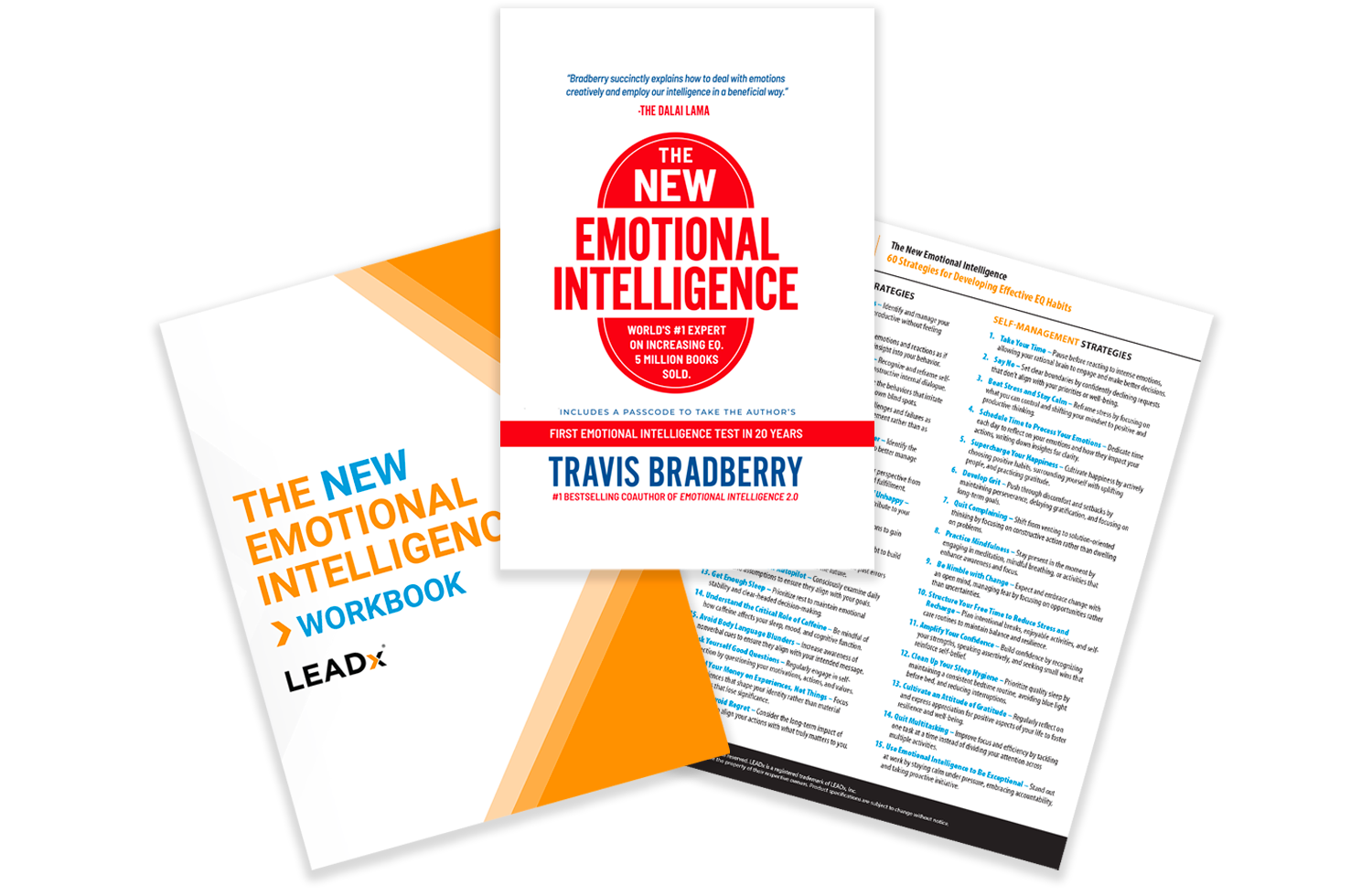
- Dr. Bradberry’s The New Emotional Intelligence book
- Access to message directly with a human, ICF-certified EQ coach for one year.
- Microlearning videos, exercises, and book summaries.
- A full New EQ™ workshop participant kit so you can deliver a 6-hour EQ workshop directly related to the 360 assessment (includes workbook, job aid, and copy of Travis’s book).
The LEADx EQ 360 is scientifically validated, built for behavior change, and designed to scale, whether you’re coaching one leader or launching a company-wide initiative.
Get certified for just $3,495, which includes everything: facilitator training, platform access, participant kits, and a full year of coaching support.