
The Emotional Intelligence Appraisal Test by Travis Bradberry: What It Is, How It Compares, and How to Use It
In an era where AI can summarize reports, analyze data, and even draft your emails, what you know matters less than how you lead. The differentiator is no longer pure knowledge—it’s emotional intelligence (EQ): the capacity to recognize emotions, manage them effectively, and build relationships that move work forward. Decades of leadership research shows that a leader’s mood and emotional intelligence shape team climate and performance. It’s no wonder then that the Harvard Business Review has referred to EQ as the sin quo non of effective leadership.
For all of the above reasons and more, interest in implementing emotional intelligence assessments within organizations has surged. Leaders want practical, fast insight they can turn into better decisions and better teams.
A Quick Lineage of EQ (and Where Bradberry Fits)
Scholars Peter Salovey and John Mayer first defined emotional intelligence in the 1990s; Daniel Goleman then popularized the concept globally, elevating EQ from academic idea to mainstream must-have for leaders. If Goleman is the popularizer, think of Dr. Travis Bradberry as the EQ practitioner who brought EQ into the workplace at scale. Through his bestselling book and his emotional intelligence assessments, he has helped millions translate EQ from theory into daily behavior. Core to his success has been his certified EQ trainer program.
What Is the Emotional Intelligence Appraisal?
The Emotional Intelligence Test™ is a fast, workplace-focused self-assessment built on four core EQ skills:
- Self-Awareness
- Self-Management
- Social Awareness
- Relationship Management
You’ll also see these grouped as Personal Competence (self-awareness + self-management) and Social Competence (social awareness + relationship management).
How it works. The test uses behavior-based items (“How often do you…?”) tied to observable EQ habits—for example, seeking feedback, recognizing your role in conflict, or explaining your decisions. Because it measures the frequency of on-the-job behaviors, it gives a practical snapshot of how EQ shows up day to day.
What you get. Your report includes an overall EQ score, scores for each of the four skills, and targeted recommendations. If you score lower on self-management around, say, not letting anger take over, your report surfaces emotion regulation strategies (e.g., paced breathing, labeling emotions, pre-commitment plans for tough conversations).
Newer Alternative: The Emotional Intelligence Test™ (Bradberry & LEADx)
You’ll see two tests associated with Bradberry:
- Emotional Intelligence Appraisal (his old, un-updated assessment from ~20 years ago)
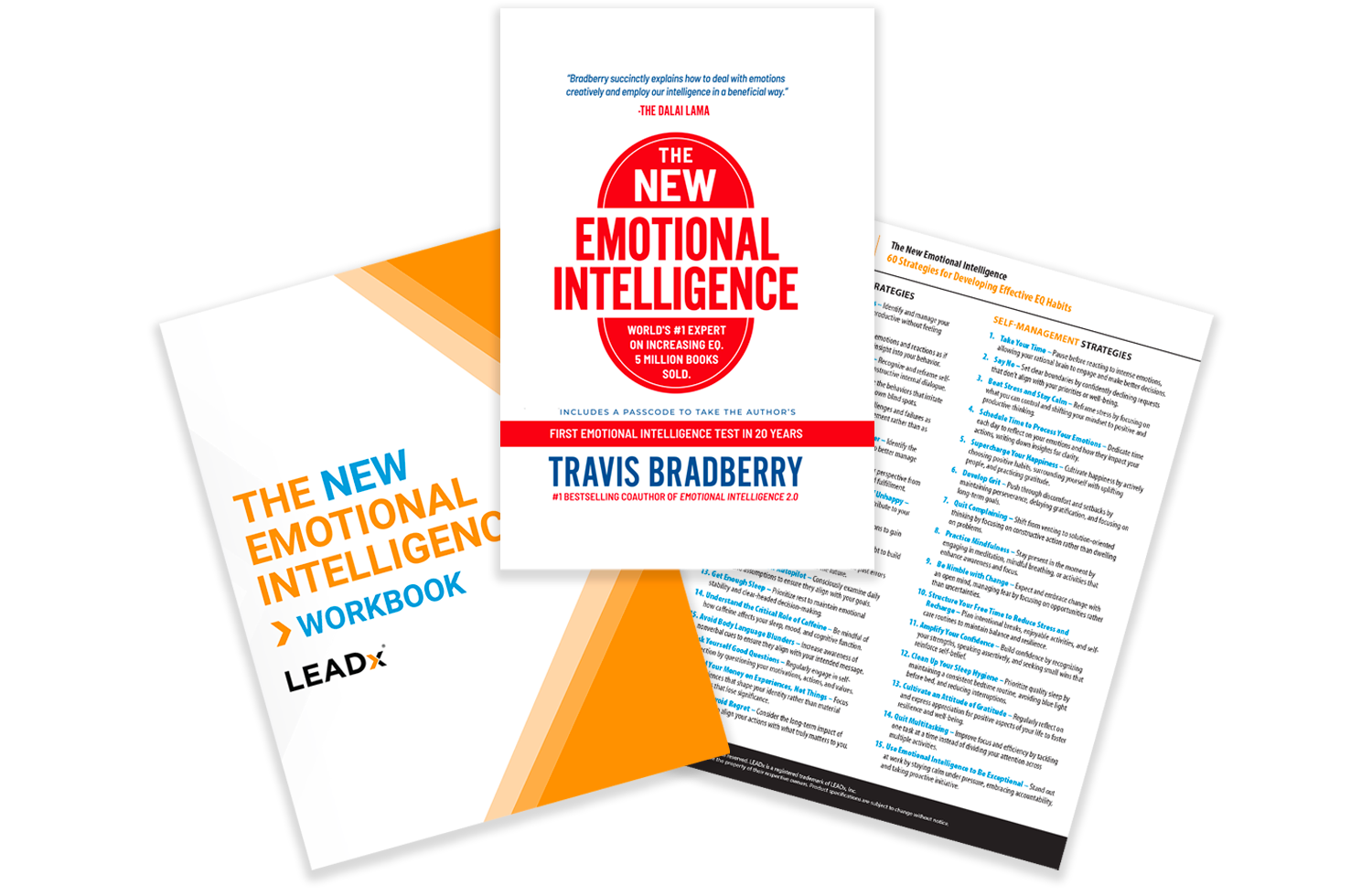
- Emotional Intelligence Test™ (new; developed alongside The New Emotional Intelligence, available via LEADx)
The newer test incorporates two decades of feedback on over 2 million assessments to:
- improve accuracy (harder to “game” thanks to mid-weighted items)
- expand clarity (more items for finer granularity)
- provide highly personalized practice steps.
- cater to modern work (hybrid teams, rapid change)
- reinforce assessment insights with actionable learning to establish good habits (12 months of reinforcement including daily access to a human EQ coach, micro-learning, and unlimited re-tests.
Bottom line: If you want a deeper, harder-to-fake read plus ongoing practice support, the Emotional Intelligence Test™ is designed for that next level.
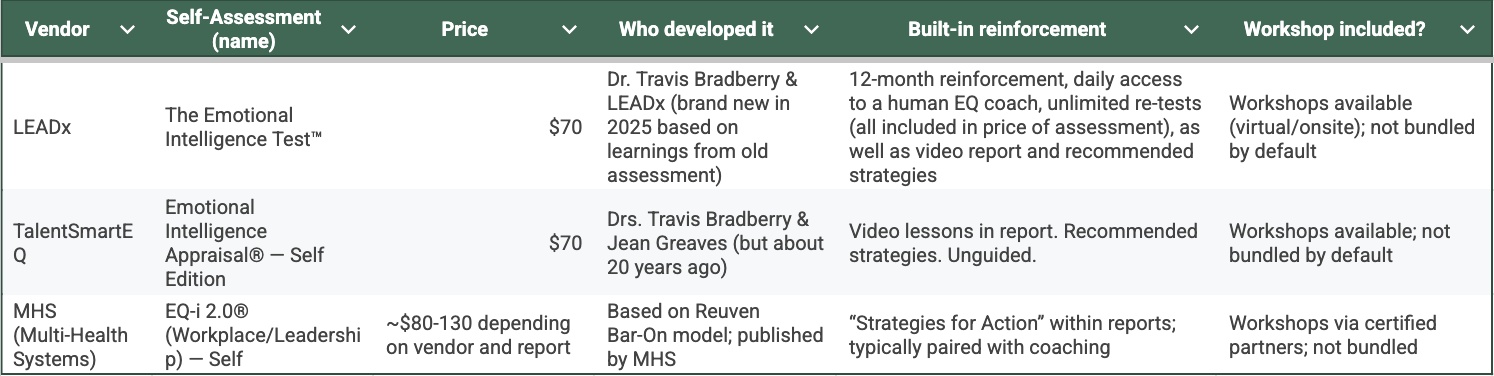
Comparison With Other Self-Assessments (At a Glance)
Below are commonly used EQ self-assessments, organized for HR/L&D buyers. (Pricing and packaging vary by region/provider; confirm current details with each vendor.)
How to Interpret Your Results (and Turn Scores Into Habits)
Use this simple, coach-tested sequence with any of the assessments above:
- Read the whole report taking in the big picture. Note your overall EQ and the four core skills. Don’t chase a single number—look for patterns across Personal vs. Social Competence.
- Name one strength, one limiter. Choose the skill you’ll leverage and the skill you’ll improve first (e.g., leverage Social Awareness, improve Self-Management).
- Pick 1–2 micro-behaviors. Tie each to a specific trigger at work. Examples:
- Self-awareness → Label before you act (“I’m feeling defensive; give me a minute”).
- Self-management → 90-second reset (paced breathing + reframe) before tough calls.
- Social awareness → Observe, then inquire (one open question before giving advice).
- Relationship management → Explain the ‘why’ behind a decision in 1–2 sentences.
- Pre-commit. Add “if-then” plans: If I feel rushed in a 1:1, then I’ll pause and summarize before deciding.
- Reinforce and retest. Use coaching and microlearning for 3-6 months, then re-test to track progress and refresh your plan.
Case Study Examples (Realistic Rollouts You Can Copy)
1) Regional Healthcare System — Onboarding With EQ
Use case: Every new hire completes an EQ self-assessment during orientation to build a shared starting point—data + a short list of strategies—for better bedside manner, calmer handoffs, and smoother inter-staff dynamics.
Rollout:
- Assessment in week one
- 60-minute cohort debrief led by an internal educator
- 90 days of weekly nudges (emotion labeling, reset routines, feedback scripts)
Impact: New hires use a common vocabulary in high-stress moments (“I’m labeling before I round,” “I’m pausing to self-manage before I page the attending”). Leaders report fewer interpersonal escalations.
L&D perspective: “Healthcare is high stakes. We needed something fast and practical. The EQ snapshot plus a few repeatable strategies helped our new hires show up calmer and more present—patients feel that.” — Director of Clinical Education at a major hospital in Southern California.
2) Global Finance Firm — A Shared Language at Scale
Use case: Offer an EQ self-assessment and year-long reinforcement to every employee to create a universal language for emotions at work.
Rollout:
- Company-wide 20-minute kickoff (“EQ in Our Culture”)
- Manager facilitation guide for 30-minute team conversations
- Quarterly refresh topics aligned to the four skills
Impact: Meetings get explicit (“I’m regulating—give me a minute to respond vs. react”). Teams normalize quick resets before high-stakes calls.
L&D perspective: “We didn’t want EQ to be a one-and-done. The shared language changed our meetings—people name what they’re feeling and choose their response. That alone has reduced friction.” — VP, Leadership & Talent at HQ in New York City
3) Pharma Sales Organization — Stronger Leader–Rep Relationships
Use case: Integrate the EQ self-assessment into manager training to boost engagement and retention by improving leader–rep conversations.
Rollout:
- Managers complete the self-assessment + guided debrief
- Each manager selects two micro-skills (e.g., “explain the why,” “inquire before advising”) to practice in 1:1s
- Biweekly peer huddles to share field wins and troubleshoot
Impact: Reps report clearer expectations, more empathy in coaching, and less defensiveness during pipeline reviews.
L&D perspective: “We focused on two micro-skills per manager for eight weeks. Reps felt the difference fast—conversations were less transactional and more supportive, which showed up in pipeline discipline.” — Senior Sales Enablement Manager at Pharma company in New Jersey
Conclusion & Next Steps
Curious which EQ assessment fits your team? Set up a strategy call to learn more.