
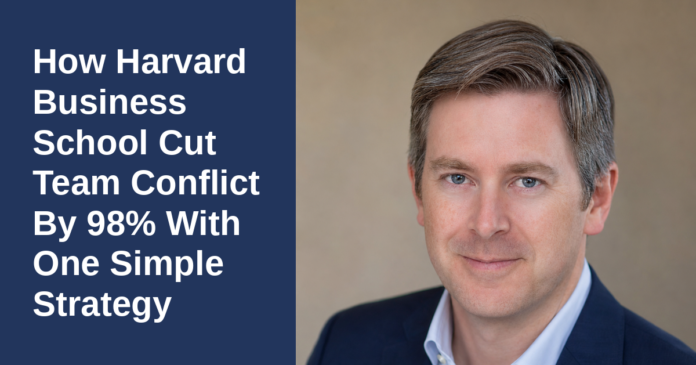
In 2024, 45 of the 158 student teams in Harvard Business School’s FIELD Global Immersion program had communication breakdowns so bad that faculty had to intervene. After going through training prior to the same event in 2025, that number dropped to just one team.
It was the same program, the same 10-day sprint challenge, and the same Harvard caliber of student. What changed is how the students learned to read one another and interact.
The interpersonal training was designed by Rob Toomey, cofounder and president of TypeCoach, who published the results in Harvard Business Review with HBS professors Leonard Schlesinger and Joseph Fuller. To learn what made the training program so effective, I had the opportunity to sit down with Toomey for an interview.

“These were not people who lacked intelligence, ambition, or experience,” Toomey explained. “They were highly capable people who lacked a sufficiently developed shared method for navigating differences in how they processed information, communicated, and reached decisions. This was particularly true under pressure.”
A Stress Test To Replicate The Pressures Of Modern Work
FIELD sends roughly 1,000 first-year MBAs out in teams of six to 16 countries, where they have about 10 days to research a real business problem for a real client and deliver recommendations. Common challenges they face include having no hierarchy, working with incomplete data, facing an unfamiliar market in another country, and an immovable deadline.
“It is an unusually effective simulation of modern work,” Toomey said. “Smart people with different backgrounds and working styles trying to solve an ambiguous problem under significant time pressure.”
The teams that came apart did so in all-too-familiar ways. Trust eroded between team members, people stopped sharing information fluidly across the team, factions formed, people disengaged, and the team as a whole lost their ability to make and execute decisions.
The Solution: Understand Someone’s Style In Order To Understand Their Intent
Toomey’s central claim is that we have misdiagnosed team conflict for a very long time. “Most consequential team conflict does not begin with genuine ill intent,” he told me. “It begins when someone behaves differently from the way we would behave in the same situation, and we assign a motive to that difference.”
The HBR article he coauthored opens on the second night of a consulting project in Hanoi. One student is pushing for closure, assigning tasks and locking in timelines, while another, who had spoken infrequently throughout the project, then introduced a strategic angle that reopened new decisions. The conversation began to disintegrate.
The teaching case built from that pattern gives the two students names. Hannah is energetic, vocal, and eager to reach closure. Willem is reflective and reluctant to commit before he has enough information. Hannah thought the decision was made. Willem was still processing. When Willem finally raised a serious concern, the timing felt deliberate to Hannah and the other team members. Why didn’t you say this earlier? Why are you undermining the team now?
“Both people were behaving responsibly according to their own cognitive preferences,” Toomey explained, “but each interpreted the other’s behavior as evidence of a character problem. Hannah saw sabotage or passivity, and Willem saw recklessness or domination. Once a stylistic difference becomes an intentional crime in someone’s mind, the conflict can become heated very quickly.”
Toomey’s point here is that teams fail because they misread one another’s intent.
Self-Awareness Is Only Half The Battle
“The pattern we see is remarkably consistent: self-awareness is useful, but insufficient,” Toomey said. “For example, knowing more about Rob does not help very much unless Rob can recognize what Sarah needs from him and adapt accordingly.”
For this reason, Toomey and his team at TypeCoach train four capabilities: recognize yourself, recognize others, anticipate friction, and adapt in real time. “This training is about recognizing a difference in real time, interpreting it accurately, and changing your approach before the interaction deteriorates,” he said.
One HBS Strategy Your Team Can Implement Now: The Team Playbook
The most actionable idea Toomey recommends is for teams to replace their team charter with a playbook. “Most team charters describe good intentions,” Toomey said. “A playbook describes observable behavior.”
Nearly every team will agree that it wants to live by attributes like trust, candor, and accountability. The trouble is that one teammate may view candor as a public and immediate objection, while another views candor as taking the time you need to reflect and raising your objections privately one-on-one (think back to Hannah and Willem as an example). Both are certain they’re behaving well, and both are also frustrated by the other’s approach.
A playbook names a specific behavior instead. For example:
- “Silence does not equal agreement or signal disengagement. Before closing an important decision, we will explicitly ask whether anyone needs additional time to process.”
- “If someone challenges the logic of an idea, we will not assume they are challenging the competence or intentions of the person who proposed it.”
- “We recognize that some people want closure earlier than others and agree to find the healthy middle ground.”
The point is to decide all of this proactively, “before stress makes generosity and clear thinking more difficult,” as Toomey put it.
Why ‘Type’ Training Will Grow In Importance As The AI Era Advances
As AI absorbs more and more technical and repeatable work, this ability for team members to understand each other and collaborate more effectively will be more important, not less. Faster output means more decisions, more coordination, and more interaction among people who process information differently.
“Interpersonal competence should no longer be treated as an innate gift or a ‘soft skill,'” Toomey said. “It’s a practical performance capability, and it can be taught.”
It might also become the defining leadership capability of the AI era – the one that increasingly separates exceptional performers from everyone else.