
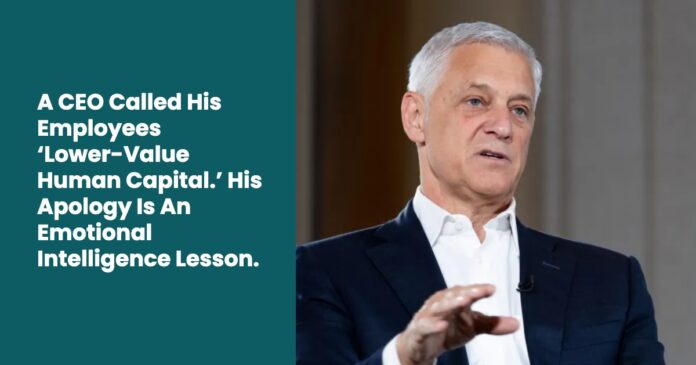
Standard Chartered CEO Bill Winters was defending his bank’s AI overhaul when he reached for a phrase he would come to regret.
The change, he insisted, wasn’t about cutting costs. “It’s not cost cutting,” Winters said. “It’s replacing, in some cases, lower value, human capital, with the financial capital and the investment capital that we’re putting in.”
 The reaction was brutal. Describing laid-off employees as “lower value human capital” — in public, on the record — landed exactly as badly as it reads.
Then Winters did something most executives won’t. He went on LinkedIn, posted the full verbatim transcript of his remarks, and addressed the blowback directly. His choice of words, he acknowledged, “has caused upset to some colleagues. For that I am sorry.”
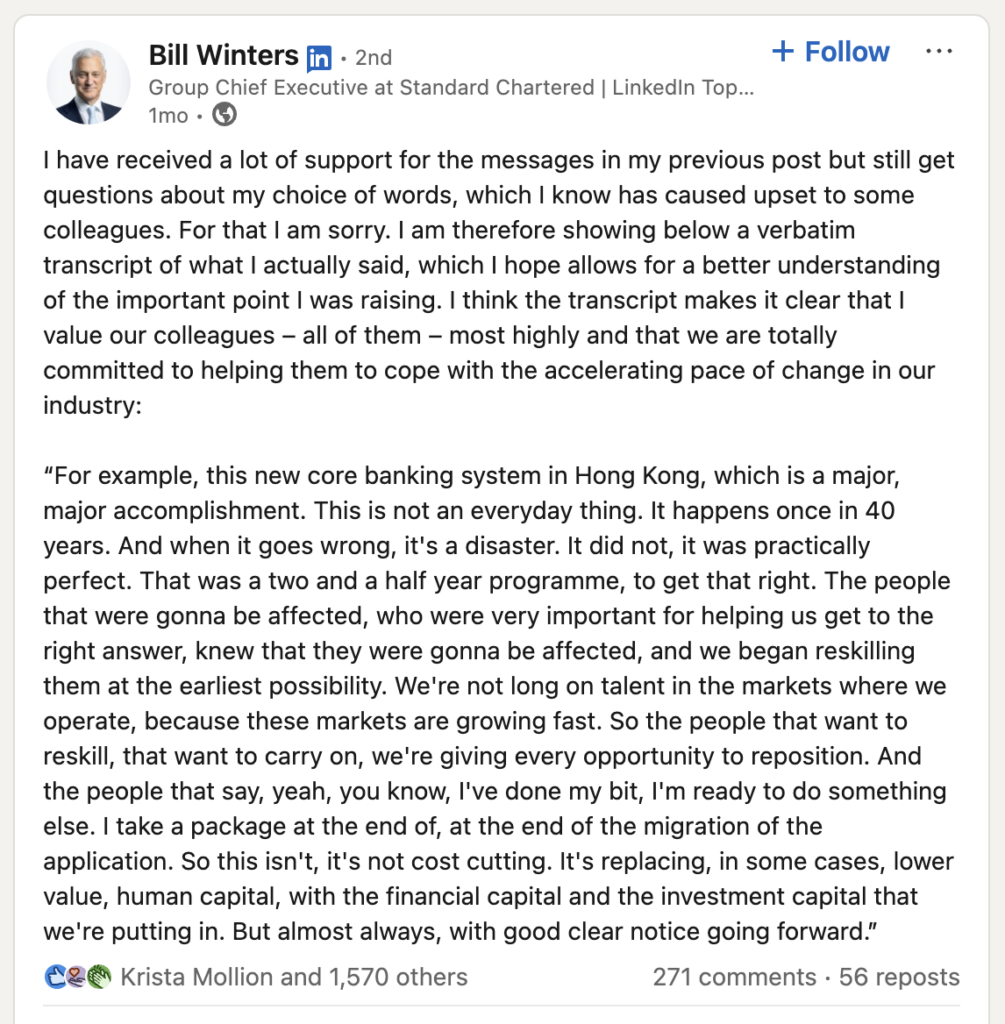
In the AI Era, CEOs are obsessed with moving fast, cutting costs, and impressing investors with agile efficiency, but they forget that their employees are judging them on whether their actions and their language preserve dignity, agency, and trust in the process. Winters’ attempted recovery holds an emotional intelligence lesson, and it might not be the one you’d expect.
Apologizing Is The Right Move, But His Apology Was Emotionally Tone Deaf
Winters told his people, in plain language, that some of them were let go because they were “lower value.” You can imagine how that would make his employees feel. They’d feel afraid (Am I lower-value too?”), uncertain (“Am I safe, or am I next?), and angry (“How dare he call my colleagues and friends “lower value” and “human capital”). Winters was so locked onto the strategic logic that he lost sight of how the words would land on his own people.
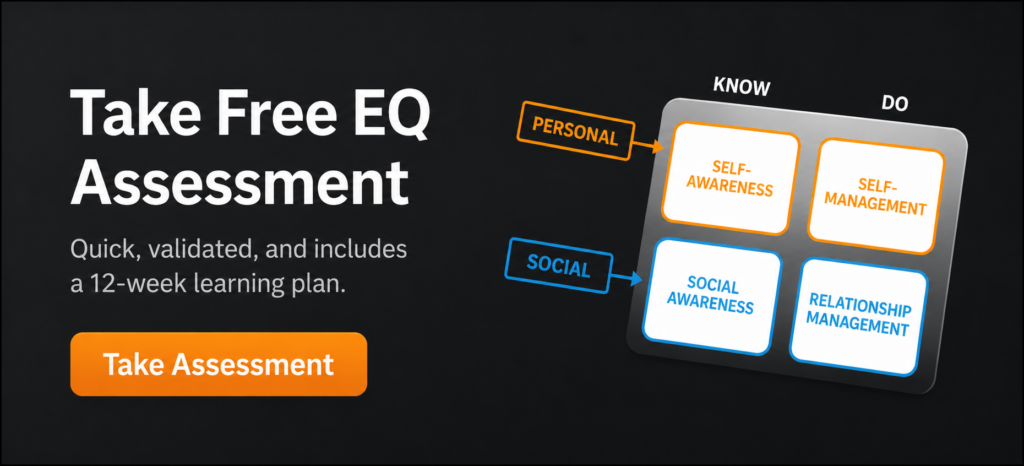
That gap between strategy and human resonance is really a matter of emotional intelligence (EI). EI is your ability to recognize and manage emotions — your own and other people’s. It splits into four skills across two competencies: self-awareness and self-management (how you handle yourself), and social awareness and relationship management (how you handle others).
Winters’ miss was a failure of the most advanced skill of the four: relationship management. Relationship management is about using awareness of your emotions and everyone else’s to act in the relationship’s best interest. EI expert Dr. Travis Bradberry would likely call Winters’ failed apology a classic example of “winning the battle to lose the war,” where he got so fixated on being right (just look at his LinkedIn post) that he damaged his relationship in the process. Though, in this case, the stakes are heightened, and “the relationship” is with all of his employees.
The EI Takeaway: Don’t Just Announce Your Decision, Explain It
The takeaway here is that if you explain your reasoning up front and in an empathetic manner, people will understand it (even if they disagree) and it will resonate better. Winters did explain, in detail, but he did so after the fact, and he refused to empathize or back down on anything he’d said previously. He even republished his offending line.
When he says, “here’s my context,” it reads as justification rather than accountability. And when he spells out why someone is “lower value,” he deepens all the negative emotions his first point stirred up instead of alleviating them.
The lesson here isn’t “explain your decision, and you’re forgiven.” Explanation needs to be paired with a genuine acknowledgment of how you’re making people feel. Winters apologized on a surface level—“for that I am sorry” — but then he doubled down on his initial point, linking to a full transcript as though that alone excused his tone deaf language. Context that lacks acknowledgment comes across as defensive, and acknowledgment that lacks context comes across superficial. A strong explanation of a decision entails both acknowledging how you made the other person feel and why you did so.
Picture a manager killing a project a team poured months into. The low-EI version: “We’re cutting this.” The high-EI version: “I know how much you put into this, and I know it stings. Here’s the thinking…”
The research backs that second example as more effective. In their classic Harvard Business Review article “Fair Process,” W. Chan Kim and Renée Mauborgne found that people will accept outcomes they dislike — even ones that cost them — when the process feels fair and the reasoning is clear. Decades of procedural-justice research from psychologist Tom Tyler point the same way: how a decision gets made shapes trust as much as the decision itself.
Putting This Idea Into Practice
Next time you find yourself making a decision, whether that’s at home or on behalf of an entire company, ask yourself: are you explaining your hard decision, or just announcing it? People can live with what they understand. What they can’t live with is being left in the dark.