
More than 90% of Principal Financial Group’s roughly 19,000 employees have been upskilled in AI fluency. For most organizations, a number like that would be the finish line. For its Senior Vice President and Chief Human Resources Officer (CHRO), Lisa Coulson, it’s just half of the equation.
“On the one hand, we’ve upskilled more than 90% of our employees in AI fluency and data literacy so they can confidently use these tools in their day-to-day work,” said Coulson. “On the other hand, we’re continuing to build human skills like empathy, communication, and trust-building so that as AI frees up time for more meaningful conversations with customers and colleagues, our people are equipped to engage with greater self-awareness and impact.”
Coulson’s view is that organizations will stand out by combining strong technology acumen with strong human skills, including communication, collaboration, self-awareness, adaptability, curiosity, and critical thinking.
Principal is a Fortune 500 financial services company that has been in business for more than 147 years, serving about 82 million customers in more than 80 markets through retirement plans, investments, and employee benefits. Coulson leads global HR strategy across that footprint.

Principal Treats AI As An Enabler And An Augmenter
“We’re approaching AI as an enabler of our people, not a replacement,” Coulson said. “That mindset is shaping how we think about talent today and going forward.”
In practice, that means embedding AI directly into workflows as part of how work gets done, helping employees move faster and focus on higher-value, judgment-driven work.As Coulson put it, “AI can surface insights and improve efficiency, but people are still accountable for decisions and outcomes.”
She is unusually specific about what that accountability will demand next. “Looking ahead one to three years, that balance becomes even more important. As AI becomes more embedded, and as more advanced capabilities begin to take on larger parts of workflows, the nature of work will continue to evolve. Roles will shift, new roles will emerge, and the expectation will be that employees are not just using AI, but working alongside it, guiding it, supervising it, and ensuring quality, trust, and compliance.”
Insights Without Judgment Don’t Create Value
When asked whether AI and emotional intelligence are at odds, Coulson rejects the premise. “I think AI and EI have to be synchronous if we’re going to truly serve customers the way they expect to be served,” she said. “AI is incredibly powerful when it comes to speed, scale, and surfacing insights, but those insights only create incremental value if they’re applied with human judgment, empathy, and context.”
Across dozens of interviews with CHROs and talent development leaders, this same idea keeps surfacing. I like to refer to it as an “equation,” which says that AI + EI = ROI.
Remove EI from the equation, and you get ideas without discernment, speed without judgment, and work without humanity. Remove AI from the equation, and it becomes nearly impossible to keep up with your competitors on efficiency, production, and innovation.
“That’s why we’re also investing in the skills that enable good judgment: adaptability, curiosity, communication, and leadership so employees can apply insights in ways that are thoughtful, responsible, and grounded in trust,” Coulson explained.
EI Training Reaches Every Level, Not Just The Top
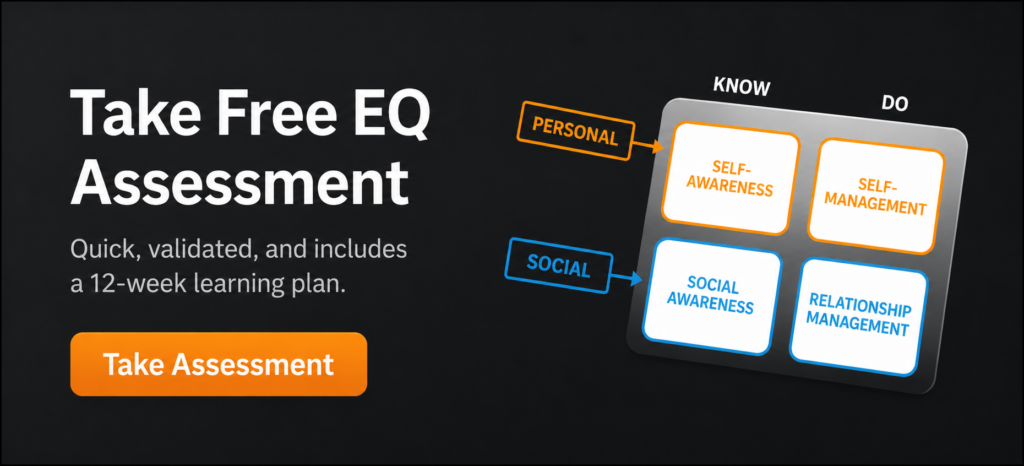
At many companies, relationship skills training is a perk reserved for high-potential executives. Principal builds it in enterprise-wide. “We focus on skills like communication, collaboration, and self-awareness through leadership programs, coaching, assessments, and team-based learning so people can keep growing over time,” Coulson said. “As we continue building AI literacy, we’re putting emphasis on change management and a growth mindset.”
For individual contributors and managers, those types of capabilities are integrated right into their core development experiences rather than offered as a separate track. Senior leaders go deeper through executive development, personalized coaching, and leadership programs that are designed, in Coulson’s words, “to ensure our senior leaders are equipped to navigate complexity, influence effectively, and lead with both clarity and empathy.”
The Pattern Coulson Noticed Long Before AI
Coulson’s conviction on enduring human skills predates the current moment by decades. It started as a pattern she couldn’t stop seeing. “I became interested in EQ in my career because I kept seeing the same thing play out. The toughest workplace challenges were rarely about technical skills. Talented people and strong teams struggled not because they lacked expertise, but because of communication breakdowns, limited self-awareness, difficulty navigating change, or a lack of trust.”
And accordingly, the highest performers were often those who had not only strong technical skills but also strong social and emotional skills. “At the organizations that consistently brought out the best in their people, the differentiator lay in human skills like empathy, adaptability, collaboration, and the ability to lead through change,” Coulson explained.
What Leaders Can Take From Principal’s Approach
Coulson’s experience points to a practical takeaway: the organizations that pull ahead are not the ones with the best technology or even the best talent. They’re the ones that know how to bring out the best in the people they already have, and EI training is a powerful lever an organization can pull to bring out the potential in their talent.
“Technical skills may open the door,” Coulson said, “but emotional intelligence is what enables people to navigate complexity, build trust, and shape cultures where employees and businesses thrive.”