
A man in his 30s named David sat in a chair all day doing nothing for days on end. He had been a productive finance professional with a wide social circle, but he’d suddenly stopped caring. He lost his job and his apartment, and he didn’t seem to mind. So, his neurologist began asking him questions.
“What would you normally do at home?” David’s neurologist asked him.
“Listen to music,” David said.
“So why did you stop?” his neurologist asked.
“Because setting up my stereo would take too much effort.”
“How long would that take?”
“Five minutes.”
David’s neurologist was Dr. Masud Husain, Professor of Neurology and Cognitive Neuroscience at Oxford, who told the story on the Huberman Lab podcast. David’s explanation that it was “too much effort to set up his stereo” fascinated Husain and inspired him to research procrastination further, to try to understand it better. Here’s what he learned.
Beware: Your Brain Puts A Price Tag On Each Task Before You Even Touch It
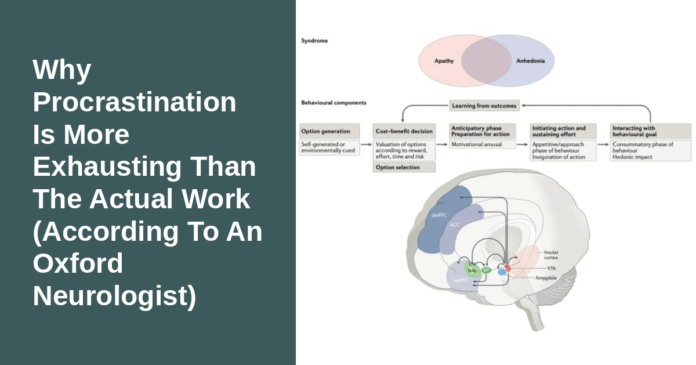
Husain describes motivation as a form of neuroeconomics. On any given day, you have twenty things you could do and no capacity for all of them, so the brain weighs each option’s reward against the effort it demands across a physical, cognitive, social, and emotional level.
Across Husain’s lab’s work with patients and healthy volunteers, one finding keeps surfacing. Everyone will work hard for a big reward, but people differ greatly on the lower end of reward potential, where less motivated people decide, as Husain puts it, “I don’t think this is worth the effort.”
Husain refers to this barrier as an activation hill. For one person, learning a language is a mountain. For another, it’s hardly noticeable. The difference lies in perception.
When Husain’s Lab Put Procrastinators into MRI Machines, They Found The Opposite Of What They Expected
Husain’s team recruited students across the motivation range, put them in an MRI, and asked them to decide whether a reward was worth a given amount of effort. Yes or no.
Husain’s team expected to find that the less motivated students would show less activity in the brain’s reward circuitry. They actually found more activity.
“Apathetic people use more brain energy when they’re making this decision,” Husain explains. The barrier is physiological, and measurable. Andrew Huberman, his interviewer and renowned neuroscientist from Stanford, described this effect, saying there’s “a cost to thinking about the effort required, plus the cost of the actual effort.” The two compound.
Anyone who has spent a Sunday not writing that wedding speech knows that deliberation costs more than the actual work. Each time you choose not to work on your speech, you create negative feelings like dread, guilt, or a small dent in your confidence.
Husain also notes that the brain learns from outcomes and feeds them into the next calculation. Meaning, the emotional residue of avoiding a task quietly raises its price tomorrow. Deliberation charges interest, and it compounds. The longer you carry a decision, the more it costs to make that decision.
Why This Is A Matter Of Emotional Intelligence
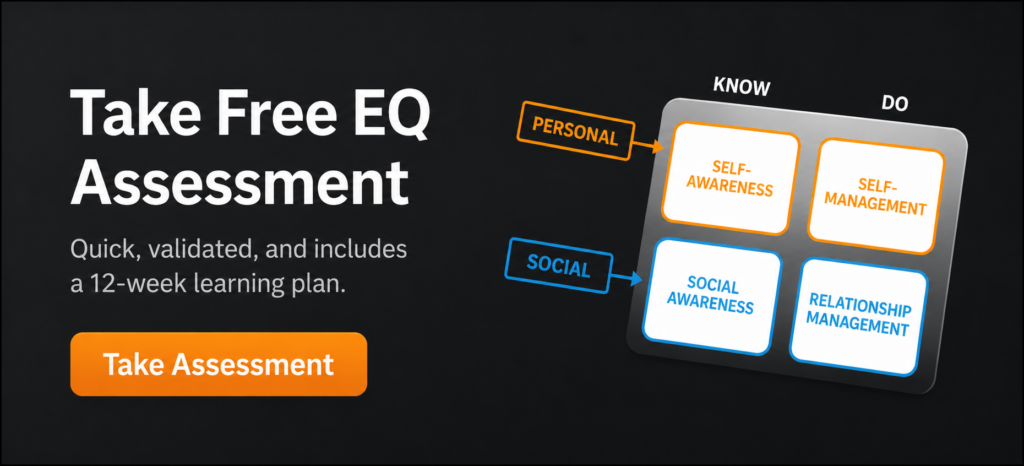
Emotional intelligence (EI) is your ability to recognize and understand emotions in yourself and others, and to use that awareness to manage your behavior and relationships. It divides into four core skills: self-awareness, self-management, social awareness, and relationship management. To get a baseline understanding of your own EI, psychologists recommend that you take a self-assessment.
Self-management is usually described as keeping composure when provoked, but it entails much more than that. Self-management is ultimately about your ability to regulate your emotions. So when you consider procrastination and all the negative emotions you stir up by not pushing off getting started, this is really a matter of self-management. You’re letting those negative emotions win the battle and multiply in strength. When, on the other hand, you make your small decisions more quickly, you stave off the added cost of waiting. This way, you have more energy for the things that really matter.
Husain’s research points to something business leaders often overlook. Ask any business leader if they would pay good money to increase “hard” skills like focus and decision-making, and they will all answer with an emphatic yes, but ask them about skills like emotional intelligence, and many falter. We naturally separate the “emotional” from the “productive,” but research such as Husain’s shows us how misguided this really is. Procrastination is an emotional intelligence problem long before it becomes a productivity one.
A Simple EI Strategy To Fight Off Procrastination Fatigue: The Pre-Decided Day
The standard advice is to break a big project into smaller steps, but Huberman flagged an important catch in that idea. When you bring the small wins into view, you also bring the small losses and challenges you’ll face.
For this reason, Husain points to a better lever further upstream. If every on-the-fly decision costs fuel, batch your decisions. This way the loop doesn’t keep running perpetually.
Try this:
- Block a fixed window each week to decide, not to work. Thirty minutes.
- Write next week’s decisions as commitments rather than intentions. What, when, how long.
- Place low-reward tasks first, since we know that’s where motivation is most likely to falter.
- When the time comes, treat the decision as made. Don’t reopen it.
- At week’s end, note which commitments you renegotiated. Since renegotiation costs you energy, it’s worth looking at the decisions you made poorly the first time around so you can improve in similar future decisions.
Remember David, who was paralyzed by the energy required to set up his stereo, a task which took only five minutes. Most of what you’re avoiding is smaller than you realize. Decide once, do it in batches, and you stop paying interest.