
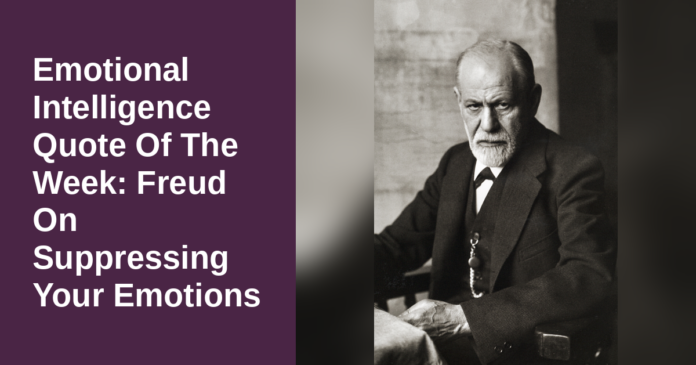
“Unexpressed emotions will never die. They are buried alive and will come forth later in uglier ways.” —Sigmund Freud
Even though this is one of Sigmund Freud’s most popular quotes, he never actually wrote it. The quote is a paraphrase of one of the most important concepts in his work (repression) that circulated long enough to be regularly attributed to him.
What Freud actually wrote is perhaps even deeper. In a short 1915 paper on repression, drafted in wartime Vienna as he tried to formalize two decades of clinical observation, he described what becomes of a feeling pushed out of your awareness and repressed:
“[Your suppressed emotion] proliferates in the dark… and takes on extreme forms of expression.”
In other words, any emotion cut off from conscious influence develops more freely, not less. Repression, Freud insists, is not an act that you complete in one attempt. It demands continuous force. Through energy and effort, you are holding a door shut, and you pay a price for this exertion every second, often without realizing it.
Why This Is A Matter of Emotional Intelligence
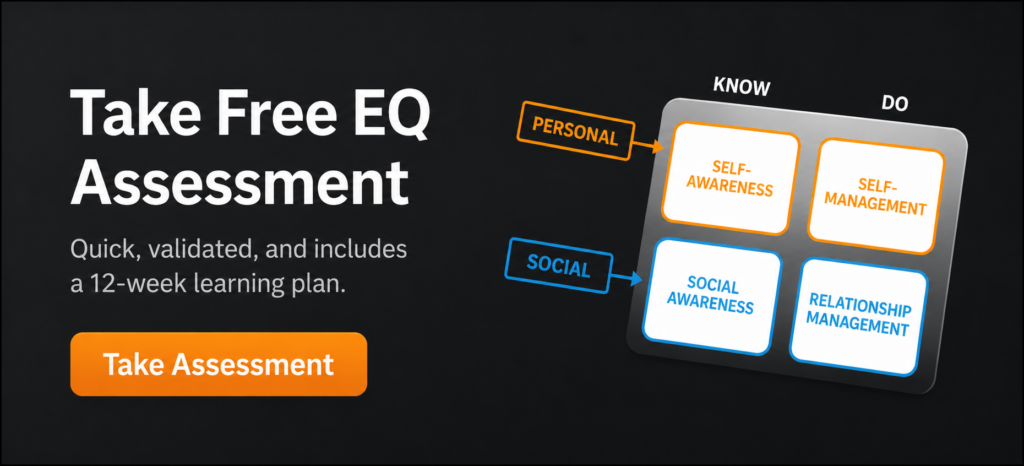
Emotional intelligence (EI) is your ability to recognize, understand, and manage your own emotions and the emotions of others in order to be more effective in your relationships, goals, and work. EI is made up of four core skills:
- Self-Awareness: Your ability to recognize and understand your emotions
- Self-Management: Your ability to regulate your emotions
- Social Awareness: Your ability to recognize and understand the emotions of others
- Relationship Management: Your ability to use the three prior skills in conjunction to build, maintain, and foster relationships
When Freud talks about the dangers of suppressing your emotions, he’s talking about that first core skill, self-awareness. Self-awareness is your ability to identify your emotions, and it relies heavily on your ability to recognize strong emotions and label them with precision, often in real time as they come up.
In Freud’s example, you may even need to recognize that your emotion is affecting you before you’ve properly identified what exactly that emotion is. When it comes to repression, we often don’t know exactly what we’re feeling. Instead, we just feel that something is off. It could manifest as bad sleep, aches and pains, getting sick, or something else. Often, to find those repressed emotions, you have to tune into your body.
To gauge your own emotional intelligence, EI experts like Dr. Travis Bradberry recommend that you take a psychologically validated EI self-assessment.
The Research: Your Body Keeps The Score, So Pay Attention To Your Body
When you suppress an emotion, as Freud says, the exertion of suppression will have some unknown cost. Often, you feel it in your body, hence the saying, “Your body keeps the score.” When researchers James Gross and Robert Levenson asked participants to conceal their reactions to emotional films, the concealment worked—visible expression dropped—but the body did the opposite of relax. Suppression actually increased participants’ sympathetic activation of their cardiovascular systems as compared to participants who weren’t asked to suppress their reaction.
In another study, Jürgen Füstös and colleagues found that people with sharper interoceptive awareness (the ability to read your own bodily signals) downregulated difficult emotions more effectively. And the payoff arrives fast. In UCLA psychologist Matthew Lieberman’s work, simply putting a feeling into words measurably reduced amygdala response on an fMRI.
So while the intensity of repressed emotions can be massive, the solution is deceptively simple. Tune into your body to understand what you’re feeling, and label that emotion with precision.
The EI Strategy You Can Apply Right Now: Tune Into Your Body And Hone Your Interoceptive Awareness
Twice a day, at times you choose in advance, stop and scan your body. Thirty seconds, top to bottom: jaw, throat, chest, shoulders, stomach, hands. You aren’t hunting for emotions. You’re hunting for signals of bodily effort. Are you clenching your jaw, breathing more shallowly than usual, or feeling tight anywhere unusual?
When you find something, just ask yourself one simple question: What would I feel right now if I let this go?
Name whatever surfaces in one sentence, out loud or on paper. If it helps, look at an emotion wheel to help you get specific.
Putting This Quote To Action
Try to run a 30-second body scan each day this week. When you find tension with no obvious physical cause, ask what you would have to feel if you let it go. Then name that feeling or idea in a sentence or two. Once it’s named, the research shows you’ve already won the majority of the fight.