
Imagine that after years of putting your head down and working for a promotion, someone brand-new to your team gets it instead. Most advice will tell that rather than be envious, you should be happy for the other person. But, new research suggests that’s the wrong way to think about it. Envy, it turns out, is inevitable, but how you respond to that envy can turn everything in your favor.
The research comes from Professor Christophe Haag out of emlyon business school in Lyon, France. His recent study shows that emotionally intelligent people feel just as much envy as their less emotionally intelligent counterparts. But, importantly, those high in emotional intelligence (EI) have learned to use envy to their advantage.
What Research On 442 Adults Reveals About How To Use Envy To Your Advantage
Haag studied 442 French-speaking adults, ages 18 to 72. Rather than asking them to rate their own emotional skills, the method most EI research relies on, he tested them in a much more complex way.
First, participants worked through four emotionally demanding scenarios: managing guilt after a colleague burned out, steering their own emotional state during a negotiation, building trust in a high-stakes conversation, and lifting a distressed friend toward hope.
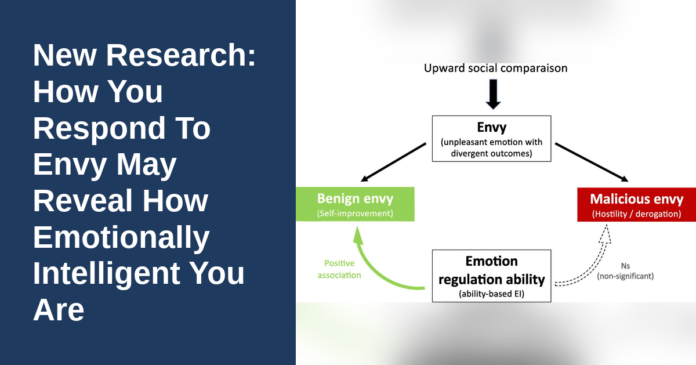
Haag then measured participants on two kinds of envy. One item asks whether you respond to your envy by focusing on becoming equally successful yourself (benign envy). Another asks whether you respond to your envy by wishing successful people would simply lose their advantage (malicious envy). Benign envy pushes you to raise yourself up, and malicious envy pushes you to pull the other person down.
Haag found that a participant’s ability to regulate their emotions predicted benign envy. It did not significantly predict malicious envy. The effect held after controlling for self-esteem, attachment style, age, and gender.
Note that the study didn’t show that your ability to regulate your emotions will cause you to feel less envy. “Emotional intelligence does not appear here as a mechanism that suppresses an unpleasant emotion,” Haag said in a recent interview for PsyPost.
Why This Is A Matter Of Emotional Intelligence
Emotional intelligence is your ability to recognize and understand emotions in yourself and others, and to use that awareness to guide your behavior and build stronger relationships. The term was coined in 1990 by researchers John Mayer and Peter Salovey, and later popularized by psychologist Daniel Goleman.
EI isn’t about being nice, and it isn't about being soft. It's about navigating emotion in a way that gets results, and unlike IQ, which barely changes after your teenage years, EI is a set of skills you can build at any age. To get a sense of your own baseline level of emotional intelligence, psychologists recommend that you take a validated self-assessment.
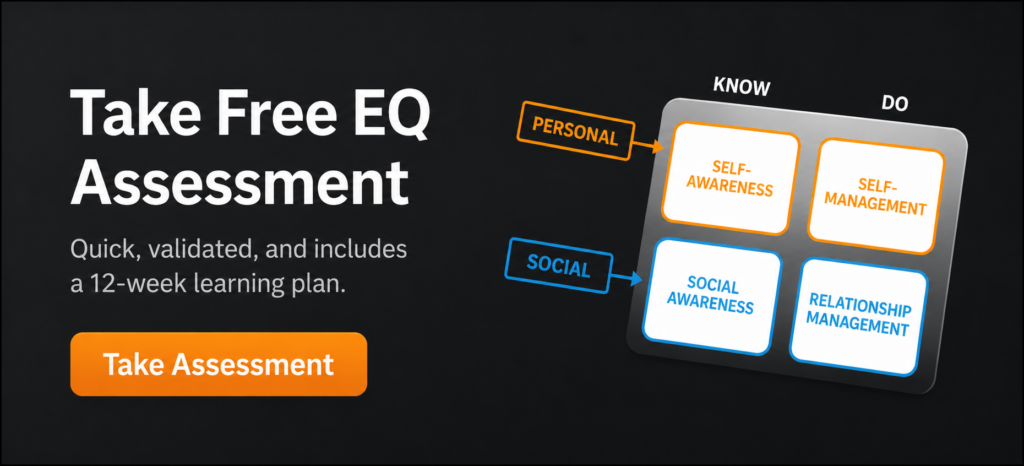
EI breaks into four core skills.
Self-awareness is your ability to identify what you're feeling and why you’re feeling it.
Self-management is your ability to choose what you do with an emotion once it's there.
Social awareness is your ability to read the emotions of the people around you.
Relationship management is your ability to establish trust, handle conflict, and influence without authority.
Haag tested seven distinct emotional abilities. Regulation, the engine of self-management, showed the strongest link to building out a constructive path for your envy.
An EI Strategy To Grow Your EI And Use Your Envy To Your Advantage
Next time you notice yourself feeling envious, follow this four-step strategy.
Name the emotion. Call it envy. Don’t just tell yourself you’re “angry” or “tired.” Get precise about the emotion you’re feeling.
Read the data. Envy is high-fidelity information about something you want and haven't admitted. Name the specific thing that you want and why you want it.
Check your future direction. Ask yourself what this feeling is about to make you do. Are you headed in a constructive direction?
Plan your next move. Plan out one concrete action in the next 48 hours that will help you use your envy to grow.
Putting This Research Into Action
Envy will keep rearing its ugly head. This is of course inevitable. What separates the emotionally intelligent person from the rest isn't that they never experience envy. It's that they treat the feeling of envy as a compass, and then they move in the most productive direction they can. Rather than beat yourself up for feeling envious of someone’s success, ask yourself, “What can I do to use my envy in a positive way?”