
Dr. Ben Rein has built an audience of over a million people by asking one question about the health claims flooding their feeds: Does the data actually confirm that? Is sugar more addictive than cocaine? “Hardly anything is more addictive than cocaine.” Should you take colostrum supplements? There’s hardly any evidence for what’s being sold.
His method is unglamorous. “Someone makes a claim online, and they’re probably referencing some data,” he told Dan Harris on the 10% Happier podcast. “Let’s find the data and let’s see if it’s true.”
So it’s worth listening when Rein—a neuroscientist, lecturer at Stanford, and author of Why Brains Need Friends—names a “hack” that survives his scrutiny and wins his recommendation. One that he emphasizes strongly is the importance of building strong social relationships. Here’s why.
The Obvious Hack You Keep Neglecting: Building Your Relationships
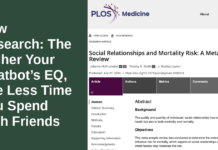
The evidence isn’t subtle. A meta-analysis led by Julianne Holt-Lunstad pooled 148 studies and followed 308,849 people for an average of seven and a half years. Those who had stronger social relationships literally had a 50% greater likelihood of survival.
Rein describes social connection as one of the most powerful things you can have in your life. Positive interaction releases oxytocin, serotonin, and dopamine together, which creates “a really powerful concoction.” He pointed out that if you search for a drug that produces the same feel-good hormones, “one of the only drugs out there you’ll find is MDMA, or ecstasy.”
Plus, the alternative to social connection is worse than merely missing out. Isolation has “its own kind of biological profile,” Rein says, which includes increases in cortisol (the stress hormone) and inflammation.
The 5 Most Likely Reasons You Talk Yourself Out Of Social Interaction
If interaction is that good for you, then why is it so easy to skip? Rein points to what he calls bad social predictions we tend to make that all bend us in the same pessimistic direction.
- We estimate that people like us less than they do. Erica Boothby and colleagues named this the liking gap, and found it among strangers in the lab, first-year students in dorms, and adults in public workshops.
- We underestimate the payoff. “Whatever you expect is an underestimation of the actual positive emotions you will experience,” Rein said.
- We assume we’re worse at socializing than we are, which makes us fear social interactions when we shouldn’t.
- We say we prefer silence to interactions with strangers. In field experiments by Nicholas Epley and Juliana Schroeder, commuters predicted that they’d prefer riding in silence, but regardless of their prediction, those assigned to talk to a stranger reported the most positive commute.
- We expect conversations to get awkward or fail the longer they run. Most conversations actually hold steady.
Stack all five of these misconceptions together, and you arrive at a familiar verdict: It’s easier to just stay home.
Isolation Is An Emotional Intelligence Problem, Not a Willpower Problem
Notice what each of the five errors doesn’t mention. They don’t mention things like “laziness” or “discipline.” Instead, they mention our inability to properly read how we come across to others. We judge ourselves as awkward, we assume other people don’t find us interesting, and we assume that the conversation will inevitably reach a point where neither person really has anything to say. All of these are a matter of reading our interactions with others poorly.
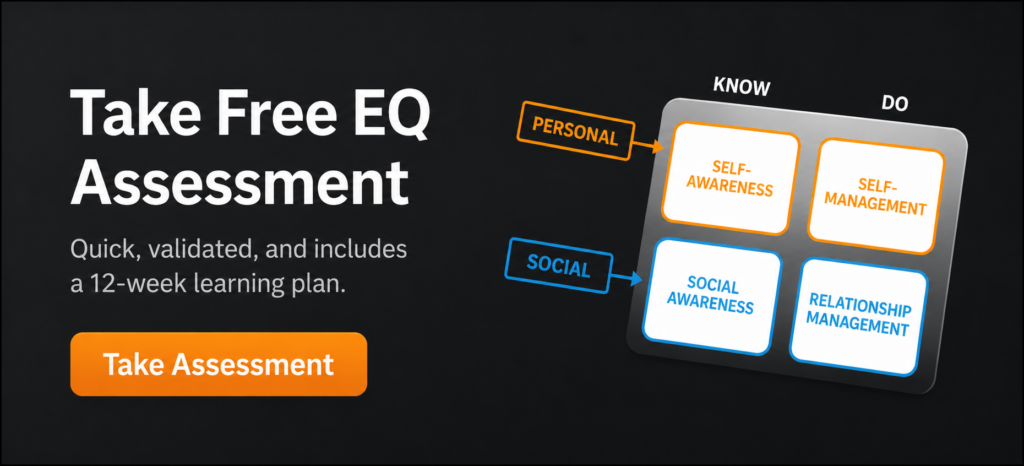
In other words, isolation is a matter of emotional intelligence (EI). EI is your ability to recognize emotions in yourself and others, then use that awareness to guide your behavior. It breaks into four skills: self-awareness, self-management, social awareness, and relationship management. To gauge your own EI, experts recommend that you take an emotional intelligence assessment.
Of the four core EI skills, social awareness and relationship management are the two really getting in our way when we make the aforementioned misjudgments about social interactions. So what can you do to overcome this tendency?
Collect Evidence Against Yourself
You can’t reason your way out of a bias, but you can take a page out of Rein’s book and outvote your bias by showing yourself the data.
Here’s how you can do so.
Before: when you catch yourself declining something social, say why out loud. “I’m too tired, and it won’t bring me any energy,” or “They don’t really want me there.” Naming what you’re feeling and why is a key first step. Remember, this is a forecast, not a fact. So the next step is, of course, to test your forecast. Go try the social interaction and compare how you feel afterward to your forecast.
After: Look back on the interaction and compare it to your forecast. “Do I feel better than I did beforehand?” “Do I feel drained?” The question Rein asks himself is even blunter: “Do I feel good right now?”
Rein compares socializing to going to the gym. Nobody needs persuading that exercise feels good afterward because they’ve felt it hundreds of times. But for some reason, most of us have never once checked how we feel after a conversation or a good hang.
Putting These Ideas Into Practice
Rein works hard at debunking neuroscience myths and telling people which brain interventions don’t actually hold up. The one that he endorses readily (social interaction) is available at all times and can change (and save!) your life.