
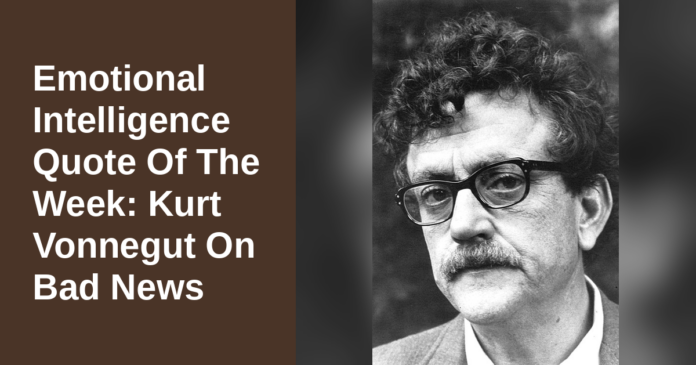
In his essay collection A Man Without a Country, novelist Kurt Vonnegut described how during one of his lectures he sketched out the rise and fall of Shakespeare’s Hamlet. He tracked Hamlet’s fortunes as a line graph, laying out what he called the “shapes of stories.” Partway through, he set his diagram to the side, turned to the audience, and said something that had nothing to do with his graph:
“The truth is, we know so little about life, we don't really know what the good news is and what the bad news is.”
Vonnegut meant that our tendency to immediately categorize events as either good or bad is misguided. By categorizing events too soon, we can overlook future information and future possibilities. You lock yourself into short-term, small picture thinking. Importantly this is true of both good and bad news, because as Tom Robbins wrote in Even Cowgirls Get The Blues, “Success can eliminate as many options as failure.”
Vonnegut’s Quote Shows The Power Of What Psychologists Call ‘Temporal Distancing’
The emotionally intelligent move is to learn to stay open to the infinite number of possibilities ahead. Psychologists recommend that you learn to zoom out, both in time and scope, before you assign a label of “good” or “bad.” If you do so, you may be surprised by how a “bad” break turns out good, or a “good” one turns out bad. You’ll spend less energy grieving short-term losses and more energy noticing new opportunities.
Researchers call this “temporal distancing,” and it holds up under study. In a 2023 eight-day diary study of 155 people published in the journal Emotion, psychologist Dylan Benkley and colleagues found that people who habitually journaled about their hard days and viewed them from a longer time horizon felt measurably less negative emotion and more positive emotion. This was even true on the day of the event. An earlier study by Emma Bruehlman-Senecal and Ozlem Ayduk found that stepping into the distant future eases emotional distress by highlighting how impermanent most “disasters” turn out to be.
How Emotional Intelligence Can Help You Practice Temporal Distancing
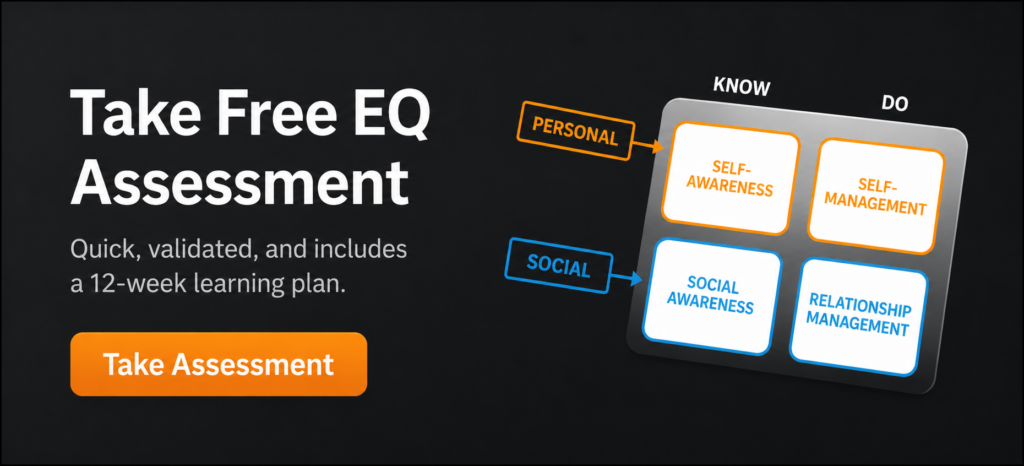
Emotional intelligence (EI) is your ability to recognize, understand, and manage your own emotions, as well as the emotions of other people, in order to be more effective in your relationships and life. EI is made up of four core skills:
- Self-Awareness, or your ability to recognize and understand your emotions
- Self-Management, or your ability to deal with and regulate your emotions
- Social Awareness, or your ability to recognize and understand the emotions of others, and your ability to empathize with others.
- Relationship Management, or your ability to use each of the aforementioned skills to build, maintain, and foster relationships with other people.
In emotional intelligence terms, Vonnegut is describing a breakdown in self-awareness where we bias toward the immediate moment, letting our negative emotions hijack our ability to think long-term. Rather than consider all the doors that a “negative” event may have opened for us in the future, we linger on the immediate negatives.
Through honed self-awareness, you can begin to slow down during your negative experiences and search for new, creative opportunities you might not have seen before. To get a measure of your self-awareness, psychologists recommend that you take a validated EI self-assessment.
An EI Strategy To Practice Temporal Distancing: The Zoom-Out Reframe
The Zoom-Out Reframe strategy is designed to cover that exact blind spot Vonnegut pointed out in his lecture. When using this strategy, you don’t just take a pollyannaish approach and ask “what's good about this?” You widen the lens entirely, before any label gets to stick, further out in time, and further out in scope.
Here’s a three-step process you can use to build this habit (based on the psychological research):
- Catch yourself handing down a verdict to yourself, like “this is terrible,” or “this is great.” Note the emotions you feel as a result, and try to recognize how both good and bad labels limit your ability to see future possibilities.
- Ask the zoom-out question: How might this look in a year? In ten?
- Hold your vision loosely and openly, and look for newer, bigger opportunities that you might not have seen previously.
If you want to take this practice especially seriously, write it down in a journal. Over time, you’ll recognize patterns and tendencies in yourself and your responses.
Putting This Quote Into Action
The next time something happens that feels unambiguously good or bad, borrow Vonnegut's humility and openness. Don't force a silver lining, and don't spiral into worst-case thinking. Just zoom out a week, a year, and then a decade. You'll likely find you were half right and half wrong about some things, but that you had no idea how most things would play out at all. Getting comfortable living in that gap between the known and the unknown, and between “good” and “bad” is exactly where emotional intelligence comes into play. You can’t control everything that happens, but you can control your reception and your reaction.