

Most of us assume our closest friends are basically just like us, but wearing different clothes. New research out of Michigan State University showed that this assumption is mostly misguided. What actually makes a friendship satisfying has nothing to do with how alike you are.
Hyewon Yang, PhD, and colleagues recruited 371 friend groups of exactly four people (1,484 participants total), verifying each group over a muted video call before the study began. The findings, published in Social Psychological and Personality Science, come from a “round-robin” design: every person rated their own Big Five personality traits, then rated the three friends in their group, and then rated how satisfied they were with each friendship.
Two things stood out. First, actual similarity between friends was weak across the board. Friends who were similar had small correlations of just .05 to .10 for four of the five traits, and no measurable similarity at all in extraversion. Interestingly, “openness” was the one trait where friends genuinely overlapped more. Even more interestingly, people consistently overestimated how similar their friends were to them, projecting their own traits onto people who often didn’t share those traits at all.
Neither actual nor perceived similarity predicted how happy people were with a friendship. Instead, the kinds of attributes that did predict friendship were threefold:
- Agreeablenes
- Conscientiousness
- Emotional stability
In other words, likability tracked much more with emotional intelligence (EI) than it did with resemblance.
How A Simple Emotional Intelligence Strategy Can Help You Stay Open, Be More Likable, And Build New Connections
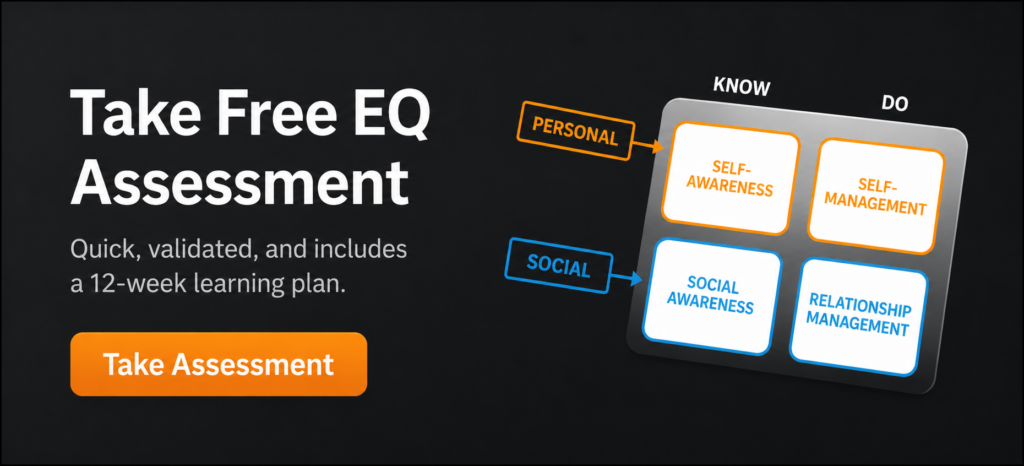
Emotional intelligence (EI) is your ability to recognize, understand, and manage your own emotions, while also recognizing and influencing the emotions of the people around you. It’s usually broken into four skills: self-awareness, self-management, social awareness, and relationship management. To see how skilled you are, experts recommend that you take a psychologically validated EI assessment.
When you’re looking to make new connections, EI skills can help you be more likable, and they can help you find people with whom you are more likely to establish a long-term connection. When making new connections, I like to remember the acronym ACE. ACE stands for Agreeableness, Conscientiousness, and Emotional stability.
Most of us default to a similarity heuristic without noticing it. Someone who shares our background, taste in music, or politics may feel like a known person, so we relax around them faster, but Yang’s data suggests that this heuristic is a poor predictor of whether a friendship will actually be a happy, valuable, and lasting one. The three ACE traits will give you much more information, and none of them require the other person to be anything like you.
A Practical Example Of ACE In Action
Say you’re new to a city and meeting people through a rec league, a book club, and a neighbor’s barbecue. The instinct is to gravitate toward whoever laughs at your jokes, shares your hobbies, or worst of all, “looks like you.”
The ACE Filter asks different kinds of questions about the people around you. For example, to determine someone’s emotional stability, you might ask, “When this person is stressed, do they stay level or spiral?” Or to determine their agreeableness, you might ask, “When plans change, are they easy or difficult to interact with?” And lastly, to determine their conscientiousness, “Do they follow through on the small stuff?” Of course, you don’t need to ask these questions point-blank. The idea is more so to consider these types of qualities and questions as you get to know someone.
And when it comes to improving your own likability, just flip this question on its head. Are you level when stressed? Are you easy to interact with when plans change? And do you follow through on the small stuff?
Putting This Research Into Action
Friendship satisfaction isn’t about finding your mirror image as much as it’s about finding a person you can truly rely on. The next time you’re deciding who to make time for, skip the similarity test and run the ACE Filter instead. Is the other person agreeable, conscientious, and emotionally stable? These are the kinds of attributes most likely to determine whether the friendship actually feels good and adds value to your life.