
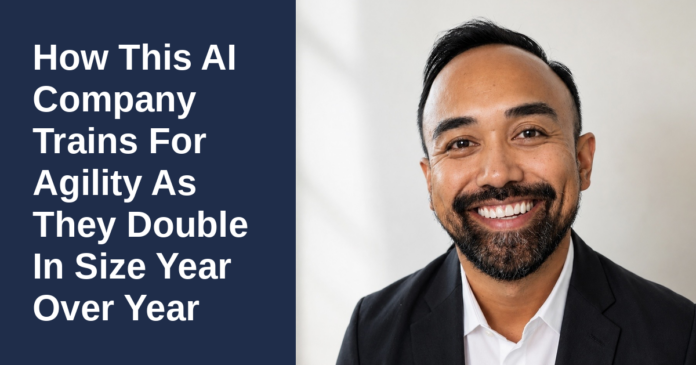
When Justin Phalichanh joined Crusoe AI a year ago, the company had about 600 people. Now, it has more than 1,700, with plans to double again this year.
That kind of growth strains any company, but it’s especially complicated in the world of AI infrastructure, where the work itself is a new frontier. Crusoe operates in the AI infrastructure space, including data centers and cloud services, with sustainability built into the company’s founding priorities. Because of this extra strain on the workforce, Phalichanh, Crusoe’s Director of Leadership and Talent Development and the founder of Bring Brilliance, sees the human challenge as just as urgent as the technical one.
“A lot of things that we’re doing and our competitors are doing have never been done before at this magnitude, gravity, and scale,” Phalichanh said. “When companies say that you have to navigate ambiguity, we’re living that, we’re experiencing it.”

Across over sixty interviews with talent development leaders, one pattern has become increasingly clear: AI can transform the way work gets done, but that actually makes emotional intelligence (EI) even more important for connection, judgment, trust, and execution. The “formula” I like to use to show this message is that: AI + EI = ROI.
At Crusoe, that formula is playing out through the work of Phalichanh and his talent development team. The company is growing fast, the industry is moving fast, and Phalichanh’s job is to help leaders build teams that can adapt. “Change is the only constant,” he said. “A reality at a high-growth company like ours is that being adaptable week by week is a necessity.”
Mastering Feedback Enables Healthy Conflict in a Fast-Paced Environment
Phalichanh’s team delivers a three-module Feedback Mastery program to all leaders at Crusoe. Phalichanh kicks off the program by asking people to raise their hands if they have been at the company for more than a year. Usually, only a few hands go up. At six months or three months, many more hands go up.
That exercise helps participants visualize the extent to which every team at Crusoe is integrating new members, projects, and expectations. “For them to even get to that point, to start reflecting on giving and receiving feedback, there’s an element of how do I connect with my teams, how do I build trust and psychological safety?” Phalichanh said.
“We’re moving so fast that conflict will inevitably come up,” he said. “It’s expected to come up, and we also expect our people to give feedback plainly. We want to avoid having prolonged conflict.”
Now, after his team trains up leaders on how to master feedback, he’s encouraging these leaders to bring the same work to their intact teams. “When you practice giving and receiving feedback with the team you work with every day, it’s going to make a big impact on how your team gets work done,” he explained.
A Shared Situational Leadership Framework to Increase Agility
One way Phalichanh’s team is building agility through this period of rapid growth is by providing a universal model for how to lead. They use the situational leadership model. All managers are enrolled in the program. “What the situational leadership model provides is a naming mechanism for leadership behaviors and a structure for important conversations,” Phalichanh explained. “It drives better conversations.” This shared framework and vocabulary around leadership help activate on-the-job application of the concepts.
L&D Has To Operate Like A Business Inside The Business
Phalichanh pointed out that people in L&D can’t assume people throughout the company know what their function offers, why it matters, or when to engage. L&D has to tell them, and they need to be willing to repeat their message clearly and consistently.
“I have to keep my stakeholders, my employees informed of what we offer, what we do, and why it matters to your team,” Phalichanh said. “When I’m able to frame it in that way and market it that way, it helps me do my work differently and in some ways even more impactfully.”
That mindset was shaped by his previous decade of L&D experience at IPG Mediabrands, a marketing organization. The environment taught him that marketing tenets like clarity, repetition, and timing need to be a big part of L&D’s ability to influence.
“To have influence in your work, you have to be able to demonstrate and articulate the value that you bring,” he said. That’s especially true in a fast-growing company like Crusoe, where new leaders join and new needs emerge. L&D has to stay visible enough that people know where to turn when the time comes.
Buy-In for Talent Development Comes From Relationships
Crusoe employees are hungry for learning, but as Phalichanh pointed out, the biggest challenge they face in the adoption of training is prioritization. When everything is moving one hundred miles per hour, how can L&D help show leaders the value of training?
To Phalichanh, the key lies in building relationships. HR business partners need to understand the offering, and functional leaders need to see the relevance to their teams. And it’s L&D’s job to build up those key stakeholder relationships. “Prioritize building the relationships,” he said, “because without them, without the connections and the community, your L&D work’s only going to go so far.”
Slow Down To Speed Up
The paradox of AI-era leadership is that speed often depends on your ability to slow down at the right moments. When Phalichanh reflected on his own learning at Crusoe, he put it this way: “If I were coaching myself, I would say it’s more important to slow down, to speed up.”
That may be the core leadership lesson to take from Crusoe’s approach to training in a time of rapid growth. AI-era ROI does not come from AI alone. It comes from pairing AI with EI, so teams can move quickly yet purposefully, and avoid letting speed become chaos.