

This month, two of America's biggest employers cut jobs while touting AI, and the backlash landed on how they said it, not just what they did. The problem, everyone seems to agree, is that leaders can't genuinely hold “pride in automation” and “grief over job loss” in the same breath.
On July 6, Microsoft confirmed Xbox will cut roughly 3,200 jobs as part of 4,800 layoffs company-wide, divesting four studios — Compulsion, Double Fine, Ninja Theory, and Undead Labs. Gaming Chief Asha Sharma's memo laid out the strategic rationale clearly. What it didn't do, critics noted, was spend any time apologizing or empathizing with those 3,200 people.
GM's approach in May was even worse. CNBC reported that laid-off employees, mostly IT roles in Austin, Texas and Warren, Michigan, sat through 15-minute meetings built around a scripted HR read-out, with no room for questions. Roughly 500 to 600 people got a script instead of a conversation, and word of it spread fast.
The data shows that AI layoffs, and how poorly they’re being done, are eroding trust in CEOs massively. Businessolver's 2026 State of Workplace Empathy Report found only 68% of HR professionals now rate their CEOs as empathetic. This percentage is down 16 points from 2022, and it’s the lowest score since the survey began in 2016. HR's own empathy toward employees and toward their organizations dropped too, evidence of a fatigue running in both directions, from the top down and the middle out.
Why This Is A Matter Of Emotional Intelligence (EI): The Low-Empathy Apology
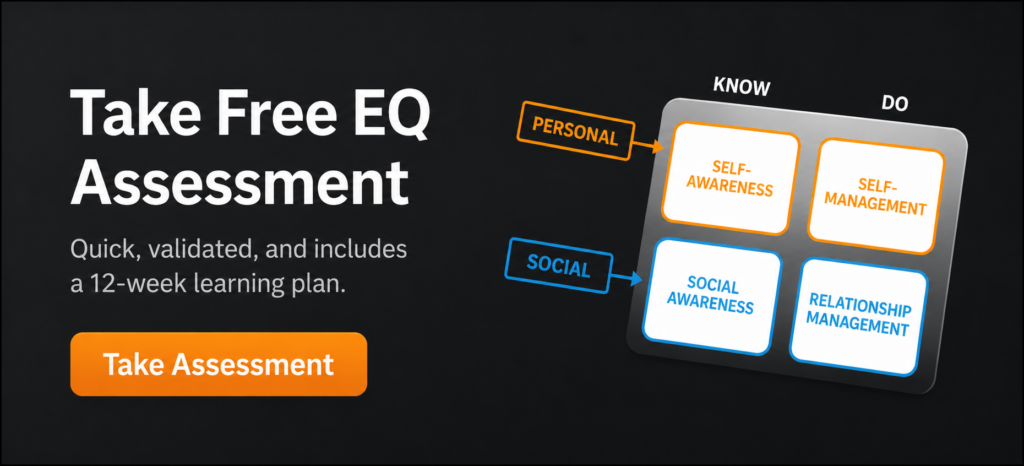
Emotional intelligence (EI) consists of four core skills areas:
- Self-Awareness
- Self-Management
- Social Awareness
- Relationship Management
To improve across any of these four EI areas, experts recommend you take a psychologically validated emotional intelligence assessment. While a couple of the above skills all influence how poorly these CEO announcements are coming across, the biggest areas lacking are social awareness and relationship management. Relationship management is your ability to handle other people's emotions with as much deliberateness as you handle your own. This is about empathy, reading the room, then acting on what you read. It's precisely what breaks down when a CEO stands next to a chart celebrating automation gains the same week hundreds of people lose their jobs to that automation. The math might be sound (big “might”), but the emotional sequencing and empathy is not. Employees, feel that gap immediately as their CEO brags about automation while overturning their colleagues’ lives.
The specific trap these CEO’s are falling into is that they pair an expression of empathy with a justification that cancels it out. “I know this is hard, but this positions us for the future.” This tells people that their loss is a rounding error in someone else's roadmap. Empathy that gets expressed and then immediately undercut is worse, in some ways, than no empathy at all because it signals the leader noticed the pain and chose to move past it. And often this is happening in literally one sentence.
This isn't limited to CEOs at a podium. The same trap opens whenever a decision affects someone, whether it’s a cut paycheck, diminishing job security, a canceled project, or a player getting cut from a team
An EI Strategy To Empathize And Communicate Better: The Now-And-Next Strategy
There's a better way to hold two truths (the business case and the human cost) without one erasing the other. Call it the Now-and-Next Strategy. When you have to explain a decision like this, you need to name its impact twice, in this order: once for the present and once for the future. Do this before you bring any justification into the conversation.
The present piece says, plainly and without hedging, what this costs someone today—their income, their routine, their sense of belonging on a team they helped build.
The future piece says what the organization will actually do to shorten the distance between today and whatever comes next. That means providing real severance timelines, real job placement support, real internal mobility options, and human beings to talk to. It doesn’t mean offering vague reassurance about “resources available.”
Only after both of those have been said in full does the business rationale come up. The Now-and-Next Strategy works because it it focuses on expressing empathy and the path forward before justifying the decision. A leader can and should still explain their decision . The problem lies in the timing of the delivery. When the apology and justification arrive at the same time, stitched into the same breath, the “empathy” feels contrived or scripted.
The same order holds at any scale, not just for CEOs announcing mega layoffs. When you’re announcing a tough decision, like reassigning a role or ending a project be sure to name the cost, name what's next, and then explain why.
Putting These Ideas Into Practice
Leaders who protect dignity in tough moments and tough decisions will need at bare minimum to express the human cost in its own sentence, spoken first and left standing on its own. This applies just as much to a manager cutting one person's project as it does to a CEO cutting thousands.