
Traditional instructional design is slow and expensive. A typical curriculum takes 160 to 320 hours of designer labor, costs upward of $50,000, and moves through weeks of needs analysis, stakeholder reviews, and revision cycles before a single learner sees it. The first wave of AI-powered learning tools attacked the speed problem and largely solved it. But it also resulted in AI training slop, content that looks polished but lacks any grounding in learning science and does not change behavior on the job. The missing piece is an AI tool that doesn’t just produce content faster but produces better learning, grounding every design decision in evidence-based neuroscience principles while cutting timelines from weeks to hours.
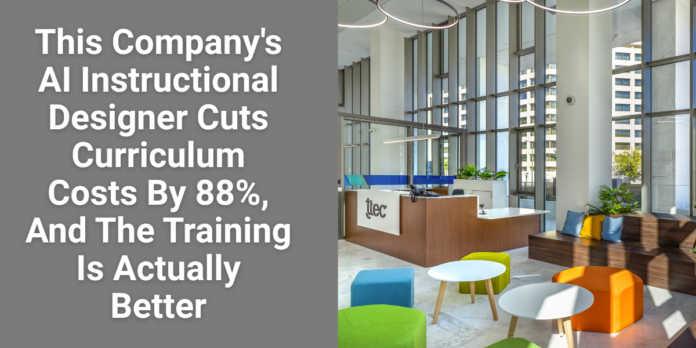
TTEC Holdings, Inc. (NASDAQ: TTEC) is a global customer experience technology and services company headquartered in Austin, Texas. Founded in 1982, the firm operates across six continents with more than 50,000 employees, serving major brands in financial services, healthcare, technology, and telecommunications. Over the past 15 months, the company’s learning organization has built something turning heads across the industry: an AI-enabled instructional designer tool called the Learning Wizard Suite. To learn more about the Learning Wizard Suite and the thinking behind it, I had the opportunity to interview Julie Stone, TTEC’s Group Vice President and Chief Learning Officer.

AI-Powered Discovery, Curriculum Design, and Coaching
The Learning Wizard Suite is a proprietary system of three AI-powered tools, TTEC’s Coaching Wizard, Discovery Wizard, and Curriculum Wizard, that work in concert to design complete training curricula grounded in learning science.
The Coaching Wizard establishes the behavioral foundation for everything else. It ingests client performance data across three tiers, from KPIs to QA scorecards to frontline coaching notes, and produces a Behavioral Gap Identification (BGI) scoring system that rates every behavior on a 0-5 scale based on performance impact, error frequency, cognitive complexity, and compliance risk. Stone described the output as “bespoke skills and behavior taxonomies” tailored to each client. Those taxonomies tell the Discovery Wizard what gaps to look for and the Curriculum Wizard where to concentrate practice time.
The Discovery Wizard kicks off the process by analyzing either an existing client curriculum or raw performance data and producing a detailed blueprint. It runs three engines in sequence: a BGI Engine that scores behavioral gaps, a Learning Science Engine that maps which of the 16 principles need activation, and a Fidelity Engine that recommends production levels to optimize cost. For redesign projects, it also triggers the Asset Reuse Engine, which evaluates every existing training asset and determines what to keep, transform, or replace.
The Curriculum Wizard takes the Discovery Wizard’s blueprint and generates a complete, structured curriculum. It operates on two tracks: Track A builds net-new programs from scratch, while Track B produces redesigned curricula that incorporate existing assets flagged for reuse by the Discovery Wizard. In both cases, the output includes day-by-day sequencing, activity design, knowledge checks, practice exercises, and measurable learning science coverage scores for every module. “It creates the entire curriculum. How many days, what’s the sequencing of the activities, are there knowledge checks or exams?” Stone said.
16 Learning Science Principles Ensure Quality
Stone is quick to draw a line between producing content and producing learning. “AI isn’t just about efficiency, it has to be about quality too,” she said. “We make sure that anything that we build in our curriculum is using evidence-based learning principles,” Stone explained. Those principles include spaced repetition, where concepts are resurfaced across multiple contexts, and deliberate practice with built-in feedback loops. The Learning Wizard Suite systematically applies 16 learning science principles to every curriculum it generates, producing measurable quality scores that traditional instructional design cannot match.
The system also eliminates one of the oldest problems in training design: subjective prioritization. Traditional instructional designers decide which skills deserve the most focus based on experience and stakeholder politics, which makes resource allocation difficult to defend.
Reducing Costs By Up to 88%
The efficiency gains are staggering. At TTEC and many organizations, traditional instructional design takes four to eight weeks per curriculum. The Wizard Suite completes the same work four to eight times faster, a 75 to 88% reduction in development time while raising quality across every measure tracked. That performance has earned TTEC five external industry awards in 13 months, including a Brandon Hall Gold Award for Best Advance in Generative AI Learning and a Stevie Gold Award for Customer Service Training Practice of the Year.
The numbers underscore the shift. According to TTEC’s internal ROI analysis, a net-new curriculum for a 500-agent healthcare call center that traditionally required about a week of discovery and design was completed by the Learning Wizard Suite in just two hours—a 95% reduction in time. For redesign projects, the system’s Asset Reuse Engine evaluates every existing training asset and sorts it into four categories: reuse as is, transform, retire, or replace. In a recent healthcare engagement, the platform reviewed 245 training assets and found that the majority could be reused or refined, while redundant materials were retired. By preserving 58% of existing content and eliminating 18%, the redesign effort cut costs by 72%. The result: dramatically faster development, significantly lower spend, and greater consistency across the curriculum.
Freeing Instructional Designers for Advanced Work
When asked about headcount reduction, Stone reframed the conversation. “Would this allow me to operate with fewer instructional designers? Yes. But you know what else it’s allowed me to do is it’s allowed them to change their focus from creating a once-and-done training class, which we know doesn’t result in true skills proficiency, and to build that whole end to end journey,” she said.
Her designers now spend their time on higher-order questions. “Now they’re figuring out where else in this journey do I help them build their skills, when do I bring in an AI coach? When is it important to bring in their human coach?” Stone said. The AI handles the production work. The humans handle the judgment.
What Comes Next: Truly Adaptive Learning
Stone’s next priority is making TTEC’s training fully adaptive to the individual, an approach inspired by platforms like Khan Academy. The goal is a system that assesses what each person already knows, delivers self-paced learning calibrated to their starting point, and lets them graduate when ready rather than when the class schedule dictates. “We’re getting incredible value not only for reshaping the work our employees are doing, but the job to be done is to enable somebody to perform at their peak potential,” she said.
In a market flooded with AI training tools, TTEC’s Learning Wizard Suite stands out because it was built on a human insight: the point of training is not to produce materials, but to help real people develop real skills. Her advice to peers considering developing a similar system is simple. You need both deep learning-and-development expertise and AI technical capability. The Wizard Suite works not because it uses AI, but because it pairs AI with evidence-based learning design. In an industry racing to automate content creation, TTEC built something different: a system that accelerates learning itself.