
Leadership development typically starts with models, assessments, and competency maps. Dr. Brittany Grieb, PhD uses each, but she catalyzes them with “reflective storytelling.” Reflective storytelling is a practice in which leaders unearth, refine, and then tell their own stories of failure, vulnerability, and events that shaped them.
Across more than 40 interviews with L&D leaders, none have connected emotional intelligence and storytelling as clearly and deeply as Grieb. Grieb is the Senior Director of Talent Development and Employee Engagement at BioMed Realty, the largest private owner and operator of real estate for life science, technology, and innovation industries, At the heart of her approach to training is the idea that leaders can grow their self-awareness and authenticity by deliberately making sense of their lived experience. This collective vulnerability also increases trust and connection and helps you on your journey to “authentic and effective leadership.”
Leaning on this reflective storytelling approach, Grieb and her team have built out an entire talent development architecture from scratch at BioMed Realty.

Storytelling Reveals What Traditional Leadership Models Miss
“In my PhD, I learned that there are all these different theories for leadership,” she said, “but there’s very little research that tells you how to be a better leader, how to embody authenticity. There’s no clear roadmap for how to get there.” So, in her PhD in Leadership Studies, she focused her research on building that roadmap.
Specifically, she used reflective storytelling interventions to grow managers’ self-awareness. “I asked leaders to think back to their personal history, specific experiences where they felt vulnerable, faced a challenge, made a mistake, where someone really impacted their life,” Grieb explained. “Through that process of looking back into their past, they gained a deeper understanding of who they were in the present. This reflection vastly deepened their understanding of their morals and values, which in turn gave them a map forward as a leader.”
One of the frameworks she uses to show the value of these interventions is called the Johari’s Window, which maps out awareness into four quadrants:
- Open Arena – what is known to self and others
- Hidden – What is known by you, but remains private to someone else,
- Blind Spot – What is unknown to you, but clear to others.
- The Unknown – What nobody knows about you but is still true.
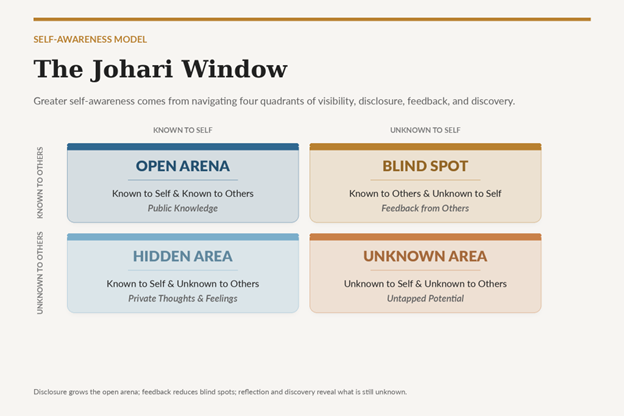
Storytelling matters because it can teach you about each of the quadrants, and importantly, dredge up truths from the Unknown. “Storytelling helps us get to that unknown space,” she said. “Storytelling is one of the only interventions that can reach that space.”
Why Storytelling And Emotional Intelligence Work Well in Tandem
Grieb doesn’t see storytelling as separate from emotional intelligence. She sees it as one of the most practical ways to build EQ.
“Self-awareness is understanding intrinsically how we are,” she said. “But emotional intelligence also extends to understanding how you are perceived.” How you see yourself and how others see you is an integral part of the personal side of emotional intelligence (self-awareness and self-management). By using storytelling to deepen your understanding of yourself and how you are perceived by others, you enable yourself to adapt your approach to show up in a more authentic and effective way.
Storytelling also plays a big role in your ability to foster connection. “When we share stories with one another, when we disclose to one another, we are being vulnerable,” Grieb added. “That vulnerability helps build trust, which then helps build community and connection.” This feeds into the social side of emotional intelligence (social awareness and relationship management).
Grieb was sure to point out that both reflective storytelling and emotional intelligence aren’t the kind of work that you “finish.” “You’re never truly self-aware and you’re never fully emotionally intelligent,” she said. “That’s why I like storytelling, because our stories evolve over time.”
Learn The Business Before You Develop Your Leaders
At BioMed Realty, Grieb was hired to build strategic talent pillars from the ground up to support over 300 employees with deep functional expertise. Rather than rely on occasional outside workshops, she wanted talent development to become something more integrated and sustainable.
Instead of walking in with a prepackaged program, she came at it from a place of curiosity. “My first 90 days, I met with as many leaders and individuals as I could across the company,” she said. Then, over her first year, she went deeper, making it her mission to more deeply understand each of their functional departments.
That meant traveling to different office locations, touring properties, and sitting with teams across functions ranging from property management to development, asset management, and finance.
“I asked leaders to talk to me like I’m a 10-year-old,” she explained. “Tell me what’s really important about this property? Or, what’s your biggest challenge right now?”
Her approach accomplished two things. It helped her learn the business, and it helped her build trust. Leaders could see that she was not trying to force generic development content onto specialized teams. She was trying to understand their world well enough to impact it.
Building BioMed Realty’s Leadership Development From Her Qualitative Research
From all of her early conversations clear themes emerged. The company needed a clearer shared understanding of leadership versus management. It needed deeper work around self-awareness, emotional intelligence, communication, trust, vulnerability, conflict management, and change.
That insight became the foundation for BioMed’s leadership architecture to support employee development at all levels of the organization: The director-level program is called Accelerate. The manager-level program is Elevate, a self-development track for individual contributors is Cultivate, and for vice presidents and above, the organization uses external coaching and well-established partner-based assessment support. Each level of the program builds on the skills, behaviors, and leadership expectations from the one prior, creating a leadership development pipeline for employees at all levels of their career at BioMed.
To reinforce the importance of these programs, BioMed invests in bringing participants together in person, supporting travel across markets so employees can connect, collaborate, and learn directly from one another. The programs are intentionally designed as hybrid experiences, combining in-person sessions with remote learning to ensure accessibility across the company’s markets.
Her team also built the programs as cohort-based cross-functional experiences, which has been especially powerful for developing leaders across geographic markets. “The value of that cross-departmental collaboration has been a complete highlight for us,” she said.
AI May Create More Space For Reflective Storytelling
Grieb sees clear ways AI can help talent leaders work faster and better. It can identify themes in 360 data, speed up synthesis, and reduce the time spent manually drawing connections across assessments. “There are many ways that AI is going to free up our time and help us draw these themes and connections that we normally would have to sit down and do ourselves,” she told me.
But she also pointed out some interesting limits. “AI will only ever work with disclosed data,” Grieb said. It can help build a development plan. It can summarize patterns. What it cannot do is uncover “a true diagnosis of what’s holding us back from reaching our potential.” That’s where reflective storytelling still matters most. It helps leaders move beyond the open arena of what is already visible and into deeper self-discovery.
The Story Brings the Strategy to Life
If leadership development typically begins with models, assessments, and competency maps, Grieb’s work offers a compelling reminder that while the tools still matter, it’s through thoughtful strategies—like storytelling—that we activate these models. Great leadership begins when people make meaning of their own experience and then translate what they learn into how they lead.