
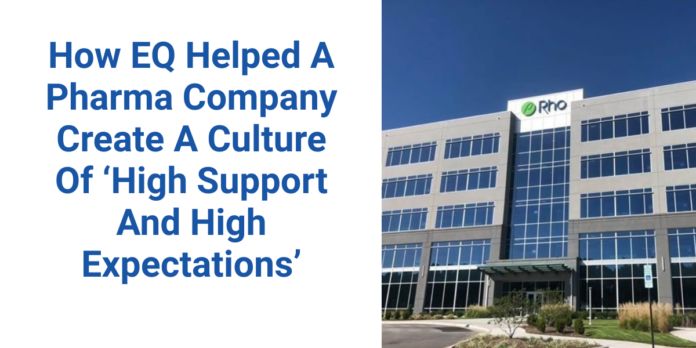
The company Rho, Inc began as a biostatistics startup in 1984, operating out of the basement of a professor at the University of North Carolina. From these early academic startup roots, Rho has since sprouted into a contract research organization with over 600 employees.
As Rho grew, they ran into a common problem: Some of the practices that helped them grow proved less effective at scale. “In the past, there was almost a stated policy of ‘Hire the best people and get out of the way,’” explained Greg Garner, their Associate Director of Organizational Development. “As we have expanded and as our systems get more complex, we found that you need to be more involved in making sure that your talented people have what they need to be successful.”
Rather than completely overthrowing the old way of hiring and developing talent, Garner and his team applied a new framework that leans on the company’s existing strengths. They use what’s called a “Restorative Framework.”
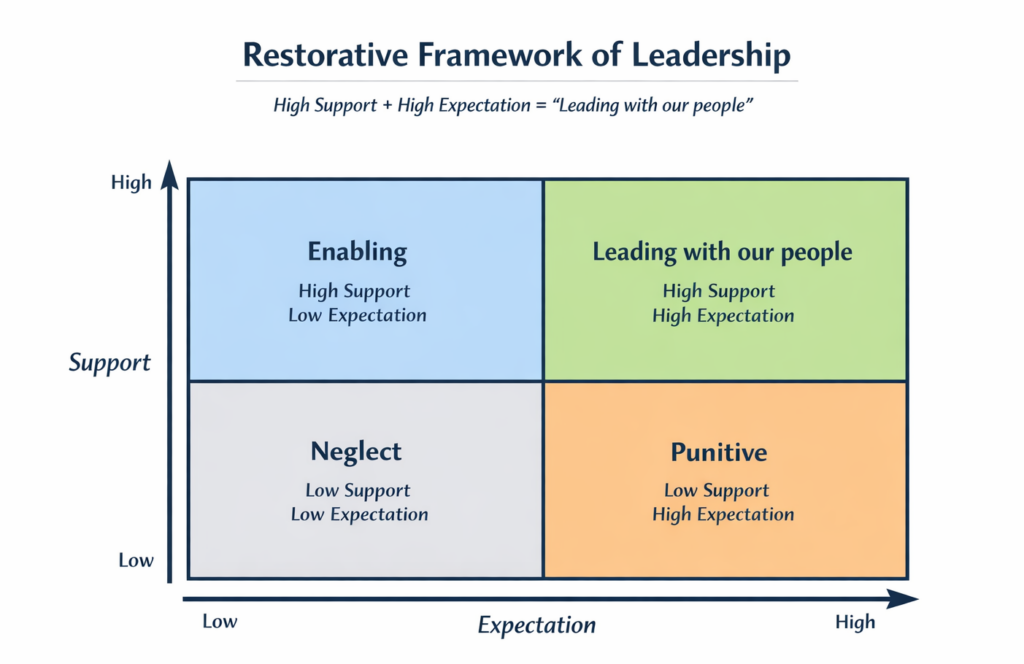
“It comes from restorative justice,” Garner said, “and it essentially boils down to this idea that we want to provide a high level of support for our people, and at the same time, we want to hold a high level of expectation from them.”
This Restorative Framework has been effective because Rho didn’t push against the existing culture; they worked with it, instilling specific behaviors to help support people while still holding high standards. Here’s how their approach plays out.

How The Restorative Framework Helps Develop Leaders
The restorative framework of leadership can be split into four boxes:
1. Low support and low expectations: This is essentially neglect, where employees are left to their own devices. Simply put, it’s NOT leadership.
2. High support and low expectations: This is called enabling, and the leader ends up doing the work for their employee or seeing weak results.
3. Low support and high expectations: This is “punitive” and often turns into the “mean boss paradigm.”
4. High support and high expectations: This is “leading with your people,” and strikes the right balance.
With this in mind, much of Garner’s team’s training revolves around getting leaders into that upper right quadrant as often as they can.
Growing Your Leadership Pipeline As Your Organization Grows
Rho’s leadership development pipeline progresses in two main stages. First, there’s an Emerging Leaders Curriculum (ELC) program to support leaders transitioning into people leadership for the first time. Then, for leaders of leaders, they offer a Growing Leaders Together (GLT) program.
Emerging Leaders Curriculum (ELC)
The Emerging Leaders Curriculum is designed for first-time managers and high-potential employees preparing to step into leadership.
To support Rho’s leaders as they transition from “teammate to boss,” emerging leaders learn the core skills for supporting people: delegation, conflict resolution, decision-making, and time management. “The program’s not just about how you can be more productive,” Garner said. “It’s also how you can help your people be more productive.” Similarly, conflict resolution isn’t just about handling your own disputes. It’s about facilitating conflict between two of your team members.
The program runs in cross-functional cohorts, creating peer networks that extend beyond the classroom. Role-play exercises—sometimes with peers, sometimes using AI-enabled coaching tools—give leaders a low-stakes environment to practice difficult conversations.
Growing Leaders Together (GLT)
Rho offers a second level of leadership development, geared for leaders of leaders. This program is called Growing Leaders Together (GLT), a more senior, peer-driven program. This program is facilitated by the VP of Employee Experience, further underscoring the investment and importance of this work.
Here, the work becomes highly reflective and identity-driven. Leaders think through and practice how their learning will apply on the job, and they engage in practical role plays in small groups. “GLT is a mechanism for our kind of cultural inculcation and value inculcation,” Garner explained.
Participants gather feedback not only from colleagues but also from people outside of work and use that feedback to think about their personalities, leadership styles, and habits in terms of a variety of leadership and personality models.
The goal is overall life alignment. “Who you are at the office should match who you are at home,” Garner said. When leaders discover gaps between those identities, it can be jarring, but ultimately productive.
“So much of senior leadership is situational,” Garner said. “There aren’t a lot of textbook answers.” With this in mind, the GLT cohorts are cross-functional, mixing regulatory scientists, data managers, and statisticians who may share little day-to-day overlap but face similar challenges. Small working groups foster psychological safety, allowing leaders to discuss real struggles candidly.
Across both the ELC and GLT, the message is consistent: “You have to know yourself so that you can know your people, so that you can know how your people hear you.”
EQ As A Bridge Across Generations
Garner told me that when leaders have been leaders for a long time, and then a new generation enters, many of them hit the same wall: the old playbook starts to feel unreliable. Because Rho hires a lot of young talent, they’ve mastered their approach to training leaders to work with newer, younger generations.
Many of their entry-level employees sit in high-leverage positions on project teams. This makes it especially important that managers can communicate clearly. So while EQ is incorporated into their Growing Leaders Together program, Garner pointed out that it gets used the most by their HR business partners who lean heavily on EQ skills when coaching leaders to connect with, communicate to, and develop their early-career talent.
“Everybody talks about how communication is two-way street,” Garner said, “but we put more emphasis on the part of the communicator to ensure that their message is understood.” Garner pushes leaders beyond the cliché. “It’s incumbent upon you as the communicator and as the managers to adjust how you deliver your support and your expectations.” You have to master the ability to change tactics, language, and approach until your people truly understand what ‘good’ looks like.
It’s through EQ skills that leaders pick up on how well their team members understood them. And it’s through EQ skills that leaders can continue to re-communicate until their message resonates.
Three Takeaways For Growing Your Company’s Leaders
First, raise support and expectations together. This is the Restorative Framework in a nutshell.
Second, treat leadership development as a pipeline, not a one-off event. New managers need tactical support. Senior leaders need situational practice and peer feedback.
Third, to reach new generations with new ways of doing things, leverage emotional intelligence skills to communicate support and expectations in a clear way.