
Across more than sixty interviews with talent development professionals, this theme comes up time and again: AI can help organizations scale personalized, just-in-time learning.
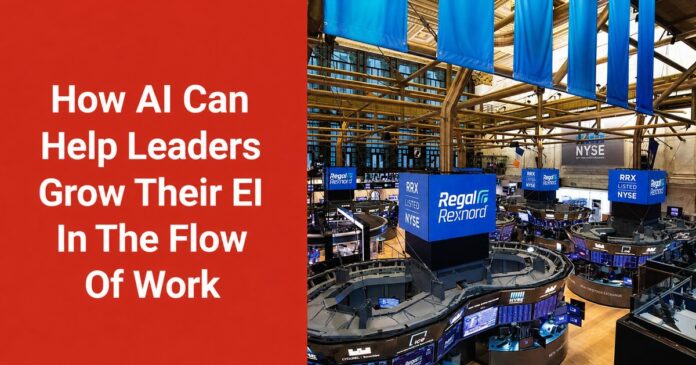
Kriste Goldsmith, senior director of leadership development at Regal Rexnord, is building out their leadership development system right now, and she has the unique opportunity to build AI directly into her leadership strategy. “It’s kind of a blessing that we’re building as AI matures right alongside us,” Goldsmith said. “We’re not trying to retrofit old systems. We’re baking AI right into our leadership development system as we build it.”
Regal Rexnord has about 30,000 associates globally and manufactures industrial automation, power transmission, and air-moving components. Goldsmith describes it simply: “We make products that make things move.” Her role is to develop nearly 4,000 leaders globally.
Sarah Kay has devoted her career to developing high-performing, emotionally intelligent leaders. Kay is the Director of Global Leadership Development at Sedgwick, a global risk and claims administration partner with over 33,000 colleagues, over 10,000 clients, and operations in over 80 countries. She helps create leadership development opportunities for roughly 4,500 leaders around the world.
“My responsibility is to create meaningful leadership development opportunities for our leaders around the globe,” Kay said. “One of my main goals is to help them better engage their teams, drive performance, and empower our colleagues.”
Across my body of more than 60 interviews with talent development leaders on emotional intelligence in practice, Kay has one of the sharpest approaches to solving the challenges leaders actually face on the job. In this interview, what stands out immediately is her discipline of matching human skills to lived moments of pressure and impact.
As Kay put it, “The world is moving at such a fast pace. One of my biggest challenges is to just help everyone slow down so that we speed up.”

Kriste Goldsmith, Senior Director, Leadership Development at Regal Rexnord
EI Is A Performance Skill at Regal Rexnord
“At Regal, we really think of emotional intelligence as a performance skill, not a soft skill,” Goldsmith said. Her reasoning is that leaders who understand themselves, build trust, create clarity, and navigate difficult conversations (all core EI behaviors) can drive change, execute strategy, and sustain performance even in times of extreme change and uncertainty.
“EI is at the backbone of our ‘Leads with Impact’ leader imperative,” she said. Emotional intelligence shows up in several areas of the Regal Rexnord leadership competency model, including knowing self, impacting others, courage, and resilience.
AI Can Help Facilitate Leadership Development in the Flow of Work
Goldsmith pointed out a problem that’s rampant in leadership development: The frontline leaders who most need coaching and development often don’t have access to personalized learning and coaching. From a budgetary perspective, giving every manager timely, individualized guidance is nearly impossible.
“The breakthrough with AI isn’t the ability to create more content,” Goldsmith said. “It’s creating more individualized development.” Her idea is to develop Regal Rexnord’s programming such that it “adapts to a leader’s strengths, gaps, role, experience, and immediate, relevant context.”
“What excites me the most is that AI is going to help us scale and give us the possibility that every leader could have a coach in their back pocket,” she said.
Her pilot program, for example, focuses on nudging leaders in Microsoft Teams before critical moments: a development meeting, a challenging one-on-one, or another conversation where the leader needs to show up with clarity and emotional intelligence. “We’re moving toward proactive skilling and coaching in the flow of work for every leader at Regal,” Goldsmith said, “so that we’ll be able to actually nudge and guide leaders in those critical moments before they even know they need to ask for help.”
AI Can Help Create an End-To-End Leadership System
Goldsmith envisions leadership development as an integrated system rather than a series of learning events.” AI creates an opportunity to connect performance data, development priorities, coaching and real-world leadership moments into a continuous experience. For example, if a leader is about to meet with a direct report, their AI could synthesize and surface that employee’s development goals or SMART goals and recent feedback prior to coaching conversations. Instead of walking into the conversation cold, the leader would have relevant context and coaching nudges that could help them facilitate a more thoughtful conversation.
“With AI, you can finally connect your data, learning, and performance in ways that weren’t possible before,” she explained. For example, when it comes to measurement, leadership development has classically relied on completion rates, satisfaction surveys, personal assessments and pre- and post-program assessments. Goldsmith wants to use AI to go a step deeper. The system should eventually help assess whether leaders are actually changing behavior and whether those behaviors are improving outcomes for employees and the business.
If a leader receives a nudge before development conversations, have the conversations meaningfully improved? “Leaders can also pause and reflect – they should receive a pulse question about how the conversation went and how their message was received,” she explained.
This connection between measurement and personalized learning then becomes a kind of positive feedback loop, where each feeds into the other.
AI Can Help Leaders Practice High-EI Conversations
One of Goldsmith’s most concrete examples of AI implementation is an AI-powered simulation built into their leader certification. Many leaders avoid hard conversations because they don’t want to get them wrong. AI simulations can give them a lower-risk place to rehearse, receive feedback, and try again before the conversation happens with a real employee.
In the exercise, leaders practice a conversation with an associate about company values in the context of launching a new initiative. The AI evaluates how well the leader sets expectations and communicates the values, and the feedback gets into emotional intelligence, too.
“In one scenario, the leader may have explained the project but failed to respond to the associate’s practical concerns. The AI feedback might point out that the associate did not feel confident or safe enough to move forward,” Goldsmith shared as an example. They can practice the conversation again to improve their score based on the feedback.
AI Is An Enabler, Not A Replacement For Leadership
Goldsmith is clear that AI is not a substitute for leadership. “AI can’t create empathy, build trust or lead with courage. It is not a replacement for emotional intelligence and great leadership,” she said. “Technology has always been an enabler. AI ca help leaders build those capabilities through preparation, practice, feedback and reflection in real-time moments that matter. It can personalize learning. It can simulate conversations. It can nudge a manager before a key moment and help measure whether behavior changed afterward.”
The promise of AI, then, when it comes to EI, is that AI can help managers practice and apply EI skills more consistently.