
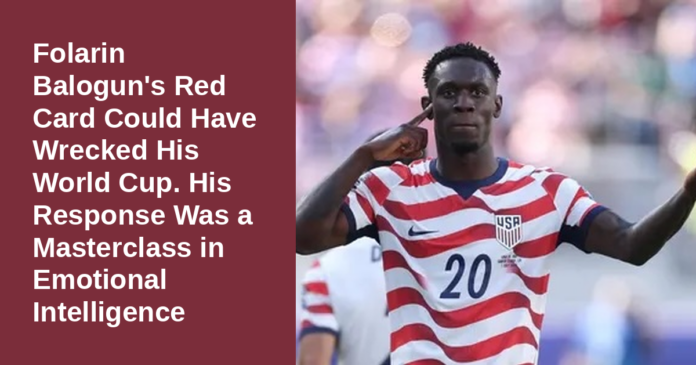
Folarin Balogun was having the game of his life. The U.S. striker had just scored his third goal of the World Cup when, in the 64th minute, referee Raphael Claus reviewed a slow-motion replay of an accidental collision where he landed on the ankle of the opposing player, and issued him a red card. Just like that, America's leading scorer was ejected and suspended from playing in the following game, which would also be the biggest U.S. men's soccer match in decades, the Round of 16 against Belgium.
Almost no one saw the referee’s call as correct. Coach Mauricio Pochettino said the collision “was never a red card,” and many people compared the moment to a collision Messi had earlier that day which didn’t even get reviewed.
What was so impressive was how calmly Balogun reacted, both in the moment and later on. Inc. columnist Jason Aten wrote that Balogun's reaction was “the best example of emotional intelligence I've seen yet.” After the final whistle, Balogun walked over to the referee, Claus, and shook his hand. Facing reporters two days later, he simply said, “I think a yellow card would have been fair,” adding that it had already happened, and he had to accept it and move forward.
Then he shared his thinking that made him so calm in response to a call that jeopardized the outcome of that game and suspended him from participating in future matches. “I never want to react out of anger and out of emotion,” he explained. “There’s still lots of people we’re inspiring, little kids, boys and girls who are watching, and we have to show them the correct way to handle things even when you think it’s unjust.”
On Sunday, FIFA's disciplinary committee suspended his one-match ban, clearing Balogun to face Belgium today.
A Live Demonstration of Self-Management
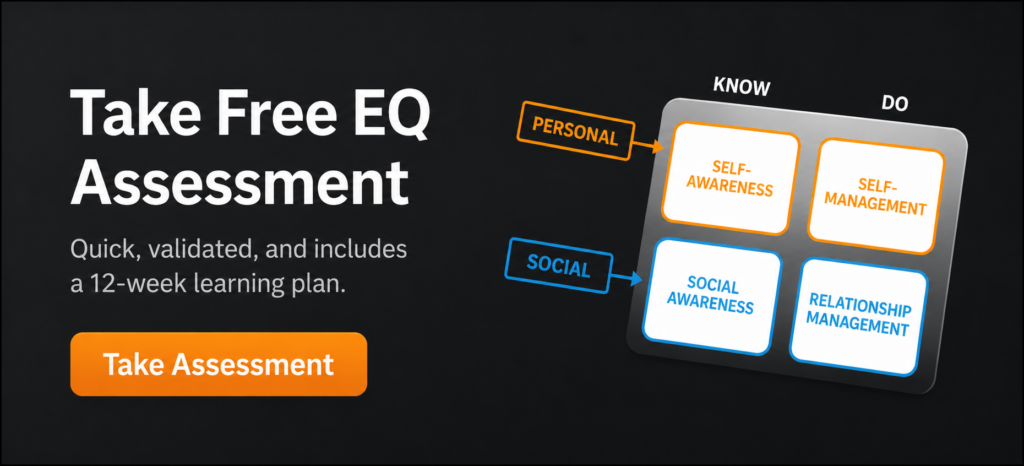
Emotional intelligence (EI) is your ability to recognize and understand emotions, both your own and other people's, and your ability to use that awareness to manage your behavior and relationships. EI consists of four core skills: self-awareness, self-management, social awareness, and relationship management. (If you're curious where you stand, you can measure your scores across all four with a free, validated EI assessment.)
Balogun's reaction to his red card is a case study in the second skill, self-management. Self-management is what you do with an emotion once it arrives. As emotional intelligence expert Dr. Travis Bradberry explains, “Your brain is wired to feel before it thinks: signals reach the emotional center before they ever hit the rational brain. Self-management is the discipline of holding the gap between feeling and action long enough to choose.”
Balogun acted so steady and calm from start to finish. He didn't pretend he agreed with the call. He disagreed publicly, calmly, once, and then let it go. Suppressing an emotion and managing it are not the same skill. Suppression often makes an emotion stronger, whereas tactful regulation can help you accept your emotion and then act in a productive way as you move forward.
The EI Strategy: Reframe Before You React
How did Balogun manage to stay so calm? Balogun told us in his interview. In the moment, he wasn't thinking about the referee or how angry he was about the injustice. Instead, he was thinking about the kids watching and how he wanted to be a great role model. By viewing his own reaction through this lens, he changed what that moment meant to him. It went from being an injustice against him that he had every right to blow up about, to an opportunity to show the fans what a tactful and peaceful response looks like.
This strategy has a name. Psychologists call it cognitive reappraisal, which is a tactic where you modify how you interpret an event before your emotional response fully takes hold. In research published in the Journal of Personality and Social Psychology, Stanford's James Gross and Berkeley's Oliver John found that habitual reappraisers experience less negative emotion, more positive emotion, and better interpersonal functioning than people who suppress what they feel.
Cognitive reappraisal is a strategy anyone can use. Next time a decision at work or in your personal life feels flagrantly unfair, pause and view your next move through the eyes of someone you love. How would you want that person to react if they were in your shoes?
For example, a new parent might say to himself, “How would I want my kid to grow up and handle this moment?” It’s a simple question that completely shifts how he thinks about his reaction.
The red card was out of Balogun's control, and so was the recent reversal. The only thing he ever controlled was his reaction. That always has been, and always will be, true for all of us.