

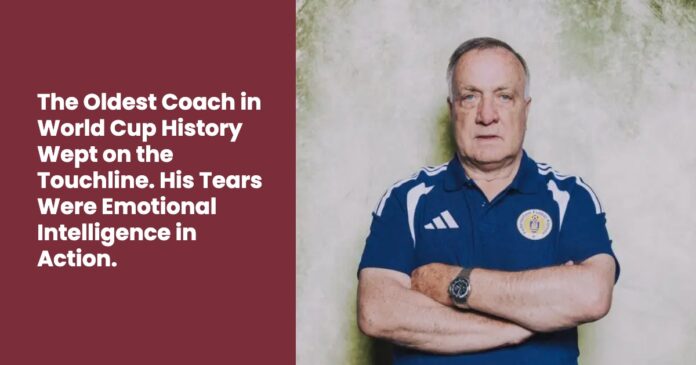
Before a ball was kicked in Houston, the cameras zoomed in on Dick Advocaat, the 78-year-old head coach of Curaçao. As the anthems played ahead of Curaçao’s first-ever World Cup match, Advocaat stood on the touchline and wiped away tears.
Then his island nation — population about 156,000, the smallest country ever to reach a World Cup — did the unthinkable. In the 21st minute against four-time champions Germany, Livano Comenencia hammered home Curaçao’s first goal in World Cup history. Advocaat threw his arms in the air, dropped back into his seat, and wept again.
Asked about his tears post-game, Advocaat said that at his age “this is when the emotion comes to the surface.” Refreshingly, the media has spoken about his crying in a positive light, not as a “lapse in composure” or a “signal of weakness.” A big reason for the changing tone of the media, and for the acceptance of Advocaat’s behavior, is the rising popularity and acceptance behind emotional intelligence (EI).

A Moment Of Emotional Intelligence: Advocaat Wasn’t Afraid To Show He Cares
Emotional intelligence is your ability to recognize emotions in yourself and others and use that awareness to guide your behavior and your relationships. Renowned EI expert, Dr. Travis Bradberry, breaks EI down into four core skills: self-awareness, self-management, social awareness, and relationship management.
Advocaat’s moment of crying publicly falls under that fourth skill, relationship management. While it might seem like a small and personal moment, his crying actually demonstrated a lot to his team and to his fans in Curacao. Specifically, he showed how expressing vulnerability is often an act of strength, and an act that bonds people to you.
But, if you’re a touch cynical like me, you might be saying, “Weren’t Advocaat’s tears involuntary? And if so, is that really an act of emotional intelligence?” This question gets at something deeper, which is that Advocaat wasn’t “performing vulnerability.” It was authentically how he felt in that moment, and he allowed himself to express it without fearing the reaction from his team, fans, or media. Advocaat had every reason to force himself to act “composed” on a global stage on live television. Instead, he opted to show everyone how much he cared.
The Research: Why Vulnerability Builds Loyalty
Vulnerability has been the through-line of Advocaat’s entire season. Back in February, he walked away from this biggest opportunity of his career, saying simply that “family comes before football,” to care for his seriously ill daughter. When her health improved, he returned in May, reportedly at his players’ urging. He had shown them, in the most public way possible, what he truly valued, and perhaps in an unexpected way, this is what won them over.
Observers reward vulnerability far more than we expect. In a 2018 paper in the Journal of Personality and Social Psychology, psychologists Anna Bruk, Sabine Scholl, and Herbert Bless documented what they called the beautiful mess effect: across seven studies, people judged their own moments of vulnerability far more harshly than the same vulnerability shown by others. That’s because we tend to read our own open emotion as weakness, while we read everyone else’s as courage. The very thing you’re most afraid to show is often what draws people to you.
Of course, crying is just one example of vulnerability. You might tell your team why a project matters to you, not just when it’s due. You might admit that a tough decision has been keeping you up at night. Or you might name what you’re proud of and what scares you. All of these are examples of vulnerability in action, and all will help you build your relationships by letting the people around you see how you feel.
Putting These Insights Into Practice
Germany went on to win 7-1, Curaçao’s historic goal swallowed by a four-time champion’s firepower. But that only sharpens the point: Advocaat didn’t cry because his team was winning. He wept over a single goal in a match they went on to lose badly. His emotion tracked the meaning of that moment.
The leaders we follow are the ones brave enough to let us see what they feel. So sit with this question for a moment: when did your team last see what you really care about?