

“Pretty much the first thing we do in our leadership development program is train emotional intelligence,” Lorna Hutchison-Milloy told me. As the Associate Director of Leadership Development and Coaching at Amgen, she leads a “small but mighty team” focused on developing over 100 first- and second-line field leaders per year.
Kicking off with emotional intelligence is intentional. “We regard emotional intelligence as the sort of foundation of all leadership development,” Hutchison-Milloy explained. In practice, that means any aspiring and newly promoted field leaders take an emotional intelligence (EQ) assessment, engage in a workshop, and put together a strategic action plan for EQ growth.
Only then do they move deeper into the longer six- or nine-month leadership journey. Her team’s reasoning is simple: “If you look at coaching skills, performance management, situational leadership, and team leadership skills, they all require emotional intelligence.” You can teach a leader what to do, but if they lack those social-emotional skills, the training won’t hold.
Across more than 40 interviews with talent development leaders, Hutchison-Milloy’s approach stood out for how her team treats EQ as foundational. Rather than make EQ a side module, it’s the soil that makes everything else grow.

Why Emotional Intelligence Is the Foundation of Amgen’s Leadership Program
“We regard emotional intelligence as the sort of foundation of all leadership development,” Hutchison-Milloy said. “That’s because we believe that the most successful leaders are those who possess emotional intelligence.”
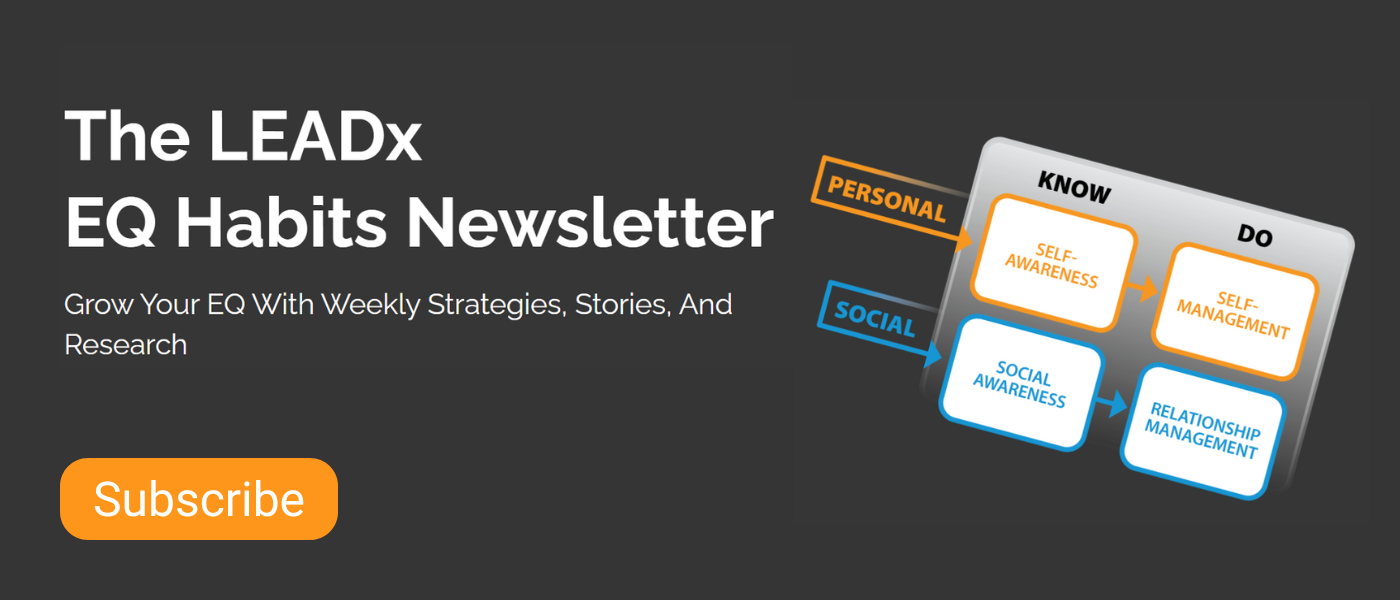
Her team trains leaders in the four core skills of emotional intelligence: self-awareness, self-management, social awareness, and relationship management. In other words, can you recognize what’s happening in you (self-awareness)? Can you control your response (self-management)? Can you accurately interpret what’s happening in others (social awareness)? And can you navigate the relationship in a way that builds trust instead of draining it (relationship management)?
For field leaders, these skills are their work. “Field leaders also need emotional intelligence to read a person and adapt to the situation on a sales call as well,” she said.
And because the research shows that EQ is highly trainable with practice, her team doesn’t treat EQ as “motivational” or “personality based.” They treat it like something you measure, train, practice, and revisit. As Hutchison-Milloy put it, “We never change after one workshop.”
Her structure is simple, scalable, and disciplined: Start with a self-assessment. Run a workshop that gives leaders a practical language for what they’re seeing in themselves and others. Build a development plan tied to that data. Refer back to that development plan over the course of the leadership development program to check on progress. “The point isn’t to get leaders to nod along. It’s to get them to notice themselves in real situations of emotional intelligence—and choose a different response.”
EQ Creates the Right Environment for the Coach Approach
“Our focus in our leadership development program has been on leaders’ ability to coach and their ability to create the right environment for coaching,” Hutchison-Milloy explained. And that ability to create the right environment is where emotional intelligence skills really come into play. Coaching requires a leader to slow down, listen, ask questions, stay curious, and resist the urge to control the outcome.
This is where I see many first-line leaders struggle. They learn the steps of a coaching conversation—open with a question, reflect back what you heard, ask the person to generate options. Then a different reality hits: the employee is upset, the leader grows impatient, and the coaching conversation begins to slip. By training EQ first, you can teach leaders how to create that optimal environment for a coaching conversation to happen.
AI as Amgen’s New Practice Partner: Simulations, Personas, and Feedback Loops
The concept is straightforward: create a persona, give leaders a scenario, and have them practice coaching the persona. The AI acts as a practice partner that can simulate conversations based on that persona (think personality, experience, age, etc.). The conversation is recorded, and then the AI reviews the recording and generates a structured feedback report.
Many participants are drawn to practicing with an AI persona because they don’t have to worry about how they come across to another person. Eliminating that fear helps create a low-stakes environment for practice, prior to role plays and real coaching conversations.
Hutchison-Milloy’s Favorite EQ Strategy: Neurolinguistic Programming
Hutchison-Milloy’s favorite EQ strategy comes from neurolinguistic programming (NLP), where you use a trigger—or “anchor”—to shift your emotional state to a more positive one. This tactic can help build self-awareness, confidence, and communication.
“You can shift your state back to something more ideal by having a trigger,” she explained. For her, that trigger is music, most recently Beethoven’s Fifth Piano Concerto. When she experiences frustration, distraction, or other negative emotions, she calls on that song, humming it to herself to reset and re-center.
To use this strategy yourself, pick an anchor in advance. A song. A short walk. A physical cue. A mantra. Something you can reliably use to reset your state when you feel it slipping.
What L&D Leaders Can Take from Amgen’s Approach
Hutchison-Milloy’s program works because it’s both human and a developmental system. It starts with social-emotional work and then builds out into coaching skills and situational leadership. And all of this is measured and then reinforced with modern practice tools like AI simulations.
If you’re leading people, three takeaways are worth applying immediately:
- Measure before you motivate. Start with an assessment and a development plan. Then revisit it—because your leaders won’t change after one workshop.
- Treat coaching as a daily practice field for EQ. The coaching conversation is a fertile field for EQ skills. Train EQ first, then practice and give feedback through that EQ lens.
- Use more reps, not more lectures. Whether it’s role-plays or simulations with AI personas, leaders get better by practicing real conversations and receiving feedback.
Because EQ appears in every moment and every interaction, it can act as an ideal foundation skill set. With social-emotional skills in their toolbelts, leaders can pick up skills like situational leadership and the coach approach much more quickly.