
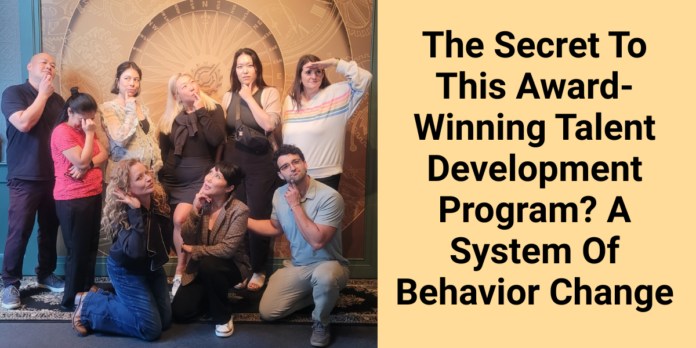
Across over 40 interviews with L&D leaders, one of the most interesting talent development ideas I’ve run into came from LA County Department of Health Services, where the Director of Leadership Development, Yvonne Banzali, and her team are rethinking the 360 itself.
Instead of stopping at how a leader is rated, their in-development 360 assessment will then ask direct reports a second question: “If this is how you’re rating your particular leader, what are you going to do to help support their growth?”
That one question shows a fundamentally different approach to talent development. It turns feedback and development into a shared responsibility between a team leader and their team members. And it shows the core philosophy behind LA County Health Services’ talent development work: Talent development works best as a system of behavior change, not a one-off assessment or event.

The 360 That Makes Behavior Change Shared Work
“We’ve of course worked with 360s before in the past,” Banzali told me. “What I didn’t like about other 360s was that they never came out with actionable reports. So, when we started designing the concept of our own 360, we were sure to build in an accountability system. That way we could operationalize behavior change and involve each leader’s team in their development.”
Banzali’s 360 redesigns post-assessment accountability. “For leaders to actually grow, you also need the environment, which includes their team members, to enable that growth,” she said. “To make it safe for the leaders to be vulnerable and grow to the needs of the team.”
The LDP team is exploring opportunities to pilot the 360 design concept to help them better understand how and where it can be thoughtfully integrated into the broader leadership development ecosystem.
6 Drivers Set the Leadership Standard at the LA County Department of Health Services
Banzali’s team’s new 360 design concept didn’t emerge in a vacuum. It sits inside a broader leadership architecture. One they’ve been building, scaling, and refining since 2018.
LA County Health Services serves a massive and complex population, and the leadership development team’s enterprise-wide programming touches thousands of leaders. Their flagship program, TOP, short for Transforming the Organization Through People, is designed as the foundation for leaders across the system, from emerging managers to executives.
“This is our foundational program,” Banzali said. “We had to create a leadership standard to make sure that it is a universal standard for all of our leaders.” That standard is built around six drivers of high-performing teams: communication, teamwork, emotional intelligence, psychological safety, inclusion and equity, and well-being.
That commitment to a common Leadership Standard helped the work grow from a small launch in 2018 into a much broader leadership ecosystem. It also helped earn external recognition, including an ATD BEST Award.
Nexus Powers the System by Turning Learning Into Daily Practice
What makes the leadership development team’s approach so uniquely strong at LA Department of Health Services is their dogged attention to turning learning into behavior change.
Currently in its pilot phase, the LDP team plans to launch an entire institution devoted specifically to behavior change—The Nexus Institute for Continuing Leadership Education and Excellence. The Nexus Institute connects leadership skills to the actual technical and managerial work leaders do every day.
First and foremost, the Nexus Institute includes workshops entirely devoted to taking what you’ve learned in other programs and applying it to your daily work. This “learning lab” space allows for peer insights, facilitator insights, and importantly, the time to think about and experiment with what you learned.
The Nexus Institute will also extend beyond workshops. It includes microlearning tied to performance systems, mentoring communities, alumni reunions, facilitation kits, and tools leaders can use with their own teams. “Learning is not an additional, outside thing,” Banzali said. “You have to find ways to actually adopt these skills into your everyday practice.”
AI Raises The Stakes For Emotional Intelligence
“The future at LA County Health Services is not about choosing between AI and EQ,” Banzali said. “It’s about both.” The more technology automates workflow and expands access to information, the more valuable distinctly human capabilities become: self-awareness, emotional regulation, trust-building, judgment, learning agility, and the ability to create a trusting environment for others.
Banzali made another distinction I found especially sharp. Leadership, she said, cannot remain “execution centered.” It has to become “environment centered.” Meaning, leaders increasingly create value by shaping the conditions under which their people can perform, adapt, and stay engaged.
As Banzali put it, “The more we are advancing technologically, the more we need to invest in human capital.”
Great Leadership Development Works As A System
When I asked Banzali what advice she would give someone stepping into her role for the first time, her answer should be required reading for every executive who is still searching for the one perfect workshop. “If you want transformation, the training itself isn’t the answer. It’s how you build the conditions around it that makes the difference,” she said.
The real strength of LA County Health Services’ talent development isn’t any single course, assessment, or framework. It’s the way the pieces fit together: a foundational program, a shared leadership standard, a behavior-focused 360, application labs, process integration, and a clear belief that EQ must be embedded into how leaders actually work.