
In leadership development, one challenge persists year over year, according to the LEADx Leadership Development Benchmark Report: Teams don’t have sufficient budget, staff, or senior support to scale high-quality development opportunities across the entire workforce.
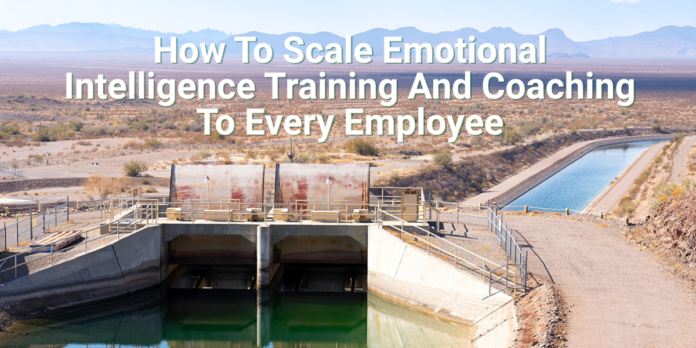
But there are organizations where the opposite is true and every single employee gets access to high-quality development. One such organization is Central Arizona Project (CAP), the organization responsible for delivering Colorado River water to the area where 80% of state’s population resides. At 500 people, half of whom spend their days spread across a 336-mile canal system of water, CAP manages to reach everyone by embedding EQ in the flow of everyday work through cohort-based programs, open-offerings, and easy-to-use tools all supercharged by in-house coaching available to every employee. Accomplishing this is no easy feat. In fact, you might say it’s about as difficult to pull off as creating and maintaining a sustainable water system in the Arizona desert.
To understand their approach, I spoke with Andrew Krahe, Program Manager overseeing Employee and Organizational Development. His philosophy is straight to the point: “Our primary focus is helping people recognize and appreciate the humanity of those around them.” And emotional intelligence, he says, is where that work begins.

Emotional Intelligence as the Cultural Foundation
CAP’s learning strategy starts with a premise that many companies skip: Emotional intelligence is a foundational business competency. “Everything we do stems from giving others grace and humility,” he told me. “Whether you’re giving feedback, having a crucial conversation, or navigating conflict…It all starts with a deep understanding of yourself and your relationships – two competencies that are hallmarks of emotional intelligence. And EQ is a skillset that can be developed and honed with practice.”
With their workforce divided between field employees, who maintain critical water infrastructure, and office employees, who navigate complex water policy, emotional intelligence becomes a unifying language.
“Everyone has to deal with emotions, whether you’re in a piece of heavy equipment or in the corner office,” Krahe said. “And what we know from the research by Dr. Lisa Feldman-Barrett and others, people who can get “granular” when recognizing and labeling their emotions regulate and express them better. And at CAP, we give people simple strategies to do just that.
A Yearlong Leadership Academy Built on EQ
CAP’s flagship program, the Supervisor Academy, has been in place for more than a decade. But its evolution over the course of that time mirrors a major shift in leadership development: from a heavy emphasis on theory (like a leadership master’s program) to an emphasis on the practical, more application-focused side of these durable, human skills (Krahe is careful to use durable skills, not soft skills. “Skills like self-awareness and relationship management aren’t soft, they are foundational and enduring”).
The Academy is cohort-based and runs for a full year. Each month, participants join half-day sessions focused on enduring durable skills like self-awareness, navigating emotions, coaching skills, and interpersonal communication. As this program is designed for people leaders, these skills are woven into crucial conversations and performance management.
One distinctive element is the “30,000-foot flyover” that Krahe and the team use to kick off the program. It’s a visual map of each participant’s assessment results laid out in one place. “We get their MBTI, CliftonStrengths, Fascinate assessment, Working Genius, the Emotional Intelligence Test on a whiteboard and tease out the overlap between each assessment. The goal is to widen the aperture and seeing the same results in different “languages” does that for folks. For example, they talk about how one’s preferred MBTI type can help build the core EQ skills of self-awareness and social awareness.
Krahe and the team help coach each leader’s transformation. “I’m an ICF-credentialed coach, so I meet with each participant monthly. They explore what they’re learning at a deeper level in their professional and personal lives. Many organizations are careful to separate the two. CAP leans into this because resonance across both is where the magic happens. “The desire to change is stronger if these durable skills can be practiced with not only employees and team members, but also significant others, children, and friends.”
The results of the program speak for themselves:
- 38% promotion rate among Academy participants. “That number is consistent across individual contributors and supervisors moving into higher roles,” Krahe pointed out.
- Improved retention numbers for those who go through development, with almost all attrition due to retirement. And this improvement is on an already high organization-wide number.
Scaling EQ Training to the Entire Organization
While the Supervisor Academy focuses on all people leaders, CAP knew the importance of giving every employee—not just supervisors— access to the same essential skills.
So Krahe and the team designed their Academy Shorts program, modular offerings that pull content from the flagship program and open it to every employee. “We didn’t want emotional intelligence to be leadership-only,” Krahe explained. “It’s good for everybody and more powerful in impact when everyone is familiar with the framework and its vocabulary.”
Employees can elect to attend monthly sessions covering many of the same topics as the Supervisor Academy: emotional vocabulary, psychological safety, and tools employees can take and apply immediately.
The organization also provides coaching to any employee who requests it, from people leaders to individual contributors. “Coaching scales more than people think,” Krahe said, pointing to the immense value a good coach generates. “Higher engagement, better safety scores, improved satisfaction. It all goes up when people feel seen and heard.”
Inside CAP’s Emotional Intelligence Workshops: 5 Strategies You Can Implement in Your Training
Krahe walked me through their EQ training in detail, and it’s far more robust than what many large companies offer. What follows are five of the best strategies and exercises they train.
1. Begin With the Mood Meter. Every session kicks off with the “mood meter” tool designed by Marc Brackett at Yale. “We want people to notice where they are emotionally, without judging themselves or feeling guilty,” Krahe explained. For this reason, they post the Mood Meter on office doors across CAP and use it in coaching sessions. Employees are encouraged to build the muscle of naming—not judging—their emotions.
2. Teach the Four “Navigational Truths” of Emotion. Based on the research of Brackett, Travis Bradberry, and others, the team presents several “universal rules of emotions”:
- We’re doing the best we can.
- Turn off your autopilot.
- Change your mindset.
- Change for yourself, not others.
3. Debrief the Emotional Intelligence Test. Participants complete an emotional intelligence self-assessment. “Sometimes scores among the group are similar, and we show them on screen, because it’s a great conversation starter,” Krahe said. “Other times, we keep them private. But the goal is always the same with the assessment: turn the mirror on yourself.”
4. Teach RULER for emotions: Recognize, Understand, Label, Express, and Regulate. “We want people to be emotional scientists,” Krahe said. “To observe emotions without bias, let them flow, but make the conscious choice to not let them control the story you are telling yourself.”
5. Introduce Practical Tools. Participants practice:
- The Red Wall: An exercise that helps people understand the six-second amygdala hijack rule, so that they can slow down and be more intentional in how they react when emotions run high.
- Granular emotional labeling: Largely steeped in the work of Dr. Lisa Feldman-Barrett, participants learn to label their emotions with increasing specificity. The research-backed idea is to “name it to tame it.”
“People go deep in these workshops,” Krahe said. “We’ve had tears in sessions. And that’s a good thing. It means we’re doing our job and creating space to be heard and be vulnerable.”
Start By Making It Safe To Talk About Emotions
Krahe emphasizes that culture—not curriculum—is the make-or-break factor for emotional intelligence training. “Making any organizational change without a deep understanding of the culture is like building a house on sand. That house will start to crack and eventually fall. Similarly, if it’s not safe to talk about emotions, none of the training is going to stick. The culture must reinforce it. That starts at the top and bottom and meets in the middle.”
This insight is echoed across many of the leaders I’ve interviewed: emotional intelligence must come before psychological safety, not after. As Krahe puts it: “People haven’t been given permission to talk about emotions, or they haven’t given themselves permission. Start there.” This idea is echoed in CAP’s programs for belonging, too. “At the core of belonging is emotional intelligence. If you build EQ, belonging follows.”
A Shared Language of Emotions
While many organizations struggle to scale high-quality leadership development programs, Central Arizona Project offers a compelling counterexample: with only 500 employees and a distributed workforce, they’ve built a culture where emotional intelligence and other enduring human skills are trained to every single employee. And where every employee has access to an ICF-certified coach.
They accomplished this not through bigger budgets or bigger teams, but by anchoring everything on a simple principle: “Help people recognize the humanity of those around them.”