
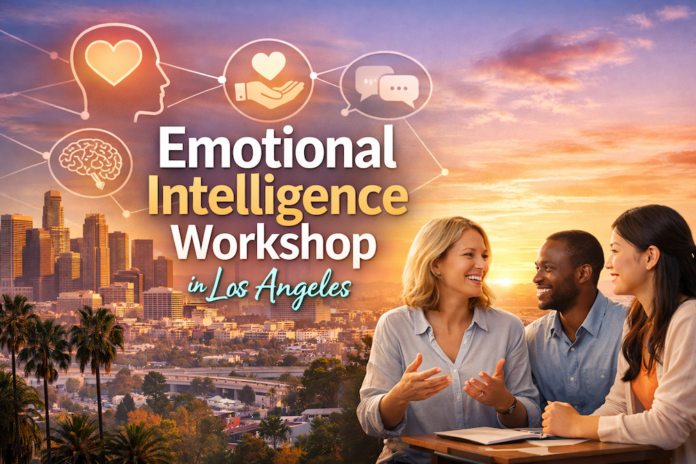
Picture a one-day training experience where your managers debrief their emotional intelligence assessment results, learn the business case for EQ, and leave with a concrete plan to improve their emotional intelligence over the next 90 days. That is high level what our emotional intelligence workshop in Los Angeles looks like. It’s designed for behavior change, not passive learning.
This guide is written for HR leaders, L&D professionals, and people managers researching emotional intelligence training in Los Angeles and EQ assessment options. We deliver EQ workshops across LA County—from corporate headquarters in Downtown LA to creative offices in Santa Monica and production lots in Burbank—so the perspective here comes from hands-on experience with the industries and teams that define this city.
The workshop we describe combines a validated EQ assessment, interactive group activities, real-world case studies drawn from common scenarios, and action planning tailored to fast-paced industries common in LA, such as entertainment, tech, healthcare, and professional services. In the sections ahead, you will learn why emotional intelligence matters in Los Angeles right now, what an emotional intelligence workshop actually involves, how EQ assessments (including the EQ Test) fit in, who benefits most, and how our specific EQ workshop in Los Angeles is structured.
Why Emotional Intelligence Matters in Los Angeles Right Now
Los Angeles is an ecosystem of high-stakes, fast-moving industries where people skills function as a performance multiplier. Entertainment and media account for roughly 19% of the regional GDP, employing over 700,000 people in film, television, and music. Silicon Beach hosts more than 1,000 tech firms, from Snapchat to SpaceX. The Port of Los Angeles handles 9.5 million TEUs annually, while healthcare systems like Cedars-Sinai and UCLA Health rank among the largest employers in Southern California. In every one of these sectors, leaders face compressed timelines, cross-functional collaboration, and constant stakeholder complexity.
Consider a showrunner managing a stressed writers’ room three weeks before a streaming deadline. Or a product lead in Playa Vista running hybrid stand-ups across time zones while engineering, design, and marketing all push competing priorities. Or a hospital charge nurse navigating friction between physicians, residents, and support staff during a staffing shortage. In each scenario, the ability to recognize emotions, manage emotions under pressure, and communicate with empathy determines whether the project succeeds or spirals into conflict.
LA’s workforce is among the most diverse in the country, with dozens of languages spoken across neighborhoods and industries. Social awareness and relationship management are not optional leadership skills here; they are requirements for inclusive leadership and effective communication. When a leader lacks the emotional intelligence to read a room, pick up on emotional cues, or navigate conflict constructively, the consequences show up in turnover, disengagement, and missed deadlines.
In this environment, emotional intelligence training is a core component of leadership development that directly impacts retention, collaboration, client satisfaction, and the success of high-visibility initiatives.
What Is an Emotional Intelligence Workshop?
An emotional intelligence workshop is a facilitated, interactive training session—typically one full day—where participants learn, practice, and receive feedback on core emotional intelligence skills: self-awareness, self-management, social awareness, and relationship management. Unlike a webinar or self-paced online course, a workshop creates space for role plays, peer feedback, and real-time coaching that accelerate behavior change.
A typical one-day emotional intelligence workshop in Los Angeles follows a structured agenda. The morning focuses on individual insight: participants review their EQ assessment results, identify personal strengths and development areas, and begin practicing self-awareness exercises such as emotion labeling. The afternoon shifts to applied skills—feedback conversations, crucial conversations, and building relationships—using scenarios drawn from common LA industries like entertainment, tech, and healthcare.
The primary goals are practical and measurable. Participants leave with improved communication techniques, strategies to manage emotional triggers in high-pressure meetings, tools for having difficult conversations, and methods for building psychological safety on their teams. These are not abstract concepts; they are skills practiced in the room and reinforced through action plans.
Who attends?
-
HR and L&D leaders building organizational capability.
-
Frontline and middle managers responsible for engagement and performance.
-
High-potential emerging leaders preparing for bigger roles.
-
Senior executives refining their influence and stakeholder management.
-
Client-facing professionals in entertainment agencies, law firms, consulting practices, and hospitality operations.
Why does an in-person or live-virtual workshop outperform self-paced learning for emotional intelligence? Because EQ is behavioral. You cannot develop strategies for managing your own emotions or reading others’ emotional cues by watching videos alone. Group practice, role plays using specific scenarios (such as a tense email thread between a studio executive and a vendor), real-time coaching from a facilitator, and peer feedback create the conditions for lasting change.
Exercises in a typical session include structured active listening practice, emotion labeling drills where participants identify and name feelings in real time, and live role plays about challenging situations such as giving corrective feedback to a stressed team member or de-escalating a client complaint.
The Four Core EQ Skill Areas
Most emotional intelligence models focus on four core components that the workshop addresses throughout the day. These skill areas build on each other and apply directly to leadership in Los Angeles.
|
EQ Skill Area |
What It Looks Like at Work in Los Angeles |
|---|---|
|
Self-Awareness |
A producer recognizes their own frustration during a notes meeting and pauses before reacting, preventing an unnecessary conflict with the director. |
|
Self-Management |
A startup founder in Santa Monica uses breathing and reframing techniques before a high-stakes investor call, staying calm and focused under pressure. |
|
Social Awareness |
A healthcare manager at a major LA hospital notices burnout signals on the night shift team and adjusts staffing and communication tone before turnover spikes. |
|
Relationship Management |
A creative director in Culver City repairs trust after a heated pre-launch conflict by acknowledging the friction and facilitating a constructive debrief with the marketing team. |
These skill areas form the foundation of leadership emotional intelligence. The workshop provides structured practice in each, with feedback loops that help participants improve self-awareness and develop strategies for stronger relationships at work.
The Role of EQ Assessments in Emotional Intelligence Training
Emotional intelligence can be measured through validated assessments, and this data transforms EQ training from generic to targeted. Instead of guessing which skills a group needs, facilitators use assessment results to focus workshop time on the specific emotional intelligence competencies that matter most for that team.
An EQ assessment provides a baseline for each participant. It identifies which skills are relatively strong—perhaps empathy or interpersonal skills—and which need focused development, such as impulse control or stress tolerance. This shared language makes coaching conversations more productive and gives participants a clear starting point for growth.
Assessments also make workshops more efficient. A production team dealing with recurring conflict might spend more time on feedback and de-escalation. A clinical team facing chronic stress might focus on stress management and self-regulation. Rather than delivering generic content, the facilitator tailors exercises to the group’s actual profile.
For HR and Talent leaders in Los Angeles, group EQ data supports broader leadership development programs. You can identify patterns across managers, inform succession planning, and build training roadmaps that address real gaps rather than assumptions. Over time, repeated assessments track measurable behavior change and help demonstrate ROI on emotional intelligence training investments.
Understanding the EQ Test
Participants complete the EQ Test online in approximately 10-15 minutes. They receive a comprehensive report summarizing their EQ profile across the four core skills. The assessment is designed to be practical, with actionable language that managers can understand and apply.
The EQ Test measures:
-
Self-Awareness: Your ability to recognize and understand your emotions.
-
Self-Management: Your ability to manage your emotions toward a positive outcome.
-
Social Awareness: Your ability to recognize and understand the emotions of others.
-
Relationship Management: Your ability to use each of the other three skills to build, sustain, and manage relationships.
Each of these domains relates directly to leadership performance. A tech executive in Silicon Beach who scores lower on impulse control might struggle with reactive decision-making during product crises. A healthcare leader with high empathy but low assertiveness might avoid difficult conversations with underperforming staff. The EQ Test makes these patterns visible.
Organizations in Los Angeles typically use the EQ Test as a baseline for leadership development programs, as part of one-on-one executive coaching engagements, for team development offsites, and during high-potential or emerging leader programs. The assessment’s credibility, structure, and compatibility with ongoing coaching make it a popular choice for organizations serious about behavior change.
For example, an LA-based professional services firm might use EQ results to shape a six-month coaching and training plan for newly promoted people managers. Each manager receives individualized development priorities based on their assessment, and the cohort attends a workshop together to build shared knowledge and practice skills.

From Assessment to Action: Turning EQ Insight Into Behavior
A common pitfall in leadership development: leaders complete an EQ Test, read the report, feel “seen,” and then return to old habits because nothing in their environment supports change. Research suggests that 70-80% of development initiatives fail due to lack of sustained application.
Workshops address this gap by converting EQ report findings into specific action steps. The framework is straightforward: insight leads to one priority, which leads to deliberate practice, which leads to feedback, which leads to habit formation over 30-90 days.
Here is a concrete example. A Los Angeles sales leader learns from their EQ report that impulse control and stress tolerance are lower than expected. In the workshop, they identify one behavior to focus on: pausing for three seconds before responding to client objections. They practice this in role plays with peers, receive feedback on their delivery, and leave with a plan to apply the technique in their next five client calls. A follow-up coaching session two weeks later reinforces the behavior and troubleshoots challenges.
Repeated application, supported by microlearning or coaching, turns one small EQ behavior into a reliable habit. That habit then shapes how the leader handles team meetings, performance discussions, and challenging situations with clients. This is how emotional intelligence training produces measurable leadership behavior change.
Target Audience: Who Will Benefit Most from an EQ Workshop?
While anyone can benefit from emotional intelligence training, certain roles in Los Angeles gain outsized value from a focused workshop.
HR and L&D leaders who are building consistent leadership expectations across offices in Downtown, West LA, and the Valley often use workshops to introduce a shared language around emotional intelligence. A workshop creates alignment and gives managers a common framework for feedback, coaching, and development conversations.
People managers and supervisors responsible for engagement, performance reviews, and conflict resolution benefit from practicing skills they will use daily. Many LA managers lead hybrid teams with both in-office and remote employees, making social awareness and communication even more critical.
Client-facing and service leaders—account managers in entertainment agencies, partners in law or consulting firms, hospitality managers in West Hollywood, clinical leaders in hospitals—operate in roles where relationship quality directly drives revenue and outcomes. High EQ supports better client relationships, stronger retention, and the ability to resolve conflicts constructively.
High-collaboration, project-based roles such as those found in creative agencies, product teams, production teams, and cross-functional project groups face tight timelines where misunderstandings or unregulated emotions can derail progress. Workshops give these professionals tools to navigate conflict and communicate effectively under deadline pressure.
It is worth noting that EQ skills spill over into life outside of work. In a city like Los Angeles—where commutes are long, schedules are demanding, and personal and professional success often intertwine—improved self-awareness and empathy support better family communication, community involvement, and overall well-being.
Inside LEADx’s Emotional Intelligence Workshop in Los Angeles
This is a one-day, high-engagement emotional intelligence workshop delivered by a certified LEADx facilitator for Los Angeles organizations. The program integrates the EQ assessment with hands-on skills practice and action planning, creating a practical path from insight to behavior change.
The flow of the day follows a clear structure:
-
Pre-work: Participants complete the EQ assessment online before the workshop
-
Morning: Debrief of individual and group EQ profiles; experiential exercises for self-awareness and self-management
-
Afternoon: Practice on social awareness and relationship management, including feedback delivery, conflict navigation, and coaching conversations
-
Closing: Personal action plans with 1-2 prioritized EQ behaviors to practice over the next 30-60 days
The workshop is grounded in emotional intelligence research, including work popularized by Dr. Travis Bradberry, author of Emotional Intelligence 2.0. It also incorporates LEADx’s leadership behavior change methodology, which emphasizes repeated practice and reinforcement rather than one-time learning events.
Role plays and case studies are tailored to LA industries. Participants might practice:
-
A studio or production leader giving corrective feedback to a stressed editor days before a release
-
A healthcare manager diffusing tension between nurses and physicians over scheduling
-
A tech team lead in Playa Vista improving collaboration between engineering and product
-
A hospitality or restaurant manager de-escalating an upset customer on a busy weekend
Participants leave with their personalized EQ report, clarified strengths, prioritized EQ behaviors to practice, and a simple plan to track progress. This is emotional intelligence training designed for application, not theory.

Our Venue: Where the Experience Happens
The workshop is delivered where it works best for the client: onsite at the organization’s Los Angeles offices or at a convenient offsite location anywhere in LA County.
Sessions are commonly held in:
-
Downtown LA near major corporate offices and professional services firms
-
Santa Monica and Playa Vista for tech and media companies
-
Burbank and Studio City for entertainment and production teams
-
Pasadena and Glendale for professional services and healthcare organizations
-
Long Beach or El Segundo for logistics, aerospace, and defense operations
The ideal room setup includes natural light if possible, movable chairs for breakout groups, tables arranged to encourage discussion, and enough space for standing activities and small-group work. AV requirements are straightforward: a projector, speakers for video content, and whiteboards or flipcharts for capturing insights.
Whether delivered at a hotel meeting room, corporate campus training center, or studio conference space, the environment is designed to feel safe, confidential, and highly participatory. Leaders must be comfortable practicing new skills, which means the physical space matters.
Workshop Format and Delivery Options
Length: One full day (typically 9:00 a.m. – 4:30 p.m. Pacific), with morning and afternoon sessions, breaks, and lunch. Minor timing adjustments can be made for shift-based teams or organizations with specific scheduling needs. Half-day or 1-hour sessions are also available depending on the context and needs.
Delivery formats:
-
Onsite: Facilitator comes to your Los Angeles location
-
Live virtual: Delivered via Zoom or Microsoft Teams for distributed LA-based or multi-city teams
Group size: 10-30 participants is ideal to support discussion and individual attention. Larger groups can be accommodated with co-facilitators or multiple sessions.
Location options organizations choose:
-
Corporate headquarters in Downtown LA
-
Creative offices in Santa Monica or Venice
-
Studio lots in Burbank
-
Academic or medical campuses near Westwood or Pasadena
-
Offsite conference centers throughout LA County
Facilitation: All sessions are led by a certified LEADx coach trained in EQ Test debriefing and experiential facilitation, with experience working with LA industries and diverse, multicultural teams.
Reinforcement options:
-
Post-workshop coaching sessions (individual or group)
-
6-12 months of access to microlearning content on emotional intelligence
-
Optional re-administration of the EQ assessment after 9-12 months to measure growth
Career Benefits of Emotional Intelligence Training
Emotional intelligence training is no longer a “nice to have” in Los Angeles leadership roles. It is increasingly viewed as a differentiator for promotions, high-impact assignments, and the ability to lead through complexity. Research indicates that leaders with high EQ are approximately twice as likely to be promoted into senior roles.
Higher emotional intelligence improves communication clarity, helping leaders articulate expectations and respond to feedback without triggering defensiveness. It supports the ability to handle conflict without damaging workplace relationships—a critical skill when you are navigating tight deadlines with cross-functional teams. Leaders who develop self-awareness and self-management are better at managing stress and ambiguity, reducing burnout risk for themselves and their teams in demanding LA industries.
Strong social awareness and relationship management lead to better client outcomes, stronger internal networks in matrixed organizations, and greater influence when driving change initiatives. In entertainment, this might mean keeping a production on track through creative disagreements. In healthcare, it might mean retaining staff during a challenging restructuring. In tech, it might mean launching a product with a cross-functional team that trusts each other.
The career benefits are concrete:
-
Improved confidence in high-stakes conversations
-
Greater ability to manage stress and lead under pressure
-
Stronger relationships with direct reports, peers, and executives
-
Enhanced expertise in resolving conflicts and navigating politically complex circumstances
-
Increased ability to communicate effectively with clients and stakeholders
Why Organizations Choose This Approach to EQ Training
Organizations choose this emotional intelligence workshop model because it focuses on behavior change, not just abstract awareness or lecture-style teaching. Many leaders have read about emotional intelligence or taken online assessments, but they have not practiced the skills in realistic scenarios with feedback.
Combining the EQ assessment, expert facilitation, and ongoing reinforcement (coaching, microlearning, or follow-up sessions) helps ensure that leaders actually apply what they learn. The approach is flexible enough to align with existing leadership competency frameworks, DEI initiatives, and performance management systems used by LA-based companies, universities, and healthcare systems.
As Amy Happ, the Director of Leadership Development at Grant Thornton said about the LEADx workshop, “This workshop is full of useful, everyday ways to build and enhance your emotional intelligence!”
The focus is on practical, immediately applicable skills and language that leaders can use in their very next one-on-one, staff meeting, or client call.
Is an Emotional Intelligence Workshop the Right First Step?
An emotional intelligence workshop is often the best first move when an organization wants to build a shared language and foundational EQ skills across a group of managers or a specific team.
Workshops make sense when you are:
-
Rolling out a new leadership model across LA offices
-
Addressing recurring conflict or communication breakdowns across teams
-
Supporting newly promoted managers who need to develop interpersonal skills quickly
-
Complementing an existing performance management or engagement initiative
This differs from EQ certification, which is more appropriate for internal HR, L&D, or coaching staff who want to become qualified to administer and debrief EQ assessments themselves as part of an ongoing internal program. Certification involves a multi-module learning path and formal accreditation.
Some organizations start with a workshop for a pilot group of managers and later pursue certification for internal practitioners. This makes workshops a practical stepping stone rather than an either/or decision. If your team needs both immediate skill-building and long-term internal capability, explore EQ certification options to learn more about that pathway.

Frequently Asked Questions
Is the EQ assessment included in this workshop?
Yes, for most Los Angeles workshops, each participant completes the EQ Test in advance and receives a personal report that is debriefed during the session. This allows facilitators to tailor exercises to the group’s actual EQ profile. Any variations in assessment options will be discussed during initial scoping conversations.
How is this different from EQ certification?
This workshop helps leaders understand and apply their own EQ results through guided practice and feedback. Certification is a longer, more intensive process for HR professionals or coaches who want to become qualified to administer and interpret EQ reports internally. Learn more about EQcertification if you are exploring that option.
Can the workshop be customized for our organization or industry?
Yes. Examples, role plays, and real-world case studies are customized for LA industries such as entertainment, tech, healthcare, and professional services. The facilitator will coordinate with HR or L&D to incorporate your organization’s language, values, and specific learning outcomes.
Is the workshop available virtually for Los Angeles–based teams?
The same one-day emotional intelligence course that Los Angeles teams receive onsite can also be delivered in a live-virtual format. This accommodates hybrid teams and remote employees who work across LA County or other time zones while maintaining the interactive, practice-based approach.
How far in advance should we schedule a workshop in Los Angeles?
We recommend reaching out six to eight weeks ahead for preferred dates, especially during busy seasons such as Q1 planning or late summer. Last-minute dates may sometimes be available depending on facilitator schedules.
How do we measure whether the workshop improved emotional intelligence?
Options include pre/post self-ratings, EQ retesting after several months, follow-up pulse surveys, and 360 feedback on specific behaviors. Qualitative indicators such as fewer escalations, improved engagement scores, and feedback from direct reports also help track progress. Teams can also use the LEADx Emotional Intelligence Test as an introductory benchmark.
Bring an Emotional Intelligence Workshop to Los Angeles
An emotional intelligence workshop in Los Angeles helps leaders navigate the city’s demanding, diverse, and fast-moving work environment. By improving self-awareness, self-regulation, empathy, and relationship management, managers gain the tools to lead more effectively and support their teams through challenging situations.
Combining an EQ assessment with a one-day, high-participation workshop and optional reinforcement creates a practical path from insight to sustained behavior change. Participants leave with clear priorities, practiced skills, and a plan to develop strategies that enhance their leadership over the following months.
If you are an HR leader, L&D professional, or executive exploring emotional intelligence training for your Los Angeles organization, request a consultation to discuss how this workshop can support your team.
In a city where cross-cultural collaboration, high-speed projects, and relationship-driven work define professional success, investing in leadership emotional intelligence is one of the most leverageable steps an organization can take. Whether your team sits in Downtown LA, Burbank, or Santa Monica, the ability to recognize emotions, respond thoughtfully, and build stronger relationships is the foundation of effective leadership.