
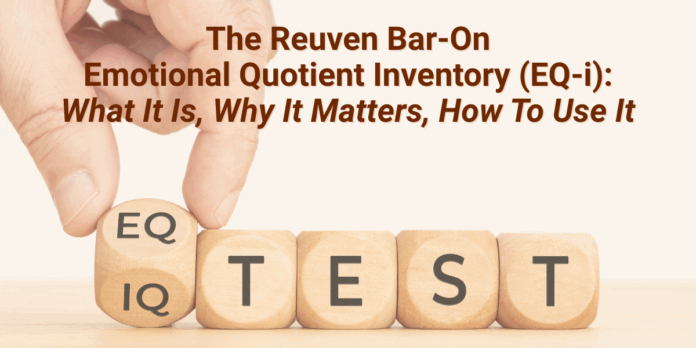
The Reuven Bar-On Emotional Quotient Inventory (EQ-i): What It Is, Why It Matters, How To Use It
At LEADx, we work with a wide range of emotional intelligence assessments. This article is intended as a neutral, research-informed overview of the Bar-On EQ-i—so you can understand its history, components, and uses—before deciding whether it’s the right tool for your needs.
Most leaders don’t get better because someone tells them to “be more empathetic.” They get better when they can see their patterns on paper and know exactly which behaviors to practice next. That’s the promise of emotional intelligence assessments done right: they create a data-backed entry point to self-awareness, a structured reflection, and a short list of high-leverage habits to build.
The challenge: not all assessments are created equal. On one end, you’ll find beautifully academic tools that are tough to debrief for busy managers. On the other, you’ll find personality-flavored quizzes with thin psychometrics that are easy to game. The Bar-On Emotional Quotient Inventory (EQ-i) leans toward the more academic, coaching-heavy approach covering a complex set of competencies.
This guide is a research-informed overview of the bar-on emotional quotient inventory (eq-i) for HR and L&D professionals, educators, coaches, and anyone pursuing personal development. You’ll get plain-English explanations, real examples, and a balanced take on where EQ-i shines and where to be cautious.
In this guide, you’ll learn:
- What the Bar-On EQ-i is and how it works
- The components it measures—and why each matters at work
- How to read an EQ-i report quickly and turn scores into behavior change
- When to choose EQ-i vs. other EI assessments (MSCEIT, TEIQue, EQ-i 2.0, and more)
- Real-life applications across leadership development, healthcare, education, and DEI
- Clear answers to common FAQs (validity, reliability, use cases, best practices)
- How to become a certified emotional intelligence coach
If you’re choosing an EI tool—or need a common language for coaching, workshops, or culture change—this article will help you decide whether the Bar-On EQ-i is the right fit and how to use it well.
What Is the Bar-On Emotional Quotient Inventory (EQ-i)?
The Bar-On Emotional Quotient Inventory (EQ-i) is one of the earliest scientifically developed tools for measuring emotional intelligence. Created by psychologist Reuven Bar-On in the late 1980s and first published in 1997, it was designed to quantify what he called emotional-social intelligence: the cluster of abilities that help us perceive, understand, and manage emotions in ourselves and in relationships with others.
Unlike ability-based tests (such as the Mayer-Salovey-Caruso Emotional Intelligence Test, or MSCEIT), the EQ-i is a self-report inventory. Participants answer 100+ items about their typical thoughts, feelings, and behaviors. Their responses are scored across 15 subscales grouped into five broad composites: Intrapersonal, Interpersonal, Stress Management, Adaptability, and General Mood. The result is a profile that highlights both strengths and potential development areas.
What makes the Bar-On EQ-i distinctive is its balance between breadth and usability. It goes deeper than surface-level “EQ quizzes” by producing scores on specific competencies (like empathy, impulse control, or optimism) that coaches and trainers can turn into concrete action steps. At the same time, it avoids being so technical that only psychologists can interpret it. That mix has made the EQ-i popular in leadership development, healthcare, education, and even clinical psychology.
A Short History: From Thorndike to Bar-On
The idea that emotions play a central role in intelligence isn’t new. In fact, the roots of the Bar-On Emotional Quotient Inventory (EQ-i) trace back over a century.
- Darwin and adaptation. Charles Darwin wrote about the evolutionary role of emotions in survival and adaptation. For Darwin, emotions weren’t distractions from rational thought—they were vital signals that helped humans and animals respond effectively to their environments.
- Thorndike and social intelligence. In 1920, psychologist Edward Thorndike introduced the concept of social intelligence: the ability to understand and manage people. He argued that success at work often depended less on raw IQ and more on how well people handled social relationships.
- Mid-century research. Through the 20th century, researchers began to recognize that interpersonal skills, adaptability, and stress tolerance were distinct from traditional measures of intelligence. Still, there wasn’t a comprehensive model that tied them together.
- Reuven Bar-On’s contribution. In the 1980s and 1990s, Israeli psychologist Reuven Bar-On synthesized these threads into what he called emotional-social intelligence. He argued that a set of non-cognitive skills and competencies determine how effectively we cope with demands and pressures. To measure these, he developed the EQ-i, first published in 1997—the first commercial emotional intelligence inventory to be peer-reviewed, normed on a large population, and widely adopted across fields.
Bar-On’s model stood apart from others by emphasizing well-being and adaptability alongside interpersonal skills. While later popularized models (like Daniel Goleman’s in the mid-1990s) focused heavily on leadership, Bar-On’s work provided a broad, psychometric foundation—one that could be used not just in business, but also in education, healthcare, and clinical psychology.
Today, the EQ-i remains an important part of the emotional intelligence landscape. It is often described as a “mixed model” of EI because it blends personality traits, emotional skills, and social competencies. That blend has been debated in academia, but it also makes the EQ-i especially practical: it maps directly onto behaviors and skills that organizations can train, measure, and improve.
Timeline of Emotional Intelligence and the Bar-On EQ-i
- 1872 — Charles Darwin
Publishes The Expression of the Emotions in Man and Animals, arguing emotions are essential for survival and adaptation. - 1920 — Edward Thorndike
Coins the term social intelligence: the ability to understand and manage people. - 1940s–1970s — Expanding concepts
Psychologists highlight adaptability, stress tolerance, and interpersonal skills as key to effectiveness, but no unified model emerges. - 1980s — Reuven Bar-On’s research
Develops the idea of emotional-social intelligence as a broad set of non-cognitive skills that shape coping and success. - 1997 — The EQ-i is published
The first commercially available, peer-reviewed emotional intelligence inventory, normed on thousands of participants across cultures.
What the EQ-i Measures: Components & Why They Matter
The Bar-On Emotional Quotient Inventory (EQ-i) measures emotional and social intelligence across 15 subscales, grouped into five composite areas. Each subscale captures a different slice of how people understand themselves, relate to others, manage stress, adapt, and sustain a positive outlook.
What makes the EQ-i powerful is its specificity: instead of giving you one vague “EQ score,” it breaks emotional intelligence into trainable competencies you can link directly to coaching goals, leadership development, or team workshops.
Here’s a plain-English breakdown of every component.
What the EQ-i Measures: Components & Why They Matter
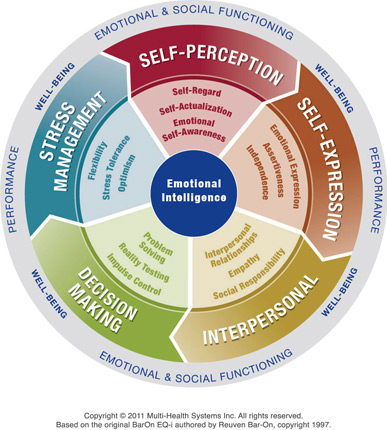
The Bar-On Emotional Quotient Inventory (EQ-i 2.0) organizes emotional intelligence into five composite scales, each with three subscales. Together, they provide a deep view of how you perceive yourself, express emotions, relate to others, make decisions, and handle stress.
What sets the EQ-i apart is that it doesn’t stop at a single “EQ score.” Instead, it highlights 15 concrete competencies you can train, coach, and track over time. Here’s how each composite works, with examples of why it matters in the workplace.
1. Self-Perception
- Self-Regard — Confidence in your abilities and acceptance of yourself. In practice: leaders with healthy self-regard are steady under pressure and model resilience.
- Self-Actualization — Ongoing pursuit of personal growth and purpose. In practice: predicts motivation, engagement, and long-term goal achievement.
- Emotional Self-Awareness — Recognizing your feelings and how they affect behavior. In practice: the foundation for regulating reactions and improving communication.
2. Self-Expression
- Emotional Expression — Communicating feelings openly and effectively. In practice: creates psychological safety and prevents bottling emotions that explode later.
- Assertiveness — Standing up for your beliefs and needs respectfully. In practice: vital for feedback, boundary-setting, and influence.
- Independence — Self-directed thinking and decision-making. In practice: fosters initiative and reduces over-reliance on approval.
3. Interpersonal
- Interpersonal Relationships — Building and sustaining mutually supportive connections. In practice: improves collaboration and team cohesion.
- Empathy — Understanding and appreciating others’ perspectives. In practice: enhances leadership trust, customer service, and conflict resolution.
- Social Responsibility — Acting with ethics and community awareness. In practice: links directly to organizational trust and inclusive culture.
4. Decision Making
- Problem Solving — Analyzing challenges and generating effective solutions. In practice: reduces thrash cycles and builds credibility.
- Reality Testing — Keeping perceptions grounded in facts and evidence. In practice: critical for strategy, forecasting, and risk management.
- Impulse Control — Managing urges and resisting rash actions. In practice: lowers conflict, improves negotiations, and prevents costly mistakes.
5. Stress Management
- Flexibility — Adapting emotions, thoughts, and behaviors to change. In practice: smooths transitions during restructuring or new initiatives.
- Stress Tolerance — Functioning effectively under pressure. In practice: linked to resilience, retention, and steady team morale.
- Optimism — Maintaining a positive outlook even in setbacks. In practice: spreads persistence and energy across the team.
While all of these competencies hold big value, I find that in a practical training and coaching environment, it becomes very difficult to effectively debrief each of these competencies in a practical, applicable way. It tends to be much more effective to train four core skills or competencies as-needed. I would even recommend going deeper on the four core skills using a 360 assessment before going this deep with a self-assessment. This is our approach at LEADx (but more on that another time).
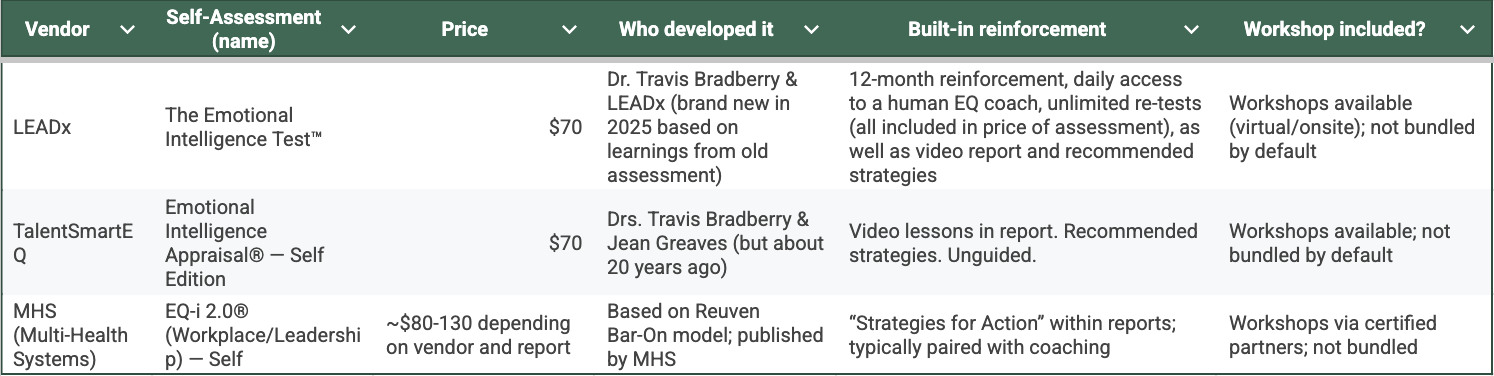
 Comparison With Other Self-Assessments (At a Glance)
 Comparison With Other Self-Assessments (At a Glance)
Below are commonly used EQ self-assessments, organized for HR/L&D buyers. (Pricing and packaging vary by region/provider; confirm current details with each vendor.) I highly recommend finding an assessment that includes a certification program so that you can learn to debrief, coach, and deliver workshops using the assessment.
Real-Life Applications of the Bar-On Emotional Quotient Inventory (EQ-i): Four Research-Backed Examples
When I think about and talk about the Reuven Bar-On assessment, I like to get into the specific competency use cases. For example, many L&D and HR professionals will get specific requests for training for specific teams. The customer success team might want to work on “crucial conversations,” the sales team might want to work on “influence,” and the engineering team might want to work on “conflict resolution.” The bar-on can be a great tool in this case because it drills down to the competency level in the report. That way you can draw on that specific competency for that training session. THEN, you can simultaneously introduce the concept of emotional intelligence as a whole and how the other core competencies interact with that one to produce the outcome behavior (i.e., conflict resolution).
To me, this is the ideal use case for Bar-on. When you know you want to introduce EQ company-wide, but you also want to drill deeper into one of the main competencies that it touches on. It can be a cool way to balance the specific needs of the team with the universal language/behaviors of the company.
Common use cases include:
1. Healthcare Worker Resilience and Burnout Prevention
- Use the EQ-i to assess emotional self-awareness, stress tolerance, impulse control, and interpersonal functioning among nurses, physicians, or allied health staff.
- Identify those with low stress-management or low adaptability scores for targeted resilience training or peer support interventions.
- Evaluate before/after changes in EQ scores after delivering an emotional-intelligence training program.
- Supporting research: A recent meta-analysis of EI training among healthcare professionals showed effectiveness of interventions in improving EI and reducing burnout indicators.
2. Leadership Development & Succession Planning in Organizations
- As part of a leadership pipeline program, give EQ-i assessments to high-potential managers to map their emotional intelligence profile (e.g. empathy, self-regard, decision-making) and identify gaps.
- Use the results to co-design coaching plans or group workshops (e.g. on conflict resolution, influence, emotional self-regulation).
- Track changes over 6–12 months to link EI growth to outcomes (like team engagement, retention, performance).
- Supporting research: The EQ-i is frequently used in organizational settings and is described as a core tool in leadership programs
3. Educational / School Administrators & Teachers
- Administer the EQ-i to school principals or teacher leaders to understand their emotional and social strengths (e.g. empathy, social responsibility, flexibility).
- Use results to design professional development in emotional leadership, conflict management, or resilience.
- Compare across schools to identify “culture-lever” leaders whose EI profiles correlate with higher teacher satisfaction or reduced turnover.
- Supporting research: A dissertation used the Bar-On EQ-i to study leadership experiences of school principals.
4. Diversity, Equity & Inclusion (DEI) & Culture Change Initiatives
- Use the EQ-i before a DEI or inclusion / unconscious bias training to benchmark emotional-social competencies such as empathy, interpersonal awareness, and social responsibility.
- After the intervention, re-assess to see if the training moved the needle on these dimensions.
- Analyze subgroup differences (by department, demographic groups) to surface systemic emotional or social intelligence gaps.
- Use results to refine future DEI interventions or embedding of emotionally intelligent behaviors in policies, onboarding, leadership norms.
Frequently Asked Questions about the Bar-On Emotional Quotient Inventory (EQ-i)
What is the Bar-On EQ-i?
The EQ-i is a self-report assessment of emotional intelligence first developed by psychologist Reuven Bar-On. It measures 15 emotional and social competencies grouped into five composites.
What is the difference between the original EQ-i and EQ-i 2.0?
The original EQ-i (1997) introduced the Bar-On model. In 2011, the EQ-i 2.0 was released with updated norms, reorganized composites, and more user-friendly reporting. Both share the same underlying competencies.
Is the EQ-i scientifically valid?
Yes. Research shows the EQ-i demonstrates good reliability and validity, and meta-analyses link emotional intelligence (including mixed/self-report tools like EQ-i) to job performance, leadership effectiveness, and well-being. Critics note it’s best used as a development tool, not a gatekeeper for hiring.
Who typically uses the EQ-i?
HR leaders, executive coaches, educators, healthcare organizations, and researchers use it to support leadership development, resilience programs, culture change, and personal growth.
How long does it take, and what do you get?
The EQ-i usually takes 20–30 minutes online. Reports provide composite and subscale scores, norm comparisons, and suggested development strategies.
Can people fake their EQ-i results?
Like all self-reports, the EQ-i is vulnerable to social desirability bias. That’s why it’s most powerful when framed as a development tool and paired with coaching, 360 feedback, or observed behaviors.
Bar-On Emotional Quotient Inventory (EQ-i): Final Takeaways
The Bar-On EQ-i remains one of the most widely used and researched emotional intelligence assessments in the world. By breaking EQ into 15 trainable competencies, it gives leaders, teams, and organizations a practical roadmap for development. Used thoughtfully alongside coaching, feedback, and training, the assessment becomes an emotional intelligence growth engine.