

As automation and AI streamline transactions and logistics for retail leaders, the human side of leadership becomes more decisive than ever. Put more simply: When the pressure is highest, how well do your leaders actually implement emotional intelligence skills?
Emotional intelligence skills are what enable a leader to thrive under that pressure, to navigate that tough conversation, and ultimately to recover from that stress in a healthy way. For these reasons and many more, Daniel Goleman wrote in his classic Harvard Business Review article that EQ is “the sine qua non of leadership success.” And that statement isn’t just theory. Recent research confirms that well-designed emotional intelligence training programs measurably improve workplace outcomes like employee satisfaction, collaboration, and reduced burnout.
Few companies embody this focus on emotional intelligence more clearly than Tractor Supply Company. As the largest rural lifestyle retailer in the U.S., with more than 2,300 stores and a mission to “Serve Life Out Here,” Tractor Supply is investing heavily in emotional intelligence to meet the demands of today’s retail environment. And few people are better positioned to explain how and why than Ryan Samia, the company’s Director of Talent and Leadership Development for the Store Support Center, Distribution Centers/Supply Chain, and Petsense.

The Architecture of a Great EQ Program: Make It A System (Not A Session)
At Tractor Supply, emotional intelligence is embedded in the way leaders are trained, from beginning to end. Here are two examples.
Leadership Essentials. Every new people leader who joins Tractor Supply’s Store Support Center (corporate hub) completes a 2-day program called Leadership Essentials. It blends cultural integration with core leadership skills. Leaders complete a DISC Behavioral Style assessment to surface communication styles and emotional triggers, then transition into an EQ assessment that becomes the basis for role plays, case studies, and guided reflection. “DISC helps people inform their communication style and their ‘triggers’ and emotional intelligence then helps them regulate to be effective despite those triggers,” Samia explained.
Petsense District Manager Cohorts. For the field-facing pet specialty retail business, Petsense by Tractor Supply recently conducted their leaders meeting for their district managers, and the main theme was around EQ Emotional intelligence reading and an assessment are foundational to the program. From there, leaders receive monthly “nudges” and discussion guides to weave emotional intelligence concepts into their weekly work.
The through-line across both programs is clear: assessments provide the data as a jumping-off point, workshops act as a space for learning and practice, and sustainment activities turn learning into habits. Pulse checks sent out to participants’ managers help Samia and his team track participant behavior change. “It’s not a one and done,” Samia emphasized. “Learning and practice need to take place over time until new behaviors stick.”
What They’re Solving for with EQ: Relationship Management and Self-Management
Different parts of Tractor Supply face different emotional challenges. Samia pointed to two key examples:
In the retail field, relationship management is critical. Customer interactions can be intense, and district managers are often caught between the needs of store managers, team members, and the people walking in the door. By practicing conflict resolution and empathy under pressure, district managers learn to keep both service and morale intact in an environment where one bad interaction can ripple quickly.
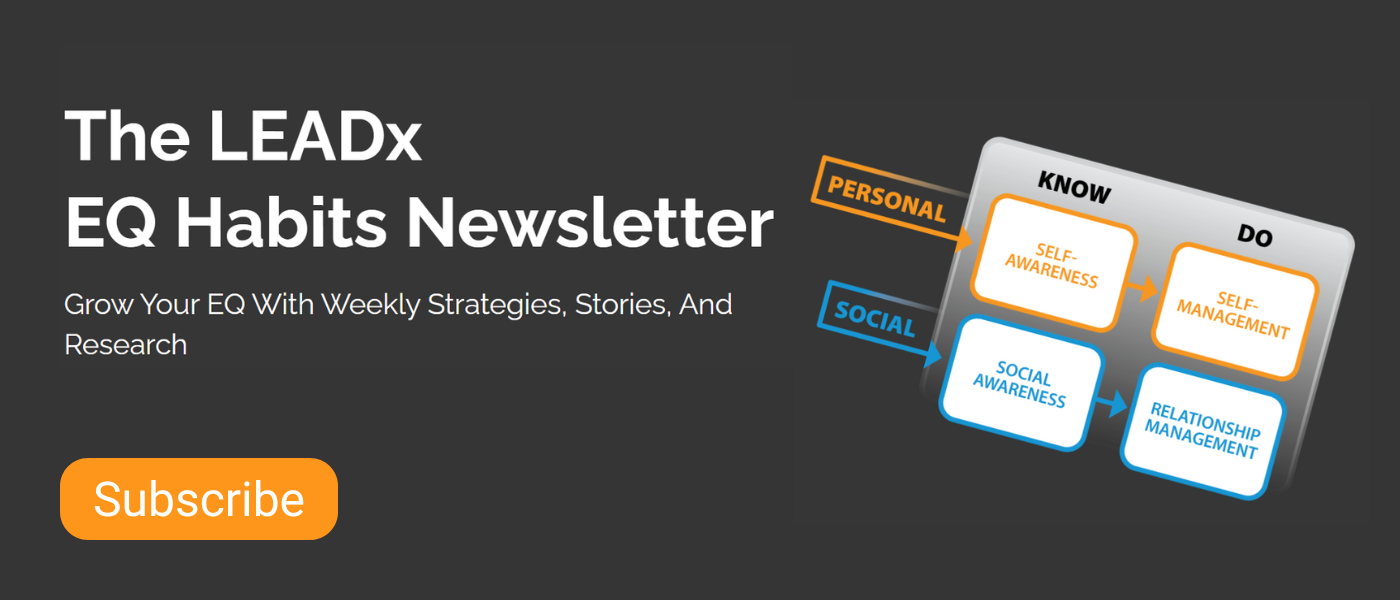
At the corporate level, self-management takes center stage. In Tractor Supply’s corporate headquarters, leaders operate in a constant state of change, from new technologies to shifting business priorities. Many leaders understand the principles of emotional intelligence and self-awareness, but applying those principles in the moment is another matter. “People are aware, but how do you still show up and carry a tough dialogue without shutting down or getting too upset to move forward?” Samia elaborated. “That’s where self-management can really help them bridge that gap between knowing and doing.”
Making Learning Stick: Four Strategies to Move From Learning to Habits
At Tractor Supply, emotional intelligence isn’t measured by the number of workshops delivered. It’s measured by whether leaders actually change the way they talk, think, and behave on the job. That means sustainment is non-negotiable. Here’s how Samia and his team do it.
Monthly nudges and discussion guides. For district managers at Petsense, the workshop is followed by months of reinforcement. Leaders get practical guides for their team calls and reminders that keep EQ top of mind.
Pulse checks on behavior, not scores. Rather than obsessing over assessment numbers, leaders are asked questions like, “What’s changing in your people’s behavior? Are they handling conflict differently? Are they listening more before responding?”
Language shifts that create culture shifts. Samia models simple practices that leaders can copy. For example, one of his go-to emotional intelligence strategies is to “label your emotions with precision.” For example, say “I feel sad” instead of “I am sad.” This subtle shift can fundamentally change how you experience your emotions. “Your emotion is not your identity,” Samia explained. “It’s something you can manage.” When leaders adopt more precise emotional language, it can reshape how they talk about stress, conflict, and connection.
Tie emotional intelligence to your culture and mission. At Tractor Supply, emotional intelligence isn’t framed as a “soft skill.” It’s positioned as the skill that powers the company’s mission. The company’s mission is broken into four pillars—customers, team members, community, and stakeholders—and each one is fundamentally about relationships. By linking EQ competencies like empathy, adaptability, and trust-building directly to Tractor Supply’s values, leaders can clearly see emotional intelligence as the way they live out the mission.
The Playbook For Practitioners: Five Best Practices You Can Apply Right Away in Your Emotional Intelligence Training
For people considering emotional intelligence training, Samia’s approach offers a practical roadmap. Specifically, he distilled five best practices that any organization can apply:
- “Start now, don’t over-engineer.” Emotional intelligence is a skill set that grows with practice. Waiting for the “perfect” program only delays progress.
- “Never do one-and-dones.” Workshops are important, but they’re just the beginning. Build reinforcement in the flow of work using nudges, guides, communities, and check-ins.
- “De-emphasize the self-assessment score.” Samia pointed out that, “You shouldn’t get fixated on a number. Your score is a starting point for growth.” The idea is to use the test to identify relative strengths and gaps, then to translate those into daily behaviors.
- “Tie training to the mission.” Emotional intelligence gets traction when leaders see it as the “how” behind the organization’s purpose, not as an add-on. As mentioned in the previous section, Tractor Supply’s values all circle around different relationships (i.e., with Customers, with teams, with stakeholders), so the connection to emotional intelligence is immediately clear.
- “Measure behavior change.” Samia pointed out that pulse checks and language adoption (i.e., are people using language like “emotion labeling,” “self-management,” etc.) are often better indicators of progress than a retest score.
The Future of Emotional Intelligence Training: Assessments, Coaching, Workshops, and Community
When asked what the ideal emotional intelligence rollout would look like, Samia’s vision was both ambitious and practical. A system of behavior change. He imagined every people leader completing an emotional intelligence assessment and then engaging with a system of coaching, workshops, and community-style learning. One-on-one coaching would provide personalized support, while cohort-style groups would give leaders a forum to practice, share challenges, and hold each other accountable.
Samia pointed out that technology has an important role to play. Tools like ChatGPT can help deliver personalized nudges and prompts to keep emotional intelligence skills top of mind. But the human element remains irreplaceable. “It’s not human versus technology, it’s a combination of both,” he said.