
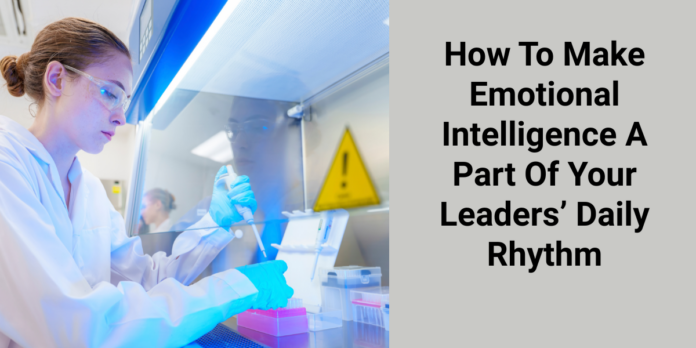
In biopharmaceutical manufacturing, precision is paramount. One miscalibrated instrument can set back months of work, and every vial produced may one day save a life. Yet despite this need for technical mastery, companies like Rentschler Biopharma prove that emotional intelligence can be just as critical to performance.
Research has long shown that when leaders develop emotional intelligence, measurable improvements to the bottom line follow. In one study, supervisors who received training in emotional competencies such as active listening and problem-solving saw lost-time accidents cut by 50%, formal grievances drop from 15 to just 3 per year, and productivity goals exceeded by $250,000. And across 20+ interviews with L&D leaders, I’ve consistently heard examples in manufacturing, construction, and the life sciences where emotional intelligence training reduced incidents by improving decision-making quality.
Rentschler Biopharma, a global contract development and manufacturing organization (CDMO) with more than 1,400 employees across Germany and the United States, put this research into practice. “We’re a company who cares about our people and want our people to have a voice,” says PJ Bouchard, Vice President of Culture and Learning and Development. “If people don’t feel safe to speak up or make a mistake, something is wrong with the culture.”

Grounding Your Culture in Clear, Practicable Behavior
The company’s operating system includes four leadership principles: psychological safety, consistency, ownership, and growth.
Leaders across the company’s sites in Germany and the United States co-created these principles. “We didn’t want our communication to be purely top-down,” Bouchard explained about the leadership principles. “We wanted it to be a conversation.” The definition of each principle includes a set of observable behaviors that bring it to life. For example, five key behaviors contribute to psychological safety. This enables Rentschler Biopharma leaders to practice and model those key behaviors. It is crucial to clearly define leadership principles so that all leaders and employees understand what is expected of them. By adopting this behavioral approach, we can take concepts that may seem abstract or theoretical, such as psychological safety, and provide clear guidance by breaking them down into specific, understandable actions. To make the principles real, every leader at the Milford, Massachusetts site, participated in quarterly, two-hour sessions, one session devoted to each principle. The session included a self-assessment, guided discussions, peer reflections, and colleagues sharing their experiences. “It’s not PowerPoint and lectures,” Bouchard said. “It’s reflection, conversation, , and connection.” This interactive and application-focused approach is designed very intentionally to help leaders become self-aware, shift, and apply these behaviors. As Bouchard so wittily put it: “As I like to say, training is for dogs. We don’t train humans. We create opportunities for people to learn and grow.We have focus on real experiences. We have dialogue with each other. We learn from each other. We engage in critical thinking.”
Empower Your Work Force to Give and Receive Feedback
To reinforce the company’s leadership principles, Rentschler Biopharma is introducing an upward feedback survey.
“Leaders will see the gap between how they think they’re showing up and how others actually experience them,” Bouchard explained. “That’s where the real learning and growth happens.”
This feedback initiative is two-way: Employees learn how to give meaningful feedback, and leaders learn how to receive it. “You don’t do things to people,” Bouchard said. “You do things with people.”
This shared responsibility for feedback strengthens trust and accountability across levels. Research supports the approach. Studies on psychological safety show that organizations with open feedback loops see higher engagement, lower error rates, and stronger retention.
An Emotional Intelligence Driven Coaching Program
At Rentschler Biopharma’s Milford, Massachusetts site, select leaders and high-potential employees participate in a nine-month coaching experience. Coaching kicks off with an emotional intelligence self-assessment. The behavioral assessment acts as a launching point for the one-on-one coaching plan and experience.
With their coach, participants explore key emotional intelligence skills like self-awareness, empathy, and impulse control. Participants uncover subtle blind spots and highlight recurring strengths. Long-term, this helps them build more authentic relationships with their teams.
“The feedback has been positive,” Bouchard says. “Many of these leaders have never had this kind of one-on-one coaching before. They start realizing, ‘I can show up differently, and people will experience me differently.’ That’s when the transformation happens.”
Making Emotional Intelligence Part of Leaders’ Daily Rhythm in a Fast-Paced Manufacturing Environment
In a biopharmaceutical facility, production moves fast. Leaders must balance deadlines, compliance, and quality controls. And they must do so while ensuring their teams feel supported. “We can’t pull people off the floor for long workshops,” Bouchard says. “Our leaders have their sleeves rolled up. They’re right there in the work.” This often makes it especially important to make learning continuous and embedded “in the flow of everyday work.”
This reality has shaped how Rentschler Biopharma sustains emotional intelligence in daily life. Beyond the leadership workshops, Bouchard’s team:
- launched a new program called Leadership Connection, where leaders meet in-person each month to discuss challenges, share experiences, and learn from each other with the ultimate goal of creating a leadership learning community.
- sends a daily Morning Brew to all leaders, their daily cup of wisdom, which prompts them to use short reflections and recognition moments in daily meetings
- runs Lunch & Learn events
These flexible, applicable program options help turn emotional intelligence from a classroom topic into a practical leadership rhythm. The long-term vision is for all leaders to embody and model these leadership principles so that they become a part of our lives, a part of our DNA.
Human Connection as a Competitive Advantage
Visitors to Rentschler Biopharma’s Milford site (where Bouchard is based) often tell her they can feel the culture as soon as they walk through the door. They feel the passion, the sense of purpose, and a degree of warmth that’s rare in a manufacturing environment. “We’re a company with a heart,” Bouchard says. “And people feel our heartbeat.”
In an industry defined by data, compliance, and precision, Rentschler Biopharma shows that empathy and awareness are strategic skills that impact the bottom line. Emotional intelligence, practiced every day, becomes the quiet force that keeps teams aligned, innovation steady, and patients’ lives at the center of every decision. As Bouchard so eloquently puts it, “emotional intelligence lays the foundation for our leaders to remain focused on a culture where everyone is respected, inspired, and engaged.”