
In professional services, domain expertise and technical skills have long served as the foundation of successful careers. Yet as automation and artificial intelligence increasingly take over the technical side of the work, what is emerging as the true differentiator is not the mastery of numbers but the mastery of relationships. In the AI age, emotional intelligence matters more than IQ.
At CLA (CliftonLarsonAllen LLP), emotional intelligence isn’t treated as an abstract idea but as a practical skill woven into daily work and leadership. With nearly 9,000 employees across the United States and a growing global presence, CLA is showing that EQ can be measured, taught, and developed at scale.
Driving this effort is a comprehensive learning strategy that embeds emotional intelligence into every stage of career development — from early career to executive leadership. Through thoughtfully designed programs and interactive experiences, CLA ensures that EQ isn’t just a concept, but a practical skill employees can apply in real time to strengthen relationships and lead effectively in a tech-driven world.

The Spark: Challenging Your Story
For Hoffman, the journey into emotional intelligence began years ago during one of CLA’s early programs, where she encountered a strategy that impacted her both professionally and personally.
“It was this concept of reality testing, today we actually call it Challenging Your Story,” Hoffman says.
She recalls applying the concept to everyday situations, such as getting upset over a conversation with her husband about dinner plans. By pausing to ask, “What did he really say? What do I really know?” she learned to separate facts from assumptions.
“I started to get into the habit of recognizing it while it was happening,” Hoffman says.
This mindset of deliberate reflection now underpins the firm’s approach to training. “We think of EQ training as a gift to people that they can use outside the workplace if they choose,” Hoffman explains.
A Four-Year Journey: The LEAP Program
To operationalize these concepts for early-career professionals, CLA developed a four-year program called LEAP, which stands for Learn, Experience, Achieve, and Propel.
The program begins with “Learn” in year one, a virtual conference for interns and new associates. While the format is remote, the curriculum is robust, covering digital agility, leadership, and emotional intelligence alongside business strategy and well-being.
The training intensifies in year two with “Experience,” which takes place in person at the firm’s dedicated Connection Centers. By moving away from large hotel ballrooms to intimate centers with a capacity of 150, the firm can focus on deep learning in small breakout rooms rather than passive listening.
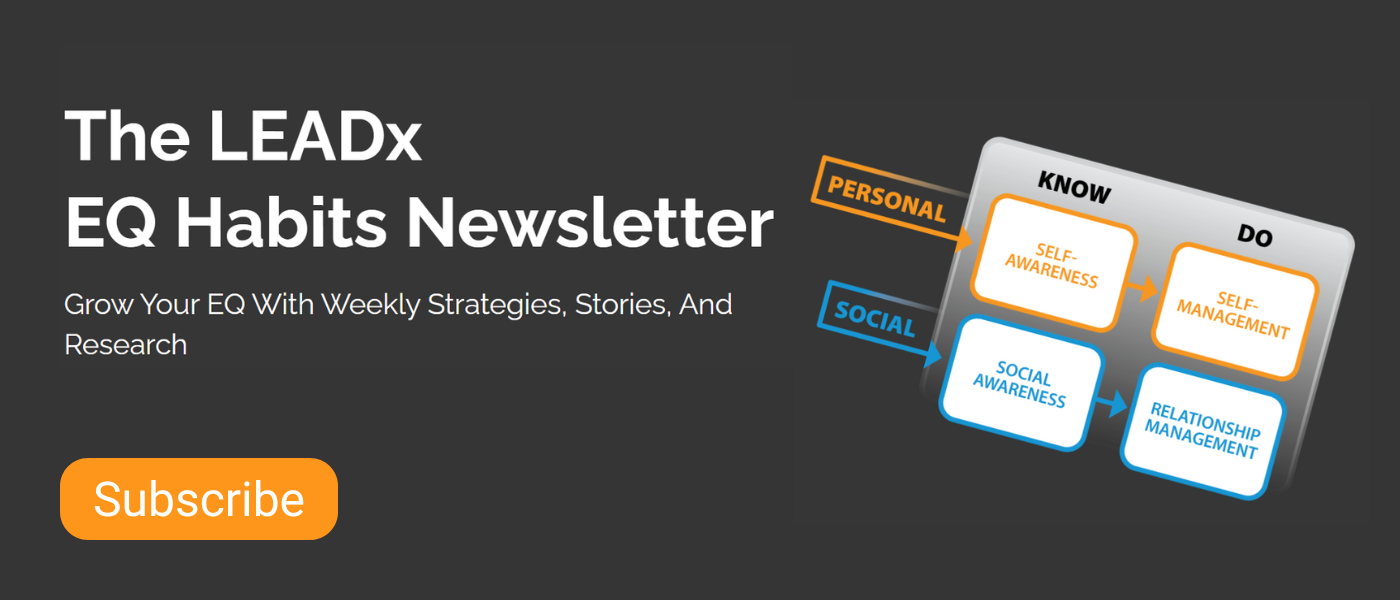
In the second year, participants dive deep into emotional intelligence skills using the EQ-i 2.0 model. This framework breaks EQ down into five distinct composites: Self-Perception, Self-Expression, Interpersonal Relationships, Decision Making, and Stress Management.
To bridge the gap between strangers in a room and make these vulnerable topics accessible, Jordan utilizes a Socratic approach and invites people to engage with a folk tale called The Chicken and the Eagle. The story, about an eagle raised to believe it is a chicken, serves as a safe “third object” for discussing self-perception and self-doubt before participants share their own personal experiences.
Building Habits Through “Learn and Return”
The third year, “Achieve,” returns to a virtual format but focuses on sustaining the momentum built in the connection centers. The firm reinforces the “learn and return” philosophy by revisiting key concepts rather than introducing entirely new ones.
To aid retention, Jordan’s team created EQ reminder cards—small, printable graphics that serve as daily nudges.
“We have one that says, resilience is your rain jacket,” Jordan says. “You can’t control the weather, but you can control how you prepare for it or how you weather it”.
By year four, titled “Propel,” the focus shifts to emerging frontline leaders who are preparing to take on management responsibilities. This in-person session introduces “Caring Conversations,” a curriculum adapted from Crucial Conversations.
This advanced training goes far beyond basic communication tips. It covers a suite of complex interpersonal skills including delivering feedback, navigating transition and change management, talking through tension, and understanding the power of words . Jordan notes that they also frame the training with a compelling metric from Harvard Business Review: “EQ counts for two times technical skills and IQ combined”.
The program culminates in a high-energy activity called “Ultimate Rock Paper Scissors,” where participants pair off, and the loser of each round becomes the winner’s cheerleader.
“You’re down to two people and the whole room is split cheering for those two people,” Jordan says. “Why is it that in corporate spaces we feel like every win is just a step to more work as opposed to just pausing and saying yeah, let’s just celebrate the win”.
Human Skills For A Digital Era
Looking ahead, CLA is preparing for a shift to skills-based learning in 2026, empowering employees to identify specific skills they need for their desired roles. This evolution includes integrating artificial intelligence directly into leadership development.
“AI can be a tool for us in our EQ,” Hoffman says. “But you still need that level of self-awareness to even think about asking for help in that way”.
Jordan is currently designing a session for the upcoming “Learn” group called “Cruising with Copilot,” which teaches new hires to treat AI as a partner rather than just a tool for rote tasks. By teaching employees how to delegate to AI with context and clarity, the firm is actually reinforcing leadership skills that apply to human teams as well.
CLA’s work reflects a simple but profound belief: technical expertise gets you in the door, but emotional intelligence keeps you growing. At CLA, learning isn’t just a compliance checklist, it’s a journey of understanding how people think, act, and ultimately, connect.