
The average middle manager is carrying more emotional weight than most organizations realize. They’re asked to absorb strategy from above, push back on that strategy, refine it, and then translate it down to their teams for execution. To pull this off, they have to keep performance on track, manage resistance, maintain trust, and stay composed through uncertainty and change. Navigating all of this requires emotional intelligence (EI).
Sarah Kay has devoted her career to developing high-performing, emotionally intelligent leaders. Kay is the Director of Global Leadership Development at Sedgwick, a global risk and claims administration partner with over 33,000 colleagues, over 10,000 clients, and operations in over 80 countries. She helps create leadership development opportunities for roughly 4,500 leaders around the world.
“My responsibility is to create meaningful leadership development opportunities for our leaders around the globe,” Kay said. “One of my main goals is to help them better engage their teams, drive performance, and empower our colleagues.”
Across my body of more than 60 interviews with talent development leaders on emotional intelligence in practice, Kay has one of the sharpest approaches to solving the challenges leaders actually face on the job. In this interview, what stands out immediately is her discipline of matching human skills to lived moments of pressure and impact.
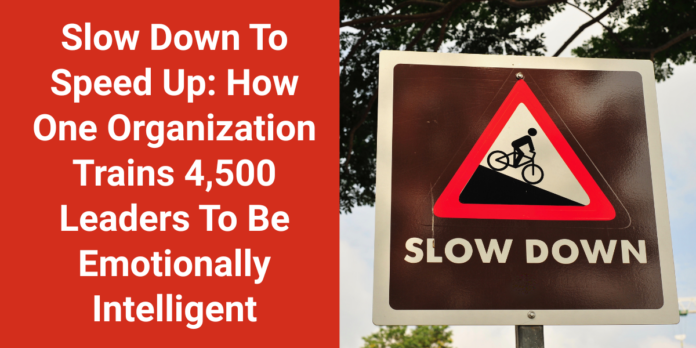
As Kay put it, “The world is moving at such a fast pace. One of my biggest challenges is to just help everyone slow down so that we speed up.”

Building High-EI Leaders Needs to Look Different at Every Level
Sedgwick’s approach is not one-size-fits-all. Kay breaks leadership development into four broad levels: aspiring leaders, frontline leaders, mid-level leaders, and senior leaders. EI skills are touched on at every level.
EI for aspiring Leaders: For aspiring leaders and individual contributors, Sedgwick pairs an in-depth online learning suite with their Sedgwick Capability Framework. The goal is to help people see what is expected of them through the Capability Framework and then access specific learning courses and exercises that will help them grow toward those expectations.
EI for frontline leaders. For frontline leaders, the top challenge is that they’re expected to both “do and lead,” Kay said. “The ratio of doing and leading doesn’t always add up to a hundred. Often, it’s beyond a hundred. Do a lot and lead a lot.” For this group, emotional intelligence often starts with presence. Kay said one of the most common challenges at this level is “confusing being busy with being present.” Her training advice for frontline leaders hinges on the idea of “move slow to move fast.” As she put it, “You’ve got to carve out the time to build the relationship, to have the connection, to give the feedback, to listen, to understand. It will feel like a lot today, but it’s going to give you time back in the long run.”
EI for mid-level leaders: At this level, Kay pointed out, leaders are responsible for “the team and the strategy.” They may need to understand the strategy, buy into it, help set it up, and execute it. But they also have to bring their teams along. “Success as a middle manager involves having hard conversations,” Kay said. “These leaders need to be able to push back and say, ‘I don’t understand the strategy. I don’t buy into it,’ in a respectful way.” At the same time, that same leader may need to turn to their team of direct reports and say, “Here’s what we need to do. Here’s how we’re going to execute this strategy.”
EI for senior leaders: “For senior leaders, EI is often about staying connected as they become more removed from the day-to-day work. The most effective leaders are skilled in creating environments where people feel comfortable sharing what’s really happening – not just what they think leadership wants to hear. Their role isn’t just to set direction and strategy, but to listen deeply enough to understand how that is being experienced throughout the company,” Kay explained.
The underlying pedagogy remains the same across every level of leadership: learning must connect to the real work of leading, and to the real on-the-job challenges that these leaders face.
Practice Drives Behavior Change
Kay is not interested in leadership development that ends when the workshop ends. “We don’t teach anything without including an opportunity to practice,” she said.
She knows the familiar pattern. “A leader attends a session, leaves deeply inspired, but then returns to the office, shoves their binder in a drawer, and falls back into their old daily rhythm.”
Kay and her team at Sedgwick interrupt that pattern by pairing content with practice, application, and feedback. “What we put into place in our programs is a structure that combines the learning of the content, practicing content, and then applying it on the job with a feedback component tied in,” Kay said. Often, the feedback comes from the participant’s supervisor.
Kay also weaves development plans, coaching, mentoring, and stretch opportunities into the programs. “There’s always a ‘What’s next?’” she said. “What’s the development plan to maximize our time together? What new opportunities might stretch you in your next three months, or six months?”
AI Helps Sedgwick Leaders Practice Difficult Conversations
Kay sees AI as part of the future of her leadership development programming. One of their most successful applications has been a communication simulator that lets leaders practice difficult conversations with an AI colleague.
“One of our most challenging skills to sharpen is how to have a tough conversation,” Kay said. With the simulator, “you can really practice those conversations with an AI colleague.”
That is a useful application because it gives leaders a lower-risk space to rehearse high-risk moments. A leader can practice how to deliver feedback, handle resistance, or stay calm when a conversation turns tense.
Still, Kay was careful not to confuse AI as a replacement for human skills. “As AI continues to take off,” Kay said, “the value of our human-centered leaders is only going to rise.”
The Stigma Around Emotion At Work Is Fading
For Kay, one encouraging shift is that leaders are more open to the language of emotional intelligence than they were earlier in her career. “Twenty years ago, I was afraid to say to leaders to be more curious, to be kinder, to be calmer,” she said. “That wasn’t really attractive to speak that way twenty years ago.”
Today, she sees more leaders understanding that performance and humanity are not opposites. “I think people understand now,” she said. “Success as a leader is about listening to understand people, not to reply to them. It is about rewarding the things you want repeated. It is about bringing curiosity to the conversation, thinking critically.”
“The lesson I’ve learned over the last twenty years, and a lesson that has only accelerated in its importance in the AI Era, is that great leadership is around the human connection and the human relationship,” Kay said.